A chiller for cold plunge projects should be purchased from a controlled duty statement and evidence pack: define the use case, water volume, temperature task, ambient range, water loop, electrical variant, water-management plan, destination obligations, acceptance tests, documents and service responsibility before comparing quotations. A low setpoint, HP badge or attractive product photo cannot establish project fit.
This page is the chiller for cold plunge procurement hub. It routes detailed questions to the correct owner instead of trying to rank for every subtopic: volume selection belongs to the sizing checklist, nominal power belongs to the horsepower guide, energy belongs to the electricity guide, and lifecycle expense belongs to the cost guide. Application pages own home, gym, hotel, clinic and hot-tub decisions. For branded bundled residential systems, compare the complete tub, chiller, maintenance and warranty route before treating a product-page feature list as the buying brief.
Table of Contents
Cold-plunge chiller buying map
What is the best water chiller for a cold plunge?
The best water chiller for a cold plunge is the configuration that meets the documented water and ambient duty, stays inside the approved flow and electrical limits, includes the required water-loop and control scope, and can be tested, installed and serviced for the actual site. There is no universal best model based only on horsepower, lowest setpoint, maximum flow or product photos.
Reject a candidate before scoring if it cannot identify the exact model and electrical variant, cannot state the test conditions behind a central performance claim, omits a required water-loop responsibility, or cannot provide a workable installation and service route.
| Decision dimension | Use the same input for every bid | Do not substitute |
|---|---|---|
| Cooling fit | Water volume, start/target temperatures, ambient range and acceptable time | Horsepower or setpoint alone |
| Hydraulic fit | Required flow, pressure loss, pump/filter/tub route and component limits | Maximum pump flow |
| Site fit | Indoor/outdoor conditions, ventilation, drainage, access and verified supply | Country-name voltage assumptions |
| Evidence | Exact model, method, conditions, results, revision and unit/order identity | Generic video, badge or brochure |
| Ownership cost | Installed price, measured/estimated energy, consumables, service and downtime scenario | Headline unit price or universal ROI |
| Support | Warranty boundary, diagnosis route, parts and qualified local work | “Global support” with no responsibility map |
If a weighted comparison is useful, publish the weights before reviewing bids and score only supported evidence:
Weighted score = Σ (dimension weight × evidence-backed score).
Keep hard rejection gates outside the weighted total. A high marketing score should not compensate for the wrong electrical version, missing flow basis or an untestable performance claim. Start with the water-volume sizing inputs, use the horsepower guide only after the duty is defined, and compare energy and lifecycle inputs with the electricity method and cost framework.
Chiller for cold plunge: quick buyer answer
Shortlist only after the project brief is complete. Ask each bidder for the exact model, revision, included water-loop components, net cooling at stated water and ambient conditions, electrical nameplate, flow limits, controls, treatment compatibility, installation requirements, destination documents, FAT plan, packing, warranty, spares and service response. Put measurable release criteria in the purchase order. Verify the shipped unit and repeat site commissioning before opening it for use.
If the buyer plans to combine a separate tub, pump, filter and refrigeration unit, use the DIY cold plunge chiller setup checklist to expose hydraulic and site interfaces before selecting parts. It does not authorize unqualified wet-area electrical or sealed-refrigeration work. When the proposed refrigeration unit is an aquarium product, check aquarium chiller duty before adding it to the shortlist.
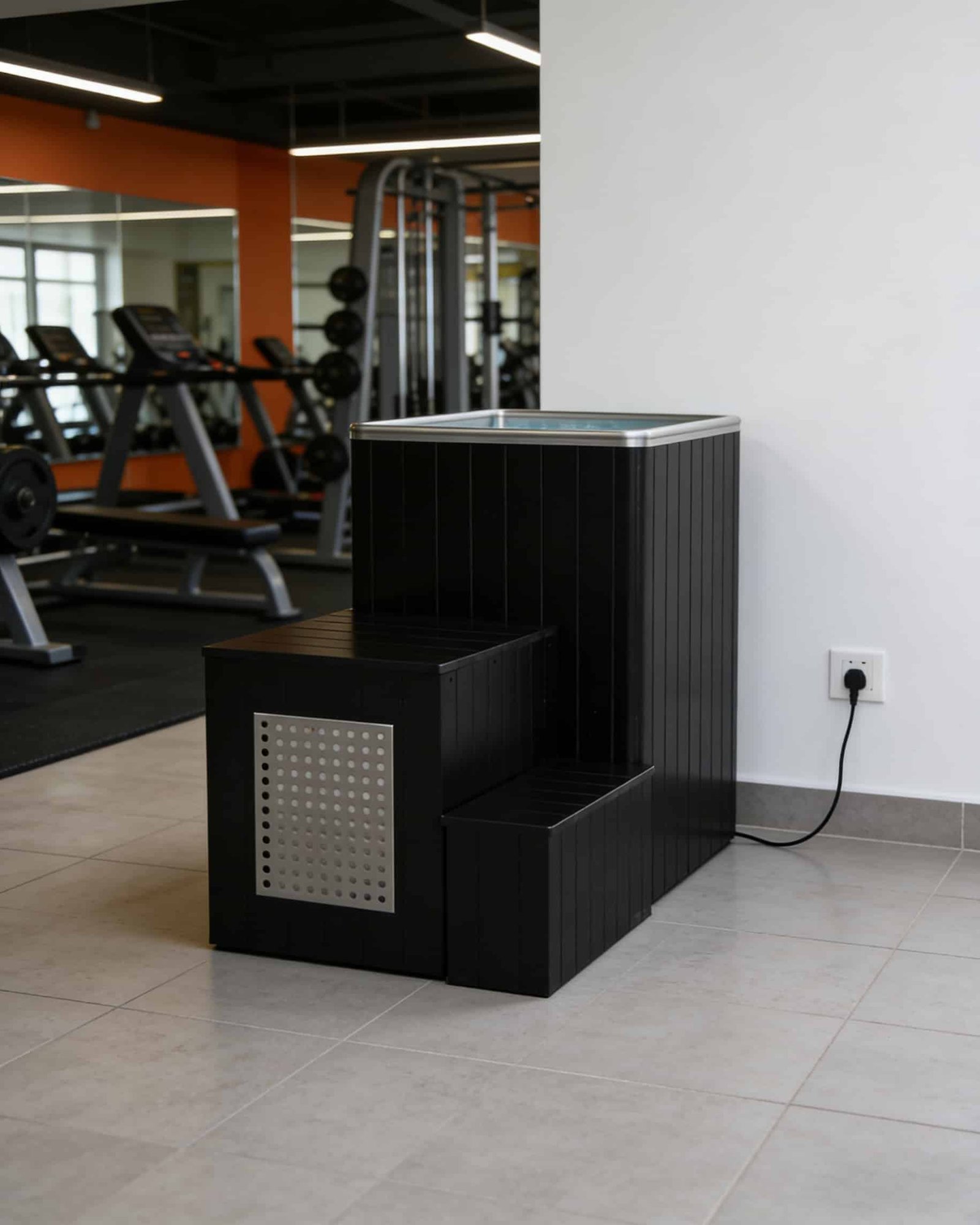
15 critical chiller for cold plunge buyer checks
| Check | Buyer must define | Supplier must return |
|---|---|---|
| 1. Use case | Home, brand, rental, gym, hotel, clinic or other owner | Declared application fit and limits |
| 2. Water duty | Working volume, start, target, pull-down and holding window | Condition-based selection |
| 3. Ambient duty | Air range, indoor/outdoor, sun, humidity and ventilation | Operating envelope and derating |
| 4. Performance | Acceptance result and tolerance | Net cooling, input and test method |
| 5. Water loop | Tub, pump, filter, treatment, pipe and elevation | Approved diagram, flow and pressure limits |
| 6. Electrical | Country, voltage, frequency and site circuit | Exact nameplate and installation requirements |
| 7. Water care | Operator, bather load, testing and cleaning plan | Material and treatment compatibility |
| 8. Controls | Access, alarms, remote use and restart policy | Controller functions and boundaries |
| 9. Configuration | Approved model and included items | Revision-controlled bill of supply |
| 10. Supplier | Contracting entity and manufacturing route | Entity, factory and quality evidence |
| 11. Destination | Market, intended use and responsible importer | Applicable evidence without blanket claims |
| 12. Acceptance | FAT, inspection and site commissioning criteria | Time-stamped model-specific records |
| 13. Documents | Language, manuals, labels and shipping file | Controlled document index |
| 14. Service | Location, uptime and response expectation | Warranty, spares and escalation route |
| 15. TCO | Evaluation period and local costs | Declared inclusions and exclusions |
1–3. Define the owner, water duty and environment
Name the project owner and operating context. A private home, short-term rental, membership gym, hotel amenity and clinical facility have different access, water, record, uptime and governance requirements. State who will install, operate, clean, test, maintain and authorize return to use. If health-related protocols or claims are involved, assign them to appropriately qualified professionals rather than the equipment seller.
Measure normal working water volume. Record source-water temperature, target range, maximum permitted pull-down time, holding period, allowed temperature drift and planned schedule. Add maximum and minimum ambient air, humidity where relevant, solar exposure, wind, equipment enclosure, cover use, tub and pipe insulation, users in the busiest window and warm make-up water. Mark assumptions that have not yet been verified.
These fields create the duty statement for a chiller for cold plunge selection. Do not convert liters directly to HP with a generic table. The same volume can produce materially different heat load outdoors, under direct sun, without insulation or during repeated commercial use. Use the dedicated sizing and horsepower pages for calculations, then bring the approved requirement back to this procurement record.
4. Require performance numbers with conditions and tolerances
Request net cooling capacity in kW or Btu/h at relevant entering-water, leaving-water and ambient conditions; electrical input at the same point; permitted water flow; operating range; and the method behind each published value. Clarify whether a figure is nominal, typical, maximum or guaranteed under contract. A minimum setpoint does not prove pull-down time, and compressor HP does not equal delivered cooling.
AHRI’s water-chilling performance standard page shows why definitions and rating conditions matter. A small plunge chiller may not be in that standard’s scope; a chiller for cold plunge buyer should never imply certification that is not documented. Instead, require a transparent model, test point, measurement method and tolerance for the offered equipment.
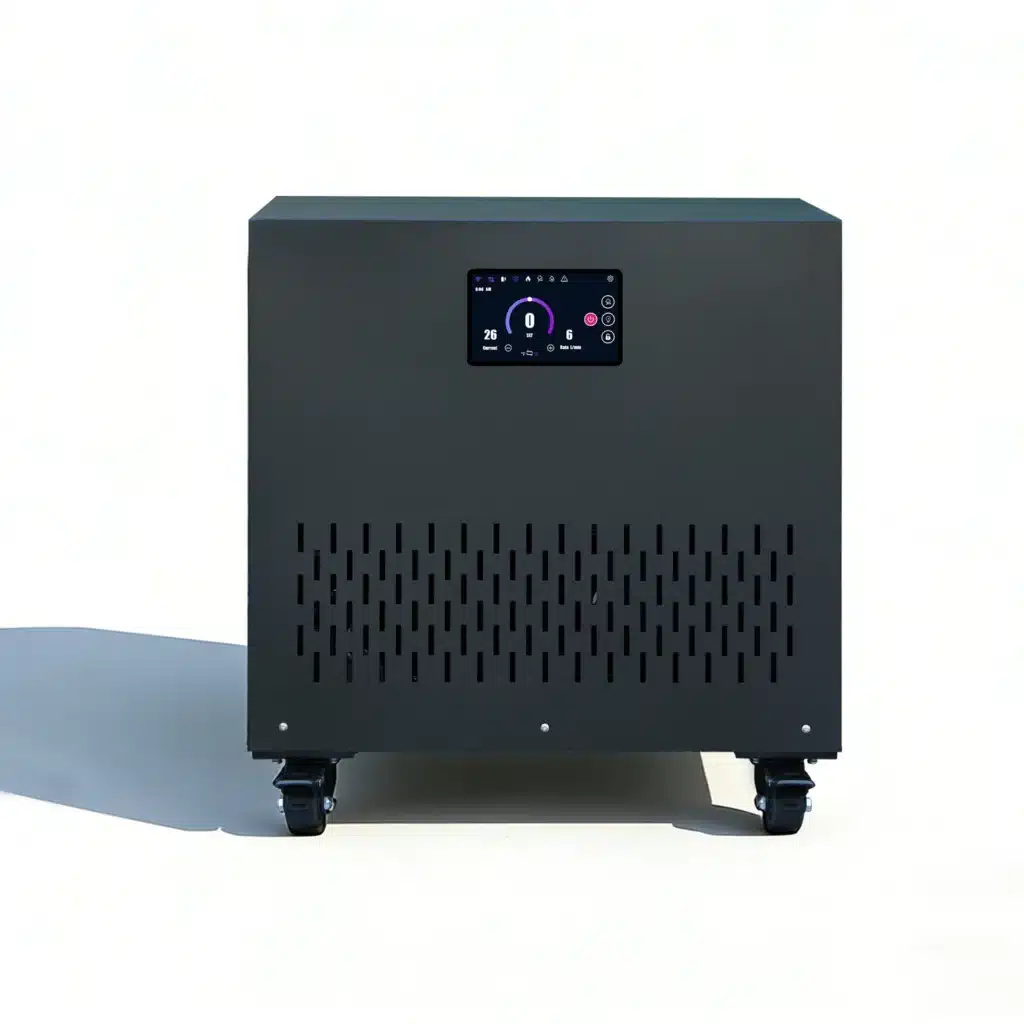
Ask what changes at high ambient temperature and near the target water temperature. Request sound data with distance and test conditions if noise matters. For a remote-control feature, specify what can be changed, who receives alarms, what happens after power loss and how software or controller revisions are recorded.
5. Specify the complete hydraulic and treatment loop
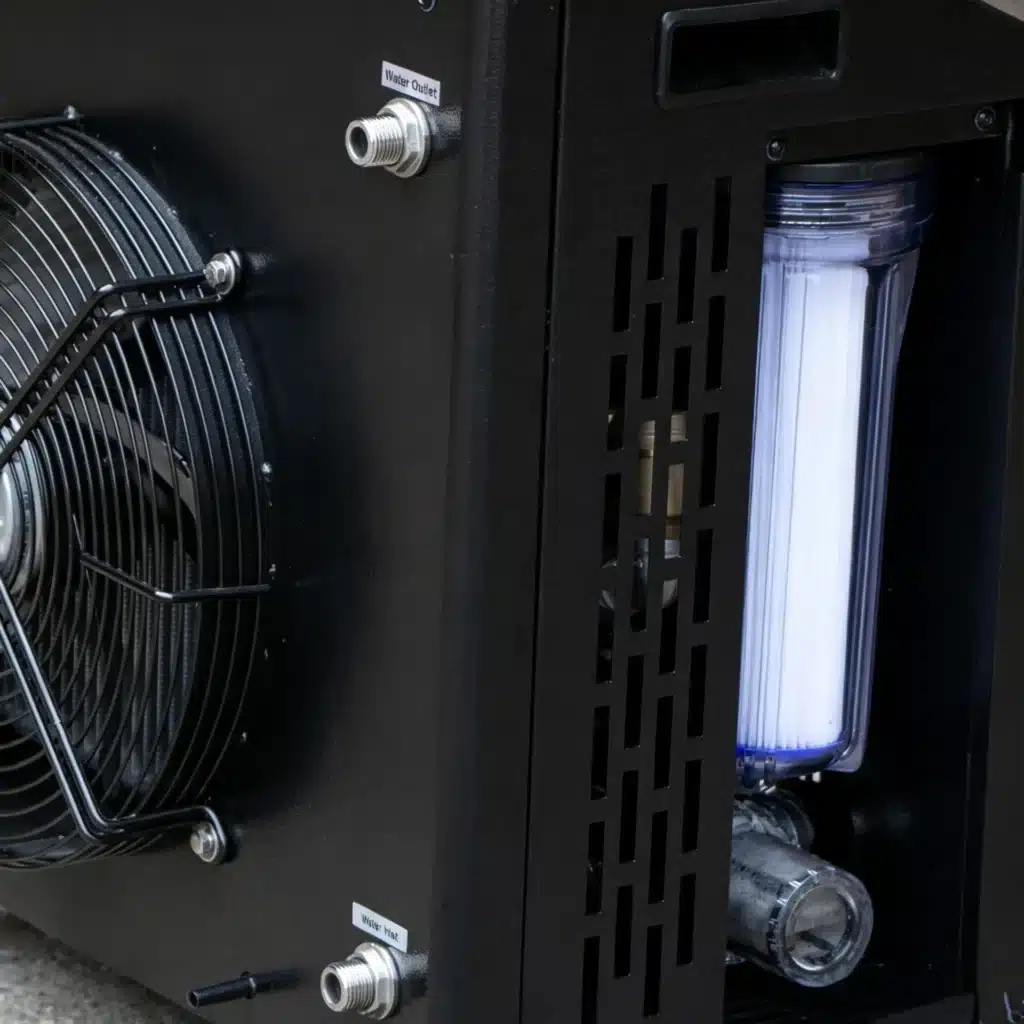
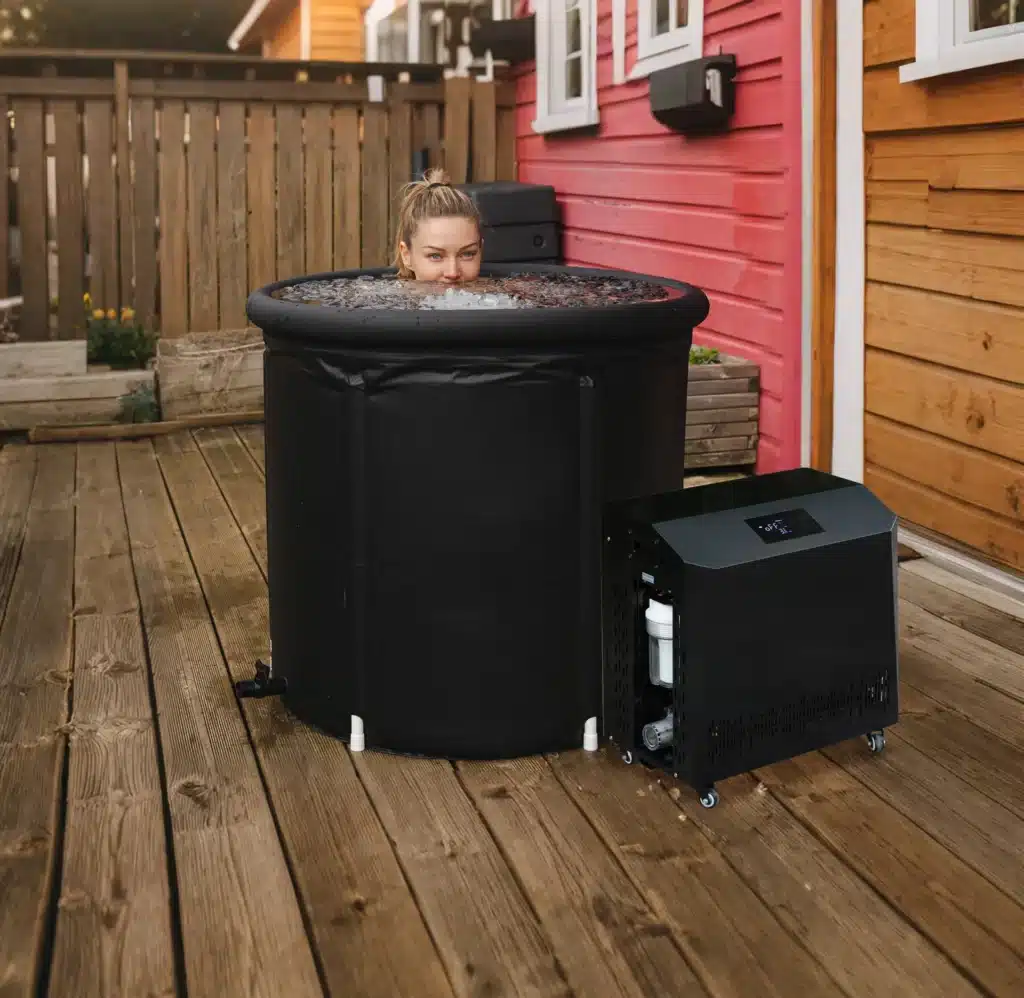
List the tub, working fill line, chiller, pump, heat exchanger, filter, treatment components, hoses or pipes, fittings, valves, suction and return arrangement, elevation, drain and cover. State which items the supplier includes and which the buyer supplies. Ask for the required flow range, pressure limits, connection sizes, maximum equivalent line length or other design limits, air-purge method and filter service trigger.
A pump’s open-flow claim is not commissioned flow through filters, fittings and a heat exchanger. Require an approved water-loop drawing and a measurable baseline. Verify leak-free operation and flow condition with clean components, then define when restriction requires cleaning or lockout. The filter owner page and maintenance guide cover those service decisions without overloading this buyer hub.
6. Close the site and electrical configuration before order
Record the destination country, exact voltage and frequency, supply type, available current, plug or termination, grounding, circuit protection, GFCI/RCD requirements, disconnect and connected auxiliary loads. Compare those fields with the offered nameplate and manual. A 220 V label is incomplete without frequency, phase, current and connection information.
For U.S. workplace context, OSHA’s general electrical standard addresses suitability, installation, labeling and damp or wet environments. It does not approve a specific product or replace local electrical and building requirements. Have a qualified person review the exact equipment and site; never rely on an adapter or extension cable as the design.
Verify floor or foundation capacity, level, delivery access, drainage, overflow, condensation, slip resistance, lighting, ventilation, air intake and hot-air discharge, weather exposure, clearances, hose protection, entry and exit, barriers and technician access. Outdoor equipment needs a documented operating environment and enclosure strategy, not a generic “waterproof” adjective.
7. Buy an operable water-management plan
Define source-water checks, approved treatment, test equipment, target ranges established for the installation, testing frequency, cleaning, filter work, water replacement, contamination response, chemical storage, training and closure/reopening authority. Confirm every wetted material’s compatibility with the treatment and temperature range. Ozone or UV can be one component; neither proves that water is safe by itself.
For public or membership venues, the CDC’s Model Aquatic Health Code overview explains that aquatic-facility design and operation are generally governed through state or local codes and that the MAHC is guidance unless adopted. Determine how the destination classifies the actual cold-plunge installation. Put the applicable operator, testing and record requirements into the project plan.
8–9. Freeze the controls and bill of supply
Assign one configuration identifier to the complete chiller for cold plunge package. It should cover model and revision, compressor/refrigeration architecture, refrigerant, heat exchanger, pump, filter, treatment device, controller and software, sensors, hoses, fittings, power cord, plug, labels, manuals, spares and packing. Reference approved drawings and document revisions.
Require written approval before a material change. A substituted pump can alter flow; another heat exchanger can change material compatibility; another controller can change alarm behavior; another plug or electrical component can affect destination evidence. The buyer should decide whether prior tests and documents remain valid. “Equivalent” is a conclusion supported by review, not a supplier’s one-word notification.

10–11. Verify the supplier route and destination obligations
Confirm the legal contracting entity, payment beneficiary, manufacturing location, export entity, quality contact and after-sales contact. Ask who controls design, procurement, assembly, testing, release and corrective action. Match business records, quotation, invoice, bank details, labels and shipping documents. The manufacturer-selection owner handles the deeper supplier audit.
Map destination obligations from intended use, market and sales route. Request only applicable declarations, reports, certificates, labels and manuals; verify issuer, model scope, standard/version, dates and whether the final configuration is covered. A CE, ETL, UL, CB or other mark should never be presented as a universal passport. For EU context, the European Commission’s CE marking guidance explains manufacturer responsibilities and that not every product is subject to CE marking.
Refrigerant, service and end-of-life obligations can vary by destination. In the United States, EPA’s Section 608 overview describes requirements for stationary refrigeration service practices, technician certification, refrigerant handling and disposal. The importer and local service provider should determine what applies to the offered chiller and refrigerant.
12. Convert marketing claims into FAT and commissioning evidence
Write pass/fail criteria before production release. Typical gates include model and nameplate identity, workmanship, dimensions, electrical configuration, water-loop integrity, clean filter and flow condition, controller functions, accessible alarms, measured temperature test under stated conditions, accessories, labels, manuals, packing and deviation approval. Define sampling if the order has multiple units.
Use the factory acceptance test owner to build the test record and the pre-shipment inspection checklist for the release gate. Photos should show identifiers and measured evidence, not only a finished cabinet. Record test instruments, conditions, time stamps, result, deviations and authorization.
Factory acceptance does not replace site commissioning. After the chiller for cold plunge installation, verify the actual circuit, water loop, drainage, airflow, leak condition, controls, operator training and a temperature baseline under recorded site conditions. Keep the approved document set and service contacts where operators can retrieve them.
Before that site gate, use the condenser heat-rejection route comparison to identify whether the project depends on ambient air or a separate condenser-water and heat-rejection system.
13. Build the document and logistics package before shipment
Create a document index with quotation, purchase order, specification, approved drawings, bill of supply, electrical data, manuals, maintenance plan, treatment compatibility, parts list, declarations and test evidence. Add commercial invoice, packing list, shipping marks, package dimensions and weight, handling and storage instructions, serial or lot traceability and the agreed Incoterms rule. Mark required language and consignee information.
Review packaging against the route: cabinet immobilization, hose and accessory control, moisture protection, edge protection, indicators if specified, pallet or crate requirements, inspection access and photo record. Agree who handles export clearance, freight, import clearance, duties, destination delivery and damage claims. A low ex-works price can become an expensive landed project when these boundaries are absent.
When the chiller will move repeatedly rather than ship once, use the portable water chiller mobility checklist to define weight, route, drain-down, connections, electrical destinations and recommissioning evidence.
14–15. Compare warranty, service and total cost under one scenario
Request warranty duration, start point, covered parts and labor, exclusions, water and environmental conditions, installation requirements, diagnostic process, evidence required for a claim, authorization to replace parts, shipping responsibility and escalation route. Ask for recommended spares, consumables, lead times and service documentation. A warranty is only useful when the buyer can reach a competent response and obtain the necessary part.
Build total cost from the same period and duty: equipment, optional components, freight, duty and tax, installation, electrical and drainage work, treatment equipment, water, measured energy, filters and chemicals, scheduled labor, spares, downtime and disposal. Keep uncertain values as ranges with their source. Do not publish a universal monthly running cost or claim that one architecture is always cheaper.

Score bids with a common evidence matrix
Use stage gates from enquiry to release
A chiller for cold plunge project should move through named gates instead of drifting from chat messages into production. At enquiry gate, confirm the business need and accountable buyer. At RFQ gate, freeze the comparable duty and response fields. At technical-approval gate, close configuration, performance, site and destination questions. At order gate, attach the approved specification and acceptance criteria to the contract.
Before production release, resolve critical assumptions and approved substitutions. Before shipment, close FAT, inspection, deviations, documents and packing. Before operational release, close installation, commissioning, training and water-management records. Each gate should name the approver, evidence, date and remaining conditions. A paid invoice or completed cabinet is not automatic authorization to pass the next gate.
Use stop criteria. Missing electrical confirmation, unresolved material compatibility, failed leak or flow test, an unapproved component change, absent destination evidence or a performance result outside agreed tolerance should hold the chiller for cold plunge project. The record should state who can accept a deviation and what compensating action is required.
Maintain a claim and evidence ledger
For every material claim, record the exact wording, source, model/configuration scope, test condition, date checked, owner and review date. Cover cooling capacity, setpoint range, electrical input, flow, filtration, treatment, sound, ingress/environment rating, certification, warranty and lead time. Separate observed facts from calculations and sales positioning.
This ledger improves buyer review and makes the published answer easier for search engines and AI systems to interpret: the subject, condition, evidence and limitation appear together. It does not guarantee citation or ranking. It does reduce ambiguity and prevents a statement verified for one model from being copied across every chiller for cold plunge configuration.
Review the ledger when the product revision, component, supplier, standard, regulation or linked source changes. Date important updates and preserve the superseded basis. If evidence expires or no longer matches the configuration, change or remove the claim before marketing continues to repeat it.
| Category | Weight decided by buyer | Evidence to score |
|---|---|---|
| Duty fit | Based on performance consequence | Condition-specific capacity and pull-down response |
| Site fit | Based on installation risk | Electrical, hydraulic, environment and layout approval |
| Water operation | Based on bather load and governance | Treatment compatibility, procedures and records |
| Configuration | Based on substitution risk | Revision-controlled bill, drawings and change process |
| Compliance | Based on destination and intended use | Applicable, model-scoped, verifiable evidence |
| Quality release | Based on order and failure consequence | FAT, inspection, traceability and deviations |
| Service | Based on uptime target | Warranty, people, spares, response and documentation |
| Landed TCO | Based on evaluation period | Comparable inclusions, ranges and local cost inputs |
Set weights before opening prices so the lowest quote does not redefine the requirement. Record “pass,” “conditional,” “fail” and “not evidenced” separately. A conditional bid should list the missing document, test or local approval and the responsible party. Keep the decision trail with the final chiller for cold plunge purchase file.
Record why the selected chiller for cold plunge bid won and which conditions remain open. A concise decision statement should identify duty fit, configuration, critical evidence, landed scope, service route, accepted risks and approvers. This creates a useful handoff for installation and future troubleshooting.
Minimum RFQ package
- Project owner, destination, intended use and operating responsibility.
- Working volume, start/target temperatures, pull-down and holding windows.
- Ambient range, location, sun, cover, insulation and peak users.
- Water-loop sketch, treatment plan, connection, flow and drainage constraints.
- Voltage, frequency, circuit and locally reviewed wet-area requirements.
- Exact scope of supply, configuration, documents, FAT and inspection criteria.
- Packaging, Incoterms, delivery point, installation and commissioning boundaries.
- Warranty, service location, spares, response and total-cost evaluation period.
The directly copyable OEM cold-plunge chiller RFQ template turns these fields into a supplier response sheet. Do not delete unknown fields; mark them “TBC” with an owner and due date. That is more useful than allowing every supplier to make a different assumption.
Chiller for cold plunge buyer FAQ
What is the first number to collect before choosing a chiller?
Measure normal working water volume, then pair it with starting and target temperatures, pull-down time, ambient range, insulation, cover and peak-use scenario. Volume alone is not a complete selection.
Is horsepower enough to compare chillers?
No. Compare net cooling capacity and electrical input at stated water and ambient conditions, plus water flow, operating envelope, controls and a model-specific test record.
Which certification does every cold-plunge chiller need?
There is no universal answer. Applicable obligations depend on destination, intended use, equipment configuration and sales route. The responsible parties should determine the requirements and verify model-scoped evidence.
Should I accept a supplier’s standard cooling-time video?
Only as limited context. Require the exact model, water volume, temperatures, ambient, flow, cover, electrical configuration, time stamps and instruments, then test the agreed duty for the ordered unit and site.
What should happen when a supplier changes a component?
The supplier should disclose the change before shipment, provide the revised configuration and impact assessment, and obtain buyer approval where required. Tests, documents, spares and destination evidence must be rechecked.
Get a comparable project quotation
Send OMNI Ice the completed duty, water loop, electrical, destination, acceptance and service fields. The response can identify a candidate configuration, stated assumptions, buyer-supplied items and remaining approvals rather than giving a one-line answer based on tub size. Submit your chiller for cold plunge RFQ.