An aquarium chiller for cold plunge use should not be approved because it can make water cold; it should be approved only when the exact model, complete water loop and installation can satisfy a written human-immersion duty. That means checking cooling capacity at the real operating conditions, minimum water temperature, permitted flow, wetted materials, water-care compatibility, electrical installation, heat rejection, controls, warranty and service support. If those records are missing, the honest decision is “not yet proven,” not “probably fine.”
This comparison is for importers, OEM brands, installers, commercial operators and technically capable home buyers deciding whether fish-tank equipment belongs in a cold-plunge project. It does not declare every aquarium unit unsuitable, and it does not certify any product. Its purpose is narrower: turn a tempting price or horsepower comparison into an evidence-based compatibility decision before anyone buys, connects or promises the system.
Can you use an aquarium chiller for cold plunge water?
Sometimes an exact aquarium chiller may be capable of removing the required heat, but capability is not the same as system suitability. A buyer needs written confirmation for the actual model and application. The decision should remain conditional until the supplier data and installation design agree on the duty point, flow window, low-temperature control, water chemistry, electrical context and intended use.
| Decision | When it is defensible | What is still required |
|---|---|---|
| Proceed to detailed review | The exact model has documented capacity near the project conditions, can reach the target range, accepts the calculated flow and has compatible wetted materials | Complete-loop design, electrical review, water-care plan, written intended-use/warranty position and an acceptance test |
| Use only as a controlled prototype | Thermal and hydraulic data look plausible, but one or more application boundaries are not yet confirmed | No commercial promise; qualified installation; monitored test; clear stop criteria; no assumption that prototype success creates certification |
| Choose a purpose-built system | The project is shared-use, commercially operated, documentation-sensitive or requires integrated filtration, sanitation, alarms and service support | Project-specific sizing and local compliance review still apply |
| Reject the candidate | The seller cannot identify the model, publish a usable duty point, confirm the target temperature or flow, address wet-location electrical installation, or state the intended-use and warranty boundary | Select another documented route; do not fill the gaps with a marketplace listing or compressor label |
The fastest safe screen is simple: ask for the model-specific manual, performance data and written application position. JBJ’s official Aquarium Series information, for example, identifies an aquarium environment and publishes model-dependent flow information. That is useful evidence for those models, but it also illustrates why “aquarium chiller” is not one universal specification. Each aquarium chiller for cold plunge consideration has its own operating envelope, connections, controls and limits.
The same refrigeration function does not create the same system duty
Both systems move heat from water to air or another heat sink. The difference appears around the refrigeration circuit. An aquarium installation is designed around aquatic life, a particular tank, a defined pump and filter arrangement, and temperatures normally chosen for that environment. A cold plunge is a human-immersion system with body load, repeated entry, cleaning, wet users, possible disinfectants, lower target temperatures and a different consequence if circulation, electrical protection or hygiene control fails.
This is why an online statement such as “rated for 500 gallons” is weak evidence. It usually leaves out starting temperature, target temperature, ambient air, pull-down time, cover state, pump heat, plumbing length, filter loading and user schedule. The cold plunge chiller sizing checklist treats tub volume as one input rather than the whole calculation, while the horsepower guide explains why compressor HP alone cannot predict installed cooling performance.
Eleven aquarium chiller for cold plunge compatibility checks
1. Confirm intended use and the warranty boundary in writing
Begin with the question most buyers leave until the end: does the manufacturer permit this exact model to serve a human-immersion water system? A reseller saying “customers do it” is not the manufacturer’s position. Ask for the manual, product label, installation limits and a written answer that identifies the model and proposed use.
The response may be yes, no or conditional. A conditional answer can still be workable if its conditions are concrete: external pump range, minimum setpoint, water chemistry, indoor location, required protective device, cleaning method or inspection interval. If using the unit outside its intended application voids support, the buyer must price that service risk rather than discovering it after a fault.
2. Calculate the actual thermal duty, not a tank-size slogan
For an aquarium chiller for cold plunge comparison, define usable water volume, starting temperature, target temperature, maximum allowed pull-down time, ambient range, sun exposure, cover schedule, number and timing of users, pump heat and expected holding period. Then request capacity data close to those conditions. A capacity figure at warm aquarium water and mild room air may not describe operation near a cold-plunge target on a hot day.
Separate pull-down from holding. Pull-down asks how quickly the system removes stored heat from the initial fill. Holding asks whether it can offset ongoing heat gain after the target is reached. An aquarium chiller for cold plunge duty may appear adequate during an overnight test yet fall behind after repeated users or with an uncovered, poorly insulated tub. The cold plunge insulation decision guide helps identify thermal-boundary variables that must stay visible in the calculation.
3. Verify the low-temperature operating envelope and freeze controls
An aquarium chiller for cold plunge duty needs a declared water-temperature range, adjustable setpoint range, control differential, sensor location and any low-flow or freeze-protection logic. Do not assume that a controller can be reprogrammed safely because its display accepts a low number. The refrigeration circuit, heat exchanger, sensor logic and water velocity all affect whether the unit can operate reliably near that target.
Record what happens after power loss, sensor failure, low flow and an iced heat exchanger. Does the unit stop, alarm, automatically restart or require a manual reset? The answer matters more than a photograph of a display. A buyer comparing very low temperature claims should also review the 0°C test-conditions guide before treating one laboratory reading as a continuous operating promise.
4. Match the complete loop to the permitted flow window
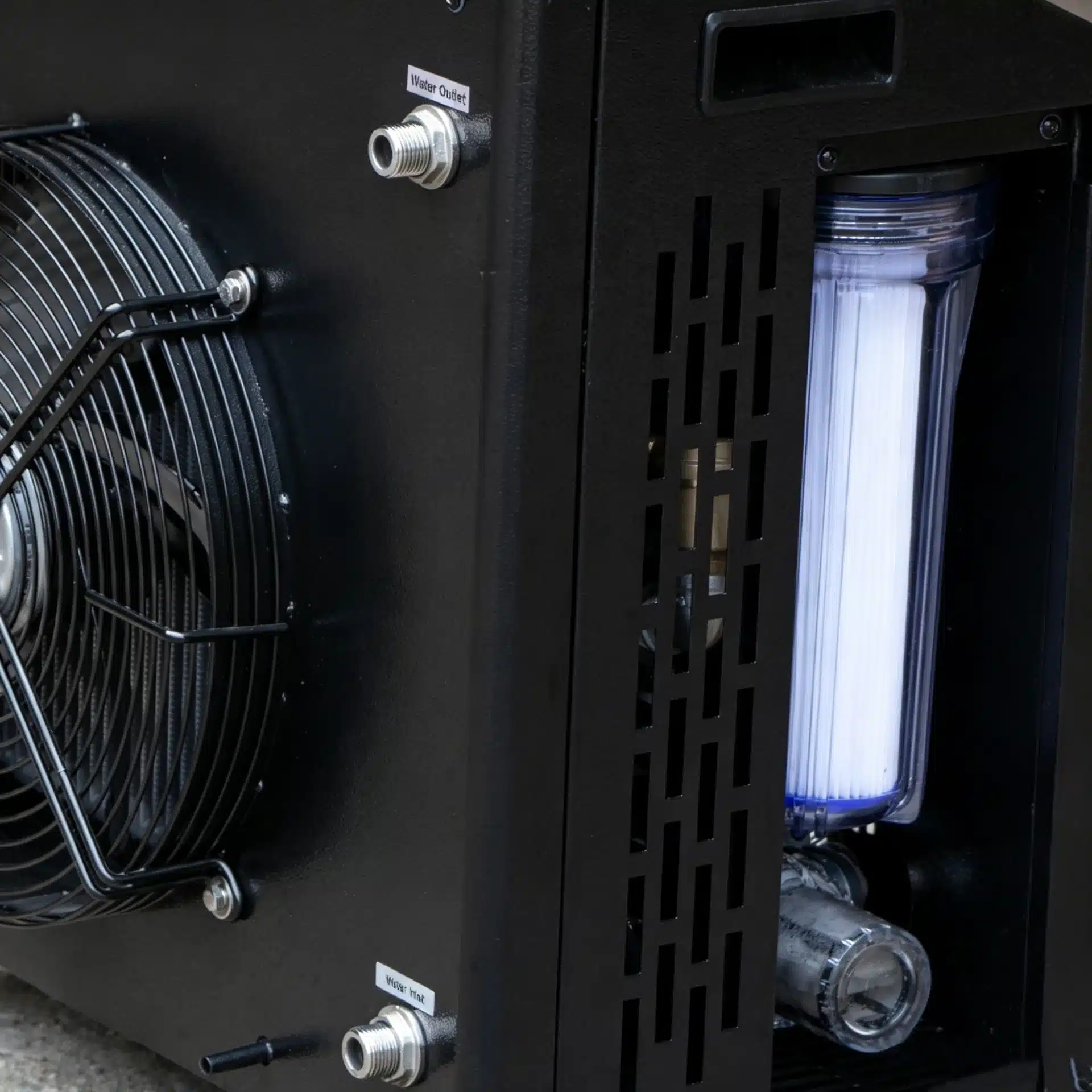
For aquarium chiller for cold plunge use, the chiller’s flow requirement must survive the real loop: suction path, pump, filter, hoses, fittings, valves, elevations and fouling allowance. Maximum pump flow is not delivered system flow. A narrow hose, loaded cartridge, restrictive quick connector or trapped air can move the operating point outside the chiller’s permitted range even when the pump label looks generous.
Request minimum and maximum flow for the exact model, allowable connection sizes and any required bypass or flow switch. Measure at a defined point with the filter in a stated condition. If priming or circulation is unstable, use the pump and priming diagnostic rather than repeatedly cycling the compressor and hoping the fault clears.
5. Identify every wetted material and its chemical limits
Before approving an aquarium chiller for cold plunge water, list the heat exchanger, internal pipe, seals, pump components, sensor wells, connectors and any metal exposed to circulation. “Titanium heat exchanger” is useful but incomplete if other wetted parts are unidentified. Compare the actual materials with the planned disinfectant, pH range, salinity if any, cleaning agents, temperature and maintenance method.
Do not convert a general corrosion-resistant claim into unlimited chemical compatibility. Ask the equipment and water-care suppliers to state concentration limits and incompatible products. Document which party owns the final chemistry decision. If nobody accepts that responsibility, the risk has not disappeared; it has merely been left between vendors.
6. Treat cooling and water hygiene as separate functions
An aquarium chiller for cold plunge water remains a refrigeration component; it does not remove all contamination or create a complete water-care program. Human entry introduces a different organic and microbial load from a closed display tank. The buyer must define filtration, disinfectant or other treatment, turnover, testing, cleaning, replacement water and records for the intended private or shared use.
For U.S. public aquatic venues, the CDC describes the Model Aquatic Health Code as guidance for jurisdictions developing and updating public pool codes. It is not a universal rule for every private cold tub or every country. It is still a useful reminder that a shared human-immersion venue is managed through design, recirculation, treatment and operating controls—not temperature alone.
NSF explains that NSF/ANSI/CAN 50 covers equipment for pools, spas, hot tubs and other recreational water facilities, including aspects such as materials, performance, corrosion resistance, marking and instructions. Applicability and required certification depend on the product, destination and authority having jurisdiction. Do not display an unrelated mark or a component certificate as proof that the whole cold-plunge system is approved.
The cold plunge filter flow guide covers filter restriction and service evidence. Commercial operators should also use the facility filter-system checklist to define user load, turnover and maintenance ownership before selecting equipment.
7. Design for a wet-location electrical context
Every aquarium chiller for cold plunge proposal needs more than matching voltage and plug shape. Record the exact nameplate data, circuit requirement, protective devices, grounding or bonding instructions, equipment location, cord routing, splash exposure and local code review. Never place a generic extension lead beside the tub or assume that an indoor aquarium installation represents an acceptable wet user environment.
In the United States, the CPSC’s pool and spa electrical safety guidance emphasizes GFCI protection, keeping cords and electrical products away from water, and using a qualified electrician familiar with applicable codes. Other destinations use different devices, terminology and rules. The actionable requirement is to obtain local qualified review, not to copy a U.S. checklist into every market. The 110V versus 220V buyer guide shows which electrical fields belong in an importer RFQ.
8. Provide heat rejection, ventilation and condensation control
An air-cooled aquarium chiller for cold plunge service rejects the removed water heat plus compressor and fan input into the surrounding air. If the cabinet sits in a small enclosure, warm discharge can return to the intake, raise head pressure and reduce useful capacity. Record manufacturer clearances, intake and discharge direction, room temperature, ventilation and whether another heat source shares the space.
The broader air-cooled and water-cooled condenser comparison explains why tub-water connections do not define the condenser route and which site utilities belong in each decision.
Cold water also creates condensation on tubs, hoses, fittings and filter housings when surface temperature falls below local dew point. Plan a visible drainage path and keep moisture away from electrical equipment and vulnerable finishes. Do not wrap the cabinet or block airflow in an attempt to solve sweating elsewhere.
9. Resolve connectors, leakage and service access before purchase
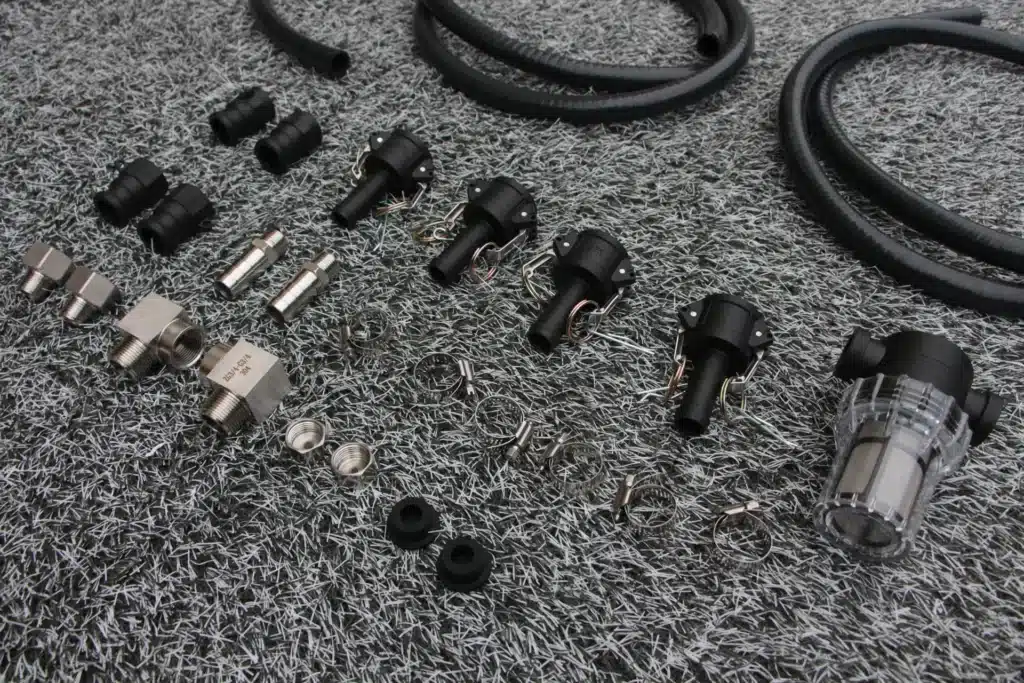
An aquarium chiller for cold plunge build should compare port thread, hose size, supplied adapters, seal material and working pressure with the rest of the loop. A stack of improvised reducers can add restriction and leak points. Ask whether the pump can be isolated, the filter can be opened, the heat exchanger can be drained and the cabinet can be removed without emptying the entire room.
A sound aquarium chiller for cold plunge plan includes a labeled loop diagram with flow direction, isolation points, drain points and the component owner. The DIY cold plunge build checklist covers the broader interface and safe-build questions. This article remains focused on deciding whether the candidate refrigeration unit belongs in that loop.
10. Test controls, alarms and restart behavior as a system
An aquarium chiller for cold plunge acceptance record should include the sensed temperature, setpoint, differential, displayed alarms and any remote-control behavior. Then test foreseeable transitions under the manufacturer’s permitted procedure: normal start, target reached, power restoration, low flow and sensor fault. Confirm whether the pump runs independently of the compressor and whether a remote switch can leave one component energized unexpectedly.
The acceptance record should distinguish observation from proof. “Alarm displayed during our test” is evidence for that identified configuration and test condition. It does not prove every fault is detected or that a third-party controller is safe to add.
11. Price documentation, spare parts and technical support
Price an aquarium chiller for cold plunge use with its support boundary. A lower purchase price can be erased by unavailable pumps, proprietary controllers, delayed sensors, refrigerant-service limitations or a warranty that excludes the application. Ask for the exploded parts reference or replaceable-unit list, troubleshooting boundaries, service contact, response channel and end-of-life parts policy. For a commercial site, define the maximum acceptable downtime and whether a spare unit or critical-parts kit is justified.
Keep the model, serial number, configuration, manuals, settings and service history together. The cold plunge chiller maintenance guide provides the recurring checks, but only the selected manufacturer can define model-specific service instructions and permitted repairs.
Aquarium chiller versus purpose-built cold plunge chiller
The labels below describe common procurement differences, not guaranteed features. Some aquarium units are well documented; some purpose-built products are not. Compare the actual offers and mark every unsupported field as unknown.
| Buyer field | Aquarium unit: likely starting evidence | Purpose-built cold-plunge unit: evidence to request | Pass question |
|---|---|---|---|
| Stated application | Aquarium, aquatic tank or reservoir | Human-immersion cold-plunge system and declared use class | Does the manufacturer permit the exact project use? |
| Capacity | Model table tied to aquarium assumptions or tank size | Capacity or pull-down evidence tied to water volume, temperatures and ambient | Can the supplier map data to the project duty without guessing? |
| Low-temperature operation | Controller range and aquatic operating limits | Target range, differential, freeze and low-flow behavior | Is continuous operation at the target explicitly supported? |
| Water loop | External pump and model-specific flow range | Declared pump, filter, ports and permitted flow in the supplied configuration | Does measured installed flow remain inside the permitted window? |
| Wetted materials | Heat-exchanger material and selected internal components | Full water-side material list and chemistry limits | Are all wetted parts compatible with the water-care plan? |
| Hygiene function | Usually relies on the aquarium’s separate filtration ecosystem | May integrate filtration or treatment, but performance still needs verification | Who owns filtration, disinfection, testing and cleaning? |
| Electrical context | Installation instructions for the intended tank environment | Nameplate and installation instructions for the supplied plunge configuration | Has a qualified local reviewer approved the wet-location installation? |
| Controls and alarms | Aquarium temperature control and product protections | Plunge duty controls, alarm logic and restart description | Have the important transitions been tested in the final system? |
| Warranty and support | May be restricted to intended aquarium use | Should state the accepted use, supplied configuration and service path | Is the application covered in writing? |
The matrix creates a fair comparison because it does not award points for category names. A purpose-built label does not excuse missing evidence, and an aquarium label does not automatically fail a technically documented candidate. The stronger offer is the one that closes the project’s thermal, hydraulic, hygiene, electrical and service questions with model-specific records.
Three scenarios lead to different decisions
Private, single-user tub with a technically responsible owner
A documented aquarium model may reach the prototype stage when the owner can design the loop, arrange qualified electrical work, maintain water quality and accept the support boundary. The prototype should be monitored and should not be promoted as a certified commercial system. The owner still needs safe operating instructions and a plan for faults, cleaning and long periods without use.
OEM product sold under another brand
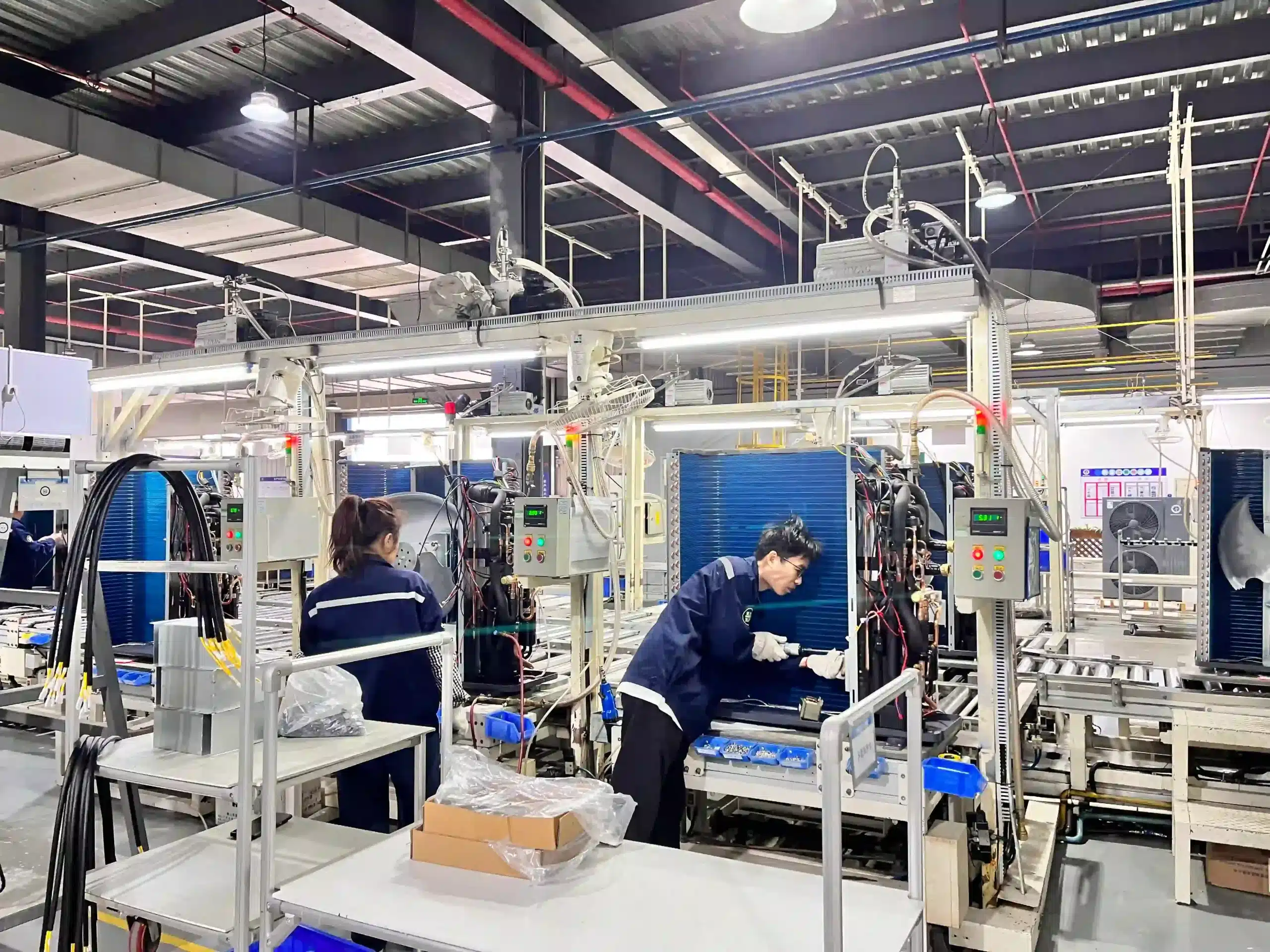
The bar is higher because the brand owner is selling a repeatable configuration to people who did not design it. A one-off bench test cannot replace documented models, approved components, warnings, manuals, production controls and destination-market review. The factory acceptance test checklist helps bind the tested sample to the supplied configuration.
Gym, spa, hotel or other shared-use site
User throughput, hygiene management, staff training, logging, downtime and local public-health or building requirements become central. A purpose-built, documented system is normally easier to specify and support, but it is not automatically approved. The facility should define turnover, treatment, daily checks, response to contamination, electrical inspection and service ownership with the relevant local professionals and authorities.
Stop the aquarium chiller conversion when evidence fails
- No exact model identity: the listing combines several units or the delivered label differs from the quoted model.
- No usable performance point: only horsepower, nominal tank size or “up to” language is available.
- Target outside the declared range: the seller recommends bypassing a sensor or changing controller parameters without manufacturer authorization.
- Unknown flow boundary: minimum and maximum flow, port size or low-flow behavior cannot be confirmed.
- Unknown water-side materials: the heat exchanger is named but seals, internal pipework or other wetted parts are not.
- No water-care owner: cooling is being treated as filtration or disinfection.
- Improvised wet-location power: extension cords, adapters, damaged leads or unreviewed wiring are part of the plan.
- Blocked heat rejection: the only proposed location is an enclosure that conflicts with required clearance or ventilation.
- Application excluded: the manufacturer or warranty terms do not permit the intended use and the buyer has no accepted alternative support plan.
- No responsible integrator: each vendor covers a component, but nobody owns the behavior of the connected system.
A “no” at this stage saves more money than an unsupported installation. It protects the buyer from buying adapters, rebuilding the loop and then learning that the unit cannot reach temperature or receive service. Use the chiller buyer checklist to compare a replacement candidate on the same project inputs.
Run an aquarium chiller for cold plunge acceptance test
Testing begins only after the documentary and installation gates pass. The test should reproduce the intended system rather than placing an unconnected cabinet on a bench. Identify the chiller, pump, filter, tub, water volume, hoses, settings and instruments; record the ambient conditions; and freeze the pass criteria before the run.
| Test stage | Record | Example decision—not a universal limit |
|---|---|---|
| Identity and setup | Model/serial, voltage version, pump, filter, loop diagram, usable volume, cover and settings | Delivered and installed configuration matches the approved test plan |
| Leak and prime | Dry joints, water level, pump prime, air purge, valve positions and flow | No visible leakage; stable circulation inside the model’s permitted range |
| Pull-down | Start/target temperatures, independent measurement point, timestamps, ambient and power events | Agreed target is reached within the project’s allowed time without prohibited alarms or icing |
| Hold | Temperature trend, cycling, ambient, cover state and declared simulated or real user load | System maintains the agreed band under the defined test condition |
| Protection | Permitted low-flow, sensor and restart checks performed according to instructions | Expected stop, alarm or restart behavior is observed and documented |
| Water and electrical inspection | Filter condition, water-care readings, condensation, drainage, protective devices and qualified sign-off | No unresolved condition blocks safe handover |
| Post-run review | Alarms, noise change, leaks, loose connections, ice formation, service access and deviations | Every deviation has a named disposition before routine use |
Do not invent a pass temperature, flow or run time from this table. Those values belong to the project brief and the exact manufacturer data. After installation, use the commissioning checklist to capture the destination-site baseline and handover responsibilities.
Copy this aquarium chiller for cold plunge block into the RFQ
AQUARIUM CHILLER / COLD PLUNGE COMPATIBILITY REVIEW

Buyer / project: [ ]
Destination country and site type: [private / commercial / shared-use / other]
Exact proposed chiller maker, model and voltage version: [ ]
Manufacturer-confirmed intended use: [ ]
Written cold-plunge / human-immersion application position: [attach / pending / not permitted]

Usable water volume: [ ]
Starting water temperature: [ ]
Target operating range: [ ]
Maximum pull-down time: [ ]
Ambient air range and indoor/outdoor location: [ ]
Cover and insulation condition: [ ]
Expected users and sessions per day: [ ]

Capacity data supplied at comparable conditions: [ ]
Permitted water-temperature range: [ ]
Control differential and freeze / low-flow protection: [ ]
Minimum and maximum flow: [ ]
Port thread and hose size: [ ]
Proposed pump, filter and measured design flow: [ ]

Complete wetted-material list: [ ]
Permitted disinfectant, pH, salinity and cleaning limits: [ ]
Filtration / disinfection / testing owner: [ ]
Required turnover or water-replacement plan: [ ]

Nameplate voltage, frequency, current and input power: [ ]
Protective device, grounding / bonding and local electrical review: [ ]
Ventilation clearance and heat-rejection plan: [ ]
Condensation and drainage plan: [ ]

Warranty coverage for intended use: [ ]
Service contact and replaceable parts: [ ]
Required manuals, declarations and test records: [ ]
Final system integrator / decision owner: [ ]
Prototype and site acceptance criteria: [attach]
Open deviations and approval authority: [ ]
For a complete supplier request, place this block beside the OEM cold plunge chiller RFQ template. That separates project inputs from the seller’s assumptions and makes two offers comparable even when their product labels differ.
Buyer next step: choose evidence before category labels
An aquarium chiller for cold plunge use is a system-integration decision, not a shortcut based on one familiar appliance. If the exact model and complete loop close all eleven checks, document the conditions and verify them in a controlled acceptance test. If important fields remain unknown—or if the project is a repeatable OEM or shared-use installation—compare a purpose-built configuration that gives one accountable path for cooling, circulation, controls and service.
OMNI can review a project brief against its available cold plunge chiller configurations without claiming that one model fits every tub. Send the completed field block through the OMNI project contact form; include water volume, temperatures, ambient, electrical supply, user schedule, water-care plan and destination so the discussion starts with the actual duty.
Aquarium chiller for cold plunge FAQ
Is an aquarium chiller automatically unsafe for a cold plunge?
No blanket judgment is reliable. The exact product may or may not fit the duty. Confirm manufacturer-permitted use, capacity at the project conditions, minimum temperature, flow range, wetted materials, water care, electrical installation and warranty. Until those facts are documented, suitability remains unproven.
Can I size a fish tank chiller for cold plunge use by horsepower?
No. Horsepower does not state useful cooling capacity at the intended water and ambient temperatures, and it does not include tub heat gain, pull-down time, pump heat, plumbing restriction, cover state or user load. Use model-specific performance data and a complete thermal and hydraulic calculation.
Does a titanium heat exchanger make an aquarium chiller compatible?
It answers only part of the materials question. Identify every wetted component and compare it with the planned disinfectant, pH, salinity and cleaning method. Compatibility also depends on thermal duty, flow, controls, electrical context, intended use and service support.
Does the chiller replace filtration or disinfection?
No. Cooling, filtration and disinfection are separate functions. A cold-plunge project needs a water-care plan appropriate to its private or shared use, plus defined testing, cleaning, maintenance and water-replacement responsibilities.
When is a purpose-built cold plunge chiller the better choice?
It is usually the cleaner procurement route when the site is shared-use, the product will be resold as an OEM system, local documentation is important, downtime is costly, or the buyer needs integrated circulation, filtration, controls and one service owner. The purpose-built label still needs model-specific evidence and qualified installation.