This cold plunge chiller horsepower guide explains how to compare 0.5HP, 0.8HP, 1HP and 1.5HP classes without pretending that horsepower alone predicts water temperature, pull-down time or commercial suitability. A defensible selection starts with the project duty and condition-specific net cooling capacity, then checks water flow, ambient derating, electrical input, control strategy and evidence from the installed system.
This page owns the meaning and use of chiller HP in a selection. Volume-led inputs remain on the cold plunge chiller sizing checklist; the broad purchasing route remains on the chiller for cold plunge buyer guide; and an existing spa-shell conversion remains on the hot-tub retrofit guide. Product pages own model-specific claims. This separation prevents one article from competing with every product and application page.
Table of Contents
Horsepower selection map
Cold plunge chiller horsepower guide: quick answer
Do not begin with “Which HP?” Begin with working water volume, start and target temperatures, required pull-down time, holding period, maximum ambient condition, indoor/outdoor exposure, insulation and cover, user schedule and connected water-loop resistance. Convert the water temperature change into thermal energy, add project heat gains, and ask suppliers for net capacity at those conditions. A larger HP label can provide margin, but only a complete, verified configuration shows whether that margin is real and useful.
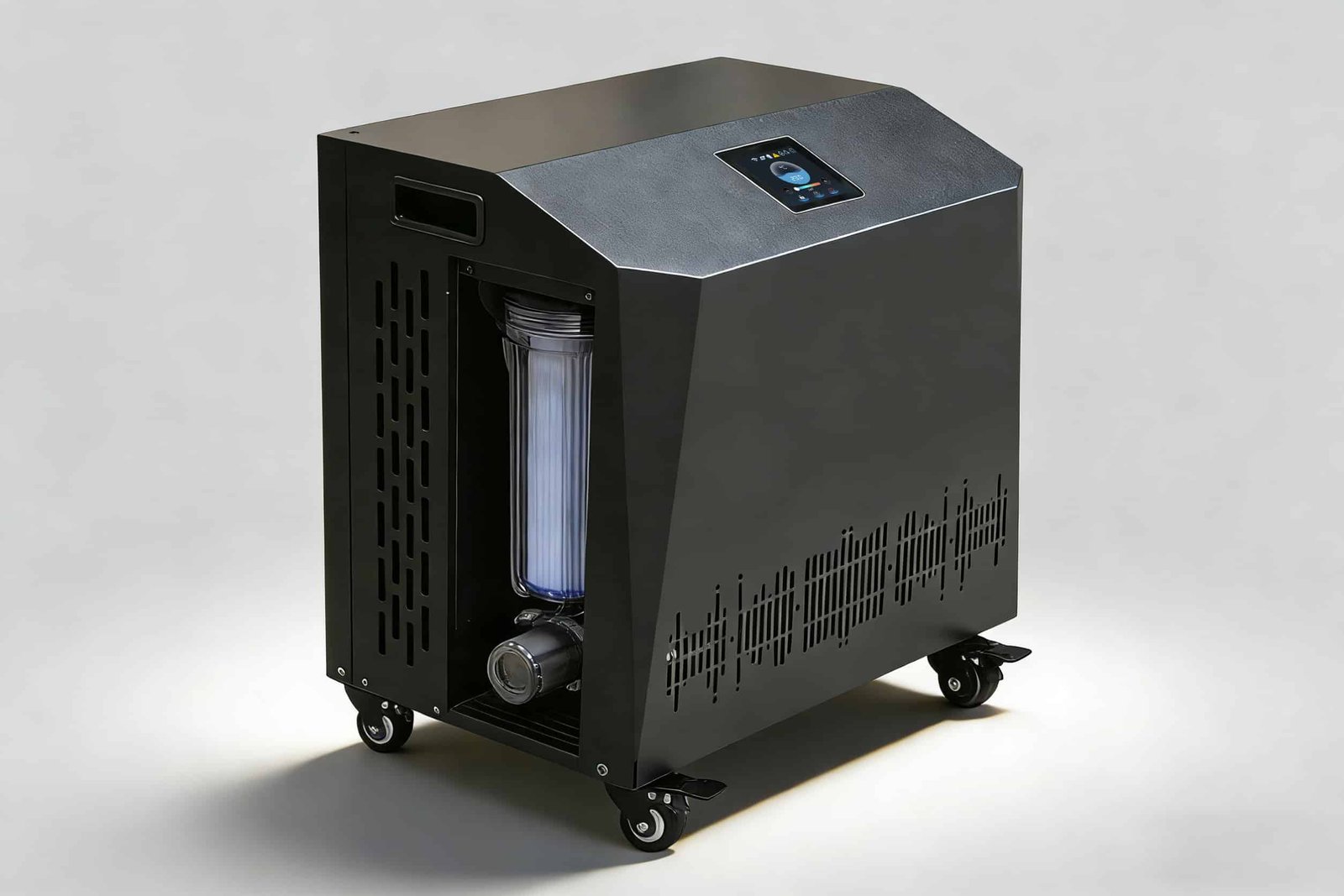
1/4 HP vs 1/2 HP chiller: compare the rating conditions
A 1/2 HP label is nominally larger than 1/4 HP, but it does not prove twice the delivered cooling or define a universal tub volume. Products in either nominal class can perform differently because the compressor operating point, heat exchangers, airflow, water flow and control strategy differ.
- Request net cooling capacity in kW or Btu/h at the same entering-water, leaving-water and ambient conditions.
- Compare permitted water flow, pressure drop or available pump head, electrical input and protection requirements.
- Ask how the rating was measured and whether the exact quoted configuration—including pump, filter and controls—was tested.
- Check the result against the project’s working water volume, insulation, target temperature, ambient range and required pull-down time.
If comparable condition-based data are unavailable, hold the selection rather than assigning either class a fixed gallon or liter limit. The same evidence rule applies when comparing 0.8HP, 1HP and 1.5HP labels later in this guide.
12 cold plunge chiller horsepower guide checks
| Check | Input or evidence | Why HP alone fails |
|---|---|---|
| 1. Working volume | Measured normal fill in liters/gallons | Shell capacity may not equal operating water mass |
| 2. Temperature change | Starting and target water temperatures | The same volume can require very different energy removal |
| 3. Pull-down time | Maximum acceptable hours to target | Capacity requirement changes with the deadline |
| 4. Holding duty | Operating window and allowed drift | Steady heat gain differs from initial cooldown |
| 5. Ambient | Air range, humidity, sun and ventilation | Available capacity changes with operating conditions |
| 6. Insulation | Shell, plumbing and cover construction | Heat gain is project-specific |
| 7. Users | Peak immersions and reset windows | People and opening the cover add heat and load |
| 8. Net capacity | kW/Btu/h at stated test points | Nominal HP is not delivered cooling |
| 9. Water loop | Required flow, head, pipe and filter data | Poor flow limits heat transfer |
| 10. Electrical | Voltage, frequency, current and protection | HP does not prove site compatibility |
| 11. Controls | Setpoint, hysteresis, alarms and restart logic | Control behavior affects stability and uptime |
| 12. Acceptance | FAT and commissioned temperature record | A label cannot prove the finished system |
1. Understand what horsepower means—and what it does not
Horsepower is useful for grouping equipment, but sellers do not always use it in exactly the same way. It may describe nominal compressor motor power, a rounded commercial class or another convention. It does not directly state the net cooling transferred from the water. For equipment marketed to fish-tank owners, also aquarium chiller duty instead of treating horsepower as proof of compatibility. Refrigeration design, compressor operating point, evaporator and condenser size, refrigerant, airflow, water flow and control logic all influence delivered performance.
Ask the bidder to define the HP claim and provide model-specific net cooling capacity, electrical input and test conditions. Record whether figures are nominal, minimum, maximum or measured. If a proposal provides only “1HP” and a minimum temperature without entering-water, leaving-water and ambient conditions, the cold plunge chiller horsepower guide comparison is incomplete.
2–3. Calculate water energy and state the pull-down deadline
For an initial water-side estimate, use Q = m × cp × ΔT. The U.S. Department of Energy’s thermodynamics handbook presents this relationship. One liter of water is approximately one kilogram for planning purposes, while the project calculation should use appropriate properties and units.
Example: 300 L cooled from 22°C to 7°C has a 15°C change. The water-only energy is approximately 300 × 4.186 × 15 = 18,837 kJ, or 5.23 kWh of thermal energy. If a system could continuously deliver 2.0 kW of net cooling at every point, the ideal water-only time would exceed 2.6 hours. Real time is longer or otherwise different because capacity changes, and the tub, room, pump, users and pipework exchange heat. This example teaches the method; it is not a performance claim for an OMNI model.
The buyer using this cold plunge chiller horsepower guide must define when the target is needed. Overnight pull-down, a two-hour reset and continuous ready-to-use holding are different duties. A supplier cannot make a meaningful prediction when “fast cooling” is the only deadline. Put the accepted pull-down window and permitted deviation into the RFQ and purchase order.
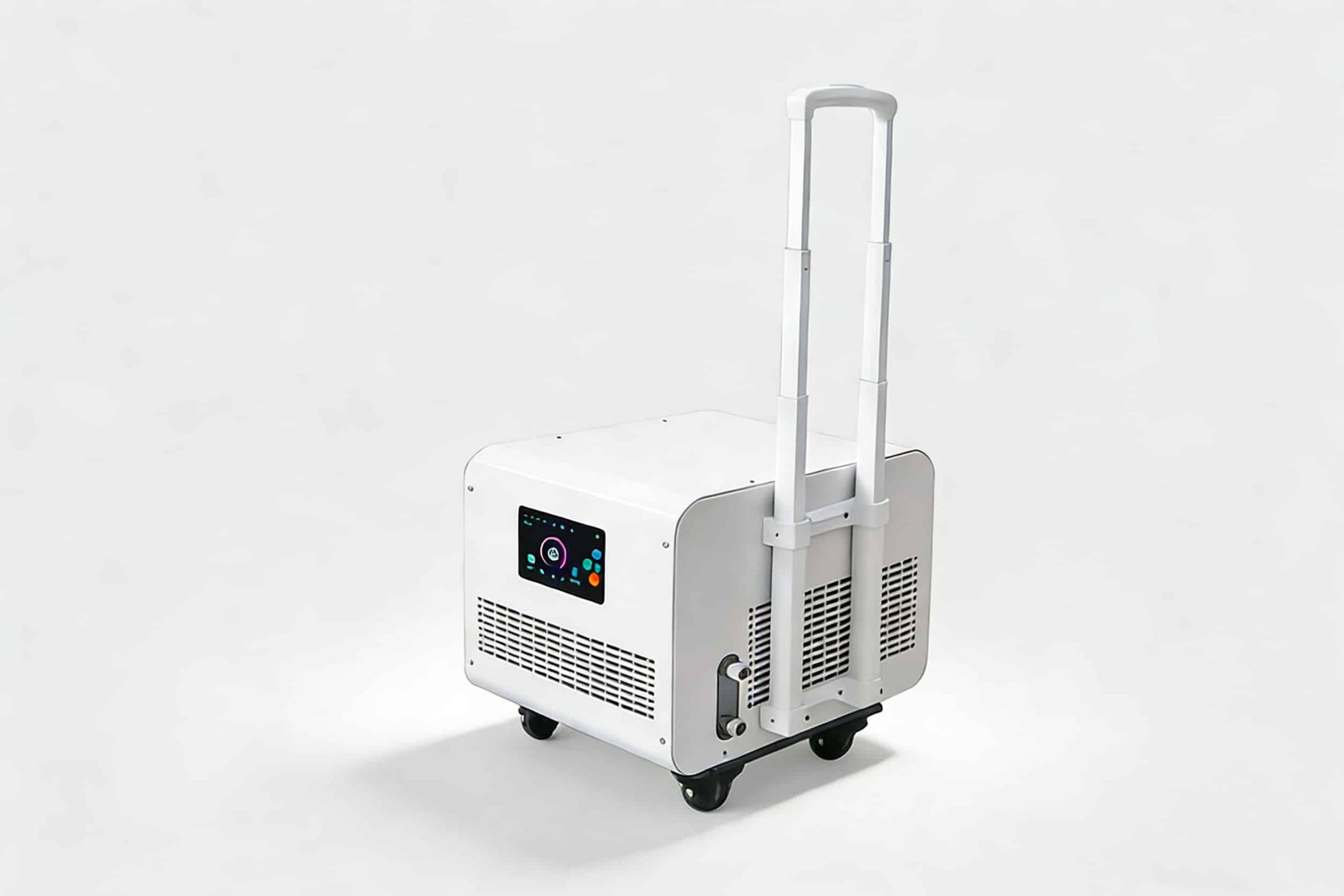
4. Separate initial pull-down from holding duty
Initial pull-down removes energy from the fill water, vessel and connected components. Holding duty offsets ongoing heat gain after the target is reached. The dominant loads may include warm ambient air, solar exposure, an uncovered surface, uninsulated walls and hoses, pump heat, frequent users, warm make-up water and repeated opening. Calculate or conservatively model both duties.
A system can eventually reach target in mild test conditions yet fail the operational requirement because it cannot recover between users or hold temperature during a hot afternoon. Conversely, a unit selected only for an unusually aggressive first cooldown may be unnecessarily large for a covered indoor tub that remains cold. A sound result from this cold plunge chiller horsepower guide balances required performance, control stability, electrical demand, sound, space and service—not a blanket instruction to “go one HP bigger.”
5 and 8. Demand condition-specific net cooling data
Request a capacity table or curve as part of the cold plunge chiller horsepower guide record, showing water and ambient test points relevant to the project. Ask for net cooling output, electrical input, permitted water flow, entering and leaving water conditions, air temperature, humidity if material, and tolerances. Identify whether accessories and pumps are included in power figures. For heat-and-cool models, keep heating claims separate from cooling selection.
AHRI’s 550/590 and 551/591 standard page shows that water-chiller ratings are tied to definitions, test requirements and published-rating conditions. Many small cold-plunge systems may sit outside that standard’s scope, so do not claim AHRI certification without evidence. Use the principle: every performance number needs a model, method, condition and tolerance.
9. Match cooling capacity to the real water loop
The water loop includes the working volume, pump, heat exchanger, filter, treatment components, hoses or pipes, fittings, valves, elevation and bypass. Each component affects flow and pressure. Request the permitted flow range and maximum pressure for the chiller, plus the pump curve or an approved integrated configuration. Open-flow pump ratings do not establish flow through a finished loop.
The cold plunge chiller pump-head calculation expands this hydraulic check into component pressure-loss inputs, clean and service-condition system curves, the pump duty point and a copyable RFQ schedule.
Low flow can reduce heat transfer or trigger protection; excessive flow or pressure can damage equipment. Dirty filters and kinked hoses can move an initially successful system outside its intended condition. Include clean and service-trigger baselines in commissioning. The filter system guide covers these hydraulic dependencies in detail.
5–6. Model ambient exposure, insulation and airflow
Record the maximum and minimum equipment-area air temperature, ventilation, enclosure, solar load, rain or moisture exposure, clearance, hot-air discharge path and any seasonal shutdown. An outdoor cabinet designation does not mean unlimited ambient performance. Request the operating envelope and capacity at the design condition, plus any protective derating or shutdown behavior.
Insulation reduces avoidable heat gain. Document tub walls, floor, lid, floating cover if used, pipe and hose insulation, gaps and condensation control. A good cover can materially change holding duty, but it should not be used during occupancy or in a way that creates an entrapment hazard. Compare the same cover condition across bids and tests.
7. Translate users into a peak operating scenario
Daily users are not enough. Record the busiest consecutive period, number of immersions, simultaneous occupancy, facility-defined immersion time, transition interval, cover-open time, warm make-up water, testing and cleaning windows, and the required temperature recovery before the next user. For gyms, hotels and clinics, also state availability expectations and the consequence of downtime.
User load affects more than heat. It changes filtration, treatment, cleaning and operator workload. A “commercial” label should therefore be supported by duty-cycle limits, service access, component life assumptions, spares and support—not only by a larger compressor. Application owners such as the commercial gym guide should define the operational scenario, while this cold plunge chiller horsepower guide translates it into comparable equipment evidence.
10–11. Verify electrical fit, controls and protection
Record destination country, exact voltage and frequency, rated and maximum current, starting characteristics if relevant, plug or termination, grounding, overcurrent protection, GFCI/RCD requirements, disconnect, connected pump loads and whether a dedicated circuit is required. Do not infer current from HP, and do not approve a model because an adapter makes its plug fit.
For U.S. workplace context, OSHA’s general electrical standard addresses suitability, installation and damp or wet locations. The CPSC also publishes pool and spa electrical safety guidance. Neither source replaces locally applicable design and inspection requirements. Use qualified professionals for the actual wet-area installation.
Specify setpoint range, sensor location, hysteresis or control band, pump interlock, flow protection, freeze protection, restart after power loss, remote-control permissions, alarm behavior and lockout. A stable system should not rely on an operator repeatedly cycling power. Record controller and software versions so later changes can be evaluated against the commissioning baseline.
0.5HP vs 0.8HP vs 1HP vs 1.5HP: what to compare
Apply uncertainty and design margin deliberately
A cold plunge chiller horsepower guide should show where uncertainty sits instead of hiding it inside a bigger model. Separate measured inputs from estimates: working volume may be measured accurately, while future user adoption or peak summer equipment-area temperature may remain a range. Ask the supplier to calculate or test a base case and one or more adverse but credible cases.
Choose margin against a named consequence. Performance margin may protect the pull-down deadline; operating-envelope margin may protect hot-weather availability; hydraulic margin may allow normal filter loading; service margin may support a critical facility. More nominal HP is only one possible response. Better insulation, a cover between uses, shorter pipework, improved airflow, staged operation, thermal storage or a second serviceable unit may solve the actual constraint more effectively.
Also check the cost of excess capacity. A larger unit can require another circuit, greater airflow, more space, different sound control and different minimum-load behavior. Ask how the controller cycles or modulates near the holding load. The cold plunge chiller horsepower guide decision should document why the selected margin is valuable and who accepted its tradeoffs.
Use a sensitivity table, not one magic answer
| Variable | Base case | Adverse case to request | Possible response |
|---|---|---|---|
| Ambient air | Typical operating day | Design summer equipment-area peak | Capacity verification, shade, ventilation or enclosure change |
| Starting water | Normal maintained temperature | Fresh fill or post-shutdown restart | Longer planned pull-down or different capacity |
| Cover/insulation | Approved cover in place between uses | Cover-open peak period | Operational control or additional holding margin |
| Flow | Clean filter baseline | Defined service-trigger restriction | Filter schedule, pump/loop change or alarm |
| Users | Expected adoption | Approved peak occupancy window | Recovery window, access scheduling or capacity change |
Have every bidder complete the same table. If one cold plunge chiller horsepower guide response is based on a 25°C room and another uses a 35°C outdoor cabinet, do not compare their HP and price as though the predictions were equivalent. Normalize the duty first, then evaluate differences in equipment and evidence.
| Nominal class | Useful role in a shortlist | Evidence still required |
|---|---|---|
| 0.5HP | Compact, lower-connected-load candidate for less demanding duties | Net capacity at target/ambient, pull-down test, flow and operating limits |
| 0.8HP | Intermediate candidate when the duty sits between common catalog classes | Same condition-based data; do not interpolate from the HP label |
| 1HP | Widely offered class with multiple architectures and feature sets | Exact compressor, exchanger, input, capacity curve, controls and service scope |
| 1.5HP | Higher-capacity candidate for more demanding or margin-sensitive projects | Site electrical fit, minimum-load control, ambient performance, sound and lifecycle cost |
This table is deliberately not a liters-to-HP recommendation. A 300 L covered indoor vessel and a 300 L uncovered outdoor vessel can create different duties; two 1HP products can also deliver different net cooling. Use product pages to build a shortlist, then require the supplier to complete the same cold plunge chiller horsepower guide worksheet for every candidate.
Check data quality before trusting a sizing output
Label each input as measured, specified, supplier-declared, calculated or assumed. Record units and the date. Confirm that water volume is the normal fill, ambient is measured where the chiller breathes, and electrical data belongs to the exact destination variant. When a capacity curve is digitized or converted, retain the original source and conversion method.
Resolve contradictions before approval. A quotation, manual and nameplate should not identify different current, refrigerant or model suffixes. If a test report covers another configuration, ask for an applicability statement and change assessment. A reliable cold plunge chiller horsepower guide record makes uncertainty visible and prevents a polished spreadsheet from overstating weak source data.
12. Convert the selection into testable acceptance criteria
Attach the approved duty to the quotation and purchase order. Identify the exact model and revision, included pump and treatment components, capacity evidence, electrical variant, water-loop requirements, controls, documentation, packing, warranty and service. Define which substitutions require buyer approval. The OEM RFQ template provides a controlled input structure.
At factory acceptance and commissioning, record water volume, start and target temperatures, ambient condition, cover state, flow condition, electrical data, time stamps, alarms, leaks and deviations. Compare the result with the agreed test method. Use the FAT checklist before shipment, then repeat the relevant performance and installation checks at the site.
For energy cost, use measured electrical input and the site tariff under a representative operating schedule. The dedicated cold-plunge chiller electricity guide explains the variables. Compressor HP, cooling kW, electrical kW and thermal kWh are different quantities; keep them in separate fields.
After commissioning, compare the observed result with the cold plunge chiller horsepower guide assumptions. Store the approved baseline with maintenance records, then investigate meaningful drift in pull-down, flow or power before changing the HP conclusion.
Buyer worksheet for a comparable HP quotation
| Buyer supplies | Supplier returns | Acceptance record |
|---|---|---|
| Measured working volume | Approved volume range and assumptions | Commissioned fill level |
| Start, target and pull-down window | Predicted result and net capacity at conditions | Time-stamped temperature log |
| Ambient and location | Operating envelope and derating | Measured test ambient |
| Water-loop drawing | Required flow, pressure limits and components | Installed configuration and baseline |
| Voltage/frequency/circuit | Exact electrical variant and nameplate | Qualified installation record |
| Peak user schedule | Recovery assumption and duty limit | Operational pilot data |
| Service location | Warranty, spares, response and exclusions | Handover and support contacts |
Cold plunge chiller horsepower guide FAQ
Is 1HP enough for a cold plunge?
The label alone cannot answer. Define water mass, temperature change, pull-down time, ambient, insulation, cover, users and loop conditions, then compare the model’s net capacity under those conditions and validate the finished system.
Does 1HP equal a fixed cooling capacity?
No. HP and delivered cooling are not interchangeable. Ask for net cooling output in kW or Btu/h, electrical input, water and ambient test points, flow and tolerances for the exact model.
Should an outdoor setup always add 0.5HP?
No universal increment is defensible. Model the actual ambient range, solar exposure, ventilation, tub and pipe insulation, cover, target and pull-down requirement, then request capacity at the design condition.
Can I estimate cooling time from HP?
Not reliably. Estimate water-side energy, divide by condition-specific net cooling only as a first model, add heat gains and control effects, and verify using a time-stamped test under agreed conditions.
What should be on a chiller performance report?
Include model and revision, water volume, start and target temperatures, ambient, cover state, water flow condition, electrical configuration, net capacity basis, time stamps, controls, alarms, leaks, deviations and tester identity.
Request a condition-based chiller selection
Send working volume, water start and target, maximum ambient, indoor/outdoor location, insulation and cover, required pull-down time, holding window, peak users, water-loop sketch, voltage/frequency, country and service expectations. OMNI Ice can compare candidate configurations against those stated inputs without substituting an HP slogan for engineering evidence. Submit the sizing brief.