Quick answer: A cold plunge chiller does not have one fixed electricity use. Consumption changes with water volume, starting and target temperature, ambient heat, insulation, cover use, water flow, maintenance and runtime.
What Determines Cold Plunge Chiller Electricity Use?
For a usable estimate, combine a meter reading or manufacturer electrical-input information with your local tariff; do not use horsepower alone as an electricity figure.
Cold plunge chiller electricity cost depends on the chiller’s electrical input, actual compressor runtime, circulation-pump power, local electricity rate, water volume, insulation, ambient temperature, and target water temperature. There is no single monthly price that is accurate for every home or commercial setup.
The correct way to estimate operating cost is to calculate kilowatt-hours from verified equipment data and realistic runtime. This guide explains the formula, shows a clearly labeled example, identifies the factors that change energy use, and helps you compare different cold plunge systems without confusing horsepower, cooling capacity, and electrical consumption.
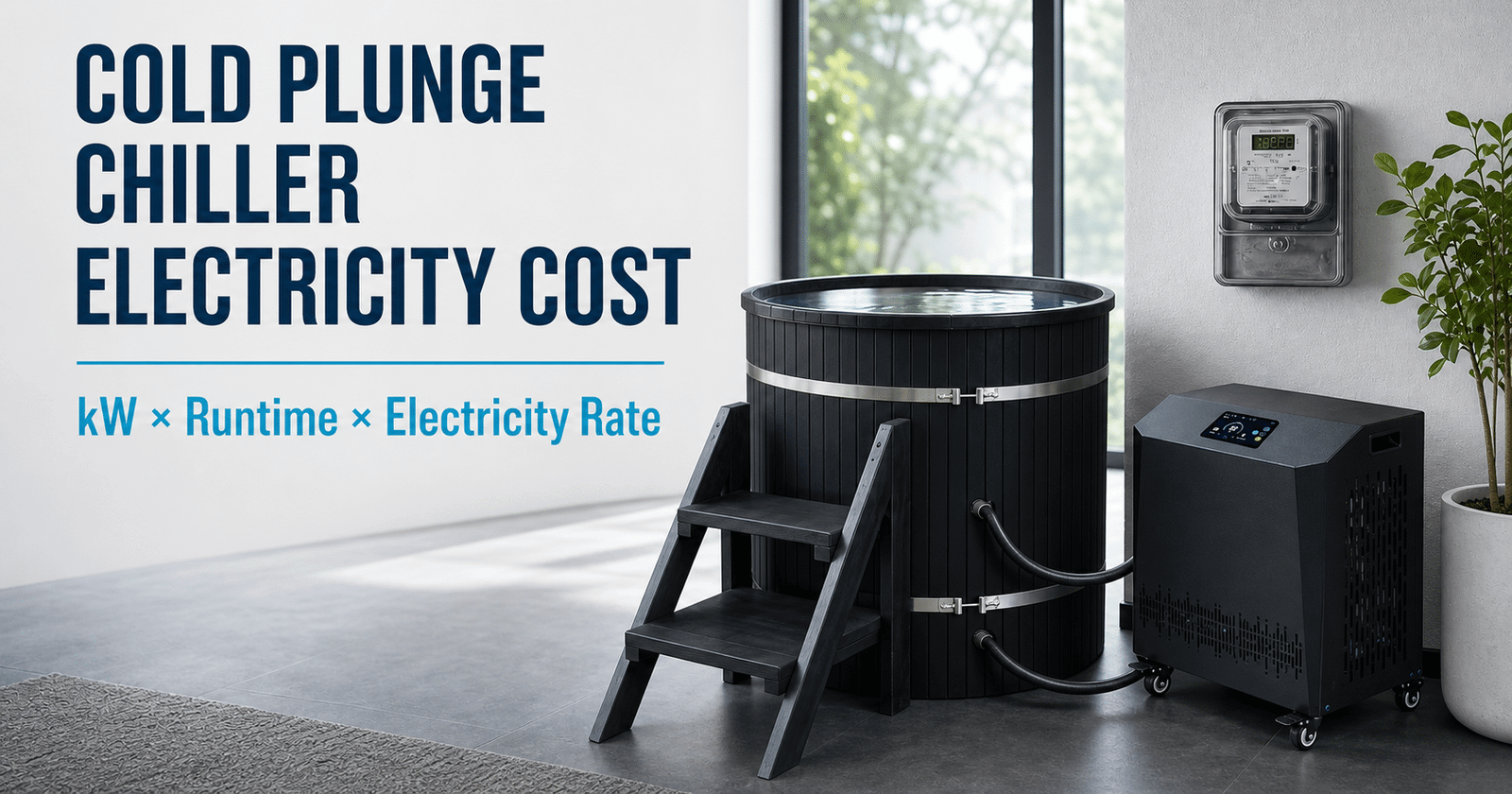
Quick answer: multiply the chiller’s electrical input in kilowatts by the number of hours its compressor operates, then multiply by your electricity price per kWh. Add the pump and any separate ozone, UV, heater, or filtration loads.
How to Calculate Cold Plunge Chiller Electricity Cost
Electricity is normally billed in kilowatt-hours, written as kWh. One kilowatt-hour means using 1,000 watts for one hour.
Daily kWh = input watts ÷ 1,000 × operating hours per day
Monthly electricity cost = daily kWh × operating days × electricity rate per kWh
Calculate each independent electrical load separately:
- Chiller compressor and fan
- Circulation pump
- Heater, if the system also provides heating
- Ozone generator or UV system
- Separate filtration equipment
- Controls and standby power
Avoid double counting: some integrated systems already include the pump, fan, and controls in the total rated input. Check the product label or approved data sheet before adding separate loads.
A clearly labeled calculation example
Assume a chiller draws 750 watts while the compressor is operating. After the initial cooldown, the compressor operates for an average of six hours per day. A separate 60-watt pump runs continuously, and electricity costs $0.16 per kWh.
| Electrical load | Calculation | Monthly energy | Illustrative monthly cost |
|---|---|---|---|
| Chiller | 0.75 kW × 6 hours × 30 days | 135.0 kWh | $21.60 |
| Separate pump | 0.06 kW × 24 hours × 30 days | 43.2 kWh | $6.91 |
| Combined total | 178.2 kWh × $0.16/kWh | 178.2 kWh | $28.51 |
This is a calculation example, not a tested monthly cost for a specific ColdTubChiller product. A covered indoor setup may consume less, while an outdoor setup in hot weather may consume more. Local electricity prices can also change the result substantially. This cold plunge chiller electricity cost example explains the calculation method, not a guaranteed bill for every installation.
How Much Electricity Does a Cold Plunge Use Per Day?
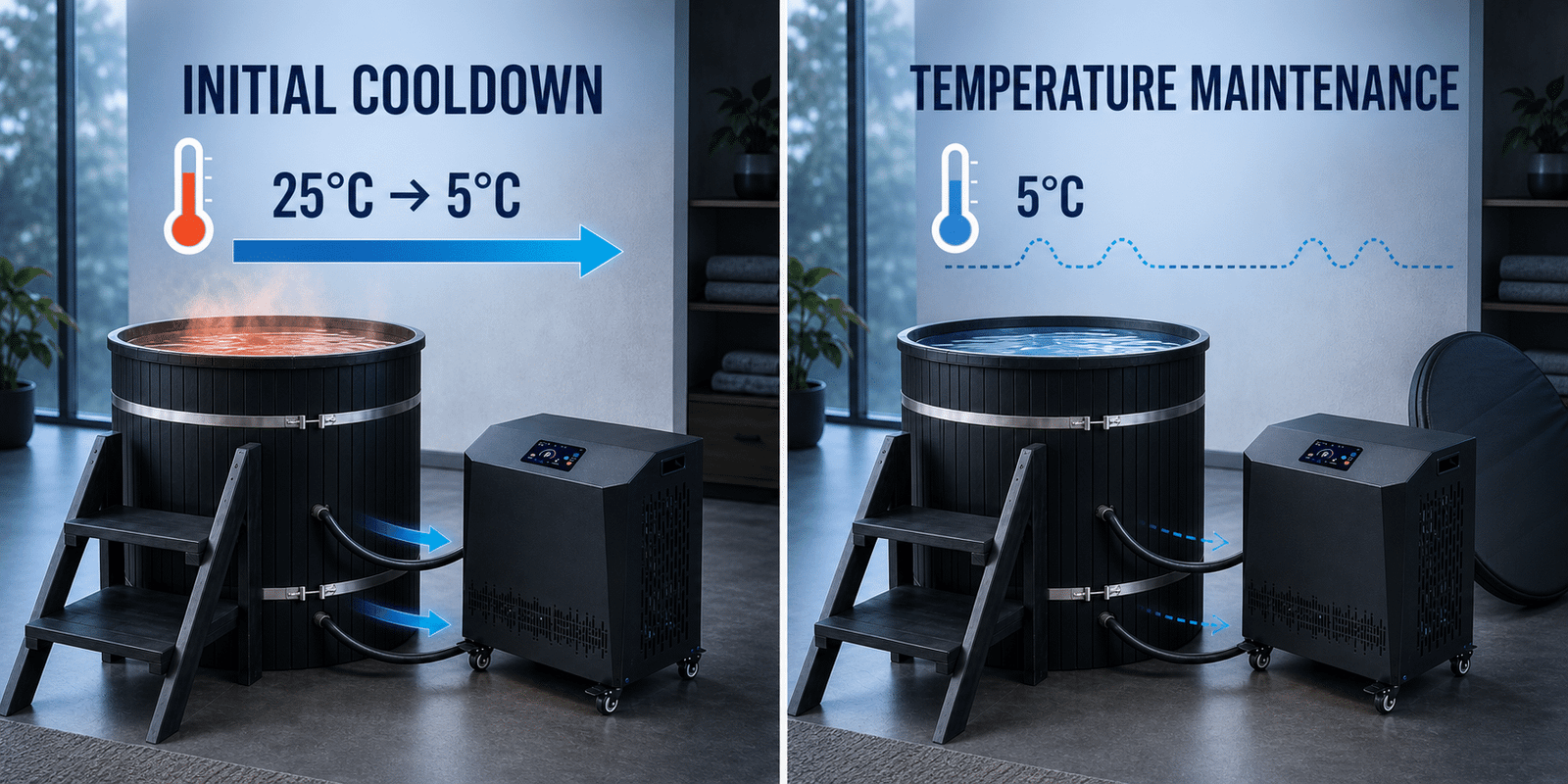
Daily electricity use has two distinct phases: initial cooldown and temperature maintenance. Mixing these phases together is one reason many online estimates are misleading.
Initial cooldown
During initial cooldown, the compressor may operate continuously or for long periods while removing heat from the full water volume. Energy use increases when the starting water is warm, the target temperature is very low, the tub is large, or the system is exposed to hot air and direct sunlight.
For a useful pull-down estimate, record the water volume, starting temperature, target temperature, ambient temperature, chiller input power, and total cooling time. A statement such as “cools in three hours” is incomplete unless those conditions are provided.
Temperature maintenance
After the water reaches the set temperature, the compressor normally cycles on and off as heat enters the system. The cold plunge may remain switched on for 24 hours without the compressor drawing full running power for all 24 hours.
The circulation pump, controller, ozone generator, and UV system may follow different schedules. For this reason, maintenance energy should be measured across the complete system rather than estimated from compressor horsepower alone.
Are Cold Plunge Chillers Expensive to Run?
Cold plunge chiller electricity cost can remain manageable when the system is correctly sized, covered and insulated. However, whether a system is “expensive” depends on the equipment, climate, target temperature, operating schedule and local electricity tariff. One fixed monthly figure cannot describe every installation.
The most important cost drivers are:
- Verified electrical input while operating
- Compressor duty cycle after reaching the set point
- Pump and water-treatment runtime
- Water volume and desired temperature
- Ambient temperature and direct sunlight
- Tub, cover, hose, and filter-housing insulation
- Number of users and recovery required between sessions
- Residential or commercial electricity price
Compare monthly kWh before comparing monthly currency. Electricity rates differ by country and utility, but kWh provides a consistent measure of equipment energy use.

Horsepower Is Not the Same as Power Consumption
Horsepower helps describe a compressor or product class, but it does not provide the complete electricity calculation. Two chillers sold as 1 HP can use different compressors, heat exchangers, pumps, fans, refrigerants, controls, and voltage configurations.
Electrical input
Electrical input is the power drawn from the electricity supply. Look for specifications such as “rated input power,” “power input,” or “rated power,” normally shown in watts or kilowatts.
Cooling capacity
Cooling capacity describes how quickly the system can remove heat under stated test conditions. It is an output value, not the same as electrical consumption. A product with 2.5 kW of cooling capacity does not automatically consume 2.5 kW of electricity continuously.
Runtime and duty cycle
Runtime determines how long the equipment draws power. Duty cycle is the percentage of a measurement period during which the compressor operates. A compressor that runs for six hours during a 24-hour day has a 25% daily duty cycle.
If you have not chosen a model, first chiller sizing guide. Correct sizing affects cooling time, maintenance runtime, purchase cost, and the ability to recover between users.
What Changes Cold Plunge Power Consumption?
Water volume
A larger volume contains more heat energy. It normally requires more energy during initial cooldown and may receive more heat through the tub surface and walls during maintenance.
Starting and target temperature
Cooling water from 25°C to 10°C is a smaller task than cooling the same volume from 30°C to 3°C. Any performance or energy figure should identify both temperatures.
Ambient temperature
An indoor system in a temperature-controlled room operates under a different load from a tub outdoors in summer. Higher ambient temperatures generally increase heat gain and can make heat rejection more difficult for an air-cooled chiller.
Sunlight and ventilation
Direct sunlight heats the tub and plumbing. Shade can reduce that heat load, but the chiller still needs the intake and exhaust clearance specified by the manufacturer. Enclosing the chiller to hide it can restrict airflow and increase runtime.
Insulation and cover
Heat can enter through the water surface, tub walls, base, hoses, fittings, and filter housing. A fitted insulated cover and properly insulated plumbing can reduce heat gain, but the saving is not a universal percentage.
Number of users
Each user adds heat, opens the cover, and increases the recovery required. One home user per day creates a different load from a recovery studio serving several people per hour.
Water flow and maintenance
A dirty filter, restricted hose, airlock, blocked heat exchanger, or poor airflow can reduce cooling performance and extend compressor runtime. Maintenance affects both reliability and energy use.
Do Insulated Cold Plunge Tubs Lower Energy Costs?
Yes, insulation can reduce heat entering the water and therefore reduce compressor runtime. The actual benefit depends on the insulation material, thickness, tub construction, cover, plumbing, ambient conditions, and target temperature.
To test whether an insulation change works, compare daily kWh across two similar periods:
- Use the same target temperature
- Choose days with similar ambient temperatures
- Keep user frequency approximately equal
- Keep pump and sanitation schedules unchanged
- Measure kWh instead of judging by compressor sound
Do not compare a cool week before insulation with a hot week after insulation and attribute the entire difference to the material.
How to Compare Energy Efficiency Between Chiller Models
Compare every model under the same conditions. A useful supplier specification or test should contain the following information:
| Comparison field | What to request | Why it matters |
|---|---|---|
| Rated electrical input | Watts at the stated voltage and frequency | Provides the correct cost input |
| Cooling capacity | Capacity plus laboratory or test conditions | Shows heat-removal ability |
| Water volume | Liters or gallons used in the test | Makes results comparable |
| Starting and target temperature | Both water temperatures | Defines the cooling task |
| Ambient temperature | Air temperature during testing | Affects heat gain and heat rejection |
| Pull-down time | Hours under the stated conditions | Helps estimate initial energy |
| Maintenance consumption | Measured kWh/day after reaching the set point | Supports ongoing-cost estimates |
| Pump included? | Yes or no, plus separate pump wattage | Prevents missing or double-counting power |
| Standby power | Watts while the compressor is off | Improves long-duration calculations |
Categories such as a 0.5 HP cold plunge chiller or 0.8 HP ice bath chiller can help narrow the intended application. The approved product label or data sheet should still control the electricity estimate.
How to Measure Actual Cold Plunge Electricity Use
A calculation is useful before purchase. A compatible electricity meter gives a better answer after installation. The U.S. Department of Energy explains that appliance DOE test procedures.
- Confirm meter compatibility. It must support the chiller’s voltage, plug type, current, startup load, and installation environment.
- Follow electrical-safety requirements. Do not place an indoor-only meter in a wet, exposed, or splash-prone area.
- Measure initial cooldown separately. Record starting temperature, target temperature, water volume, ambient temperature, cooling time, and total kWh.
- Measure maintenance use. After reaching the set point, record at least seven representative days.
- Record operating conditions. Note the number of users, cover use, weather, sunlight, and filtration schedule.
- Calculate the monthly estimate. Divide maintenance kWh by measured days, multiply by monthly operating days, and then multiply by the electricity price.
A full month of measurements is preferable when outdoor temperatures change substantially. Do not present one unusually hot or cool day as a universal operating figure.
How to Reduce Cold Plunge Electricity Cost
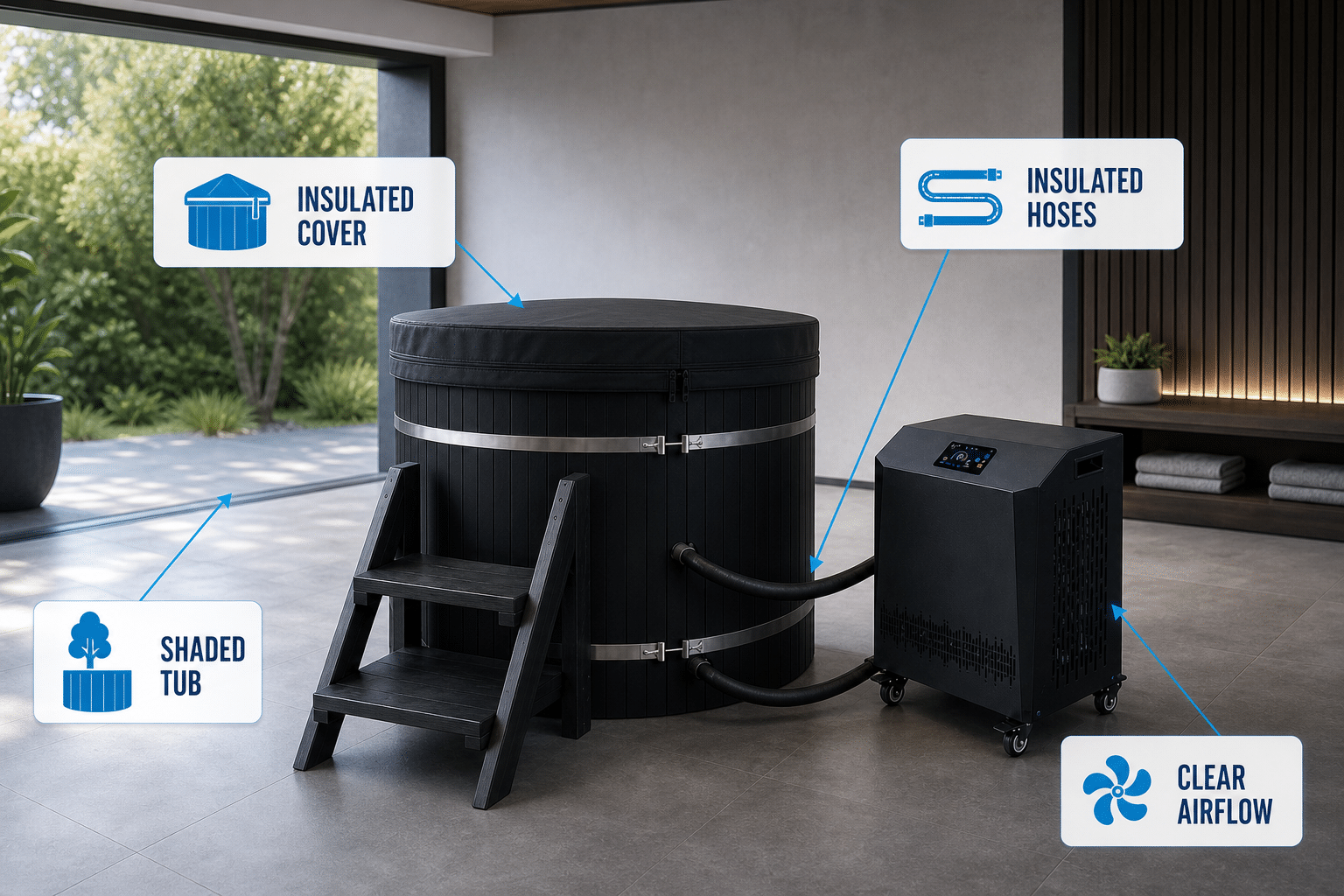
Use a fitted insulated cover
Keep the cover closed when the plunge is not in use. This limits heat exchange at the water surface and helps keep debris out.
Insulate exposed plumbing
Hoses and filter housings can absorb heat. Keep plumbing runs reasonably short and insulate components where the manufacturer permits it.
Place the tub in shade
Shade reduces solar heat gain. Do not block the chiller’s air intake or hot-air exhaust while creating the shaded installation.
Use a realistic set temperature
Lower set points increase the cooling task, especially in hot conditions. Choose the temperature you will actually use rather than automatically selecting the minimum setting.
Maintain filters and water flow
Restricted circulation reduces heat transfer and can extend runtime. Clean or replace filters according to the approved maintenance schedule.
Select the correct system size
An undersized chiller may run for long periods without reaching the target. An unnecessarily large system may increase purchase cost without providing a useful benefit for a small, well-insulated tub.
Cold Plunge Chiller Cost Versus Buying Ice
The cost of ice depends on local prices, bags required per session, session frequency, starting water temperature, and desired temperature. It is not accurate to assume that every user spends hundreds of dollars per month.
Monthly ice cost = price per bag × bags per session × sessions per month
For a chiller, include more than electricity:
Monthly ownership cost = electricity + filters + water treatment + maintenance + allocated purchase cost
This comparison separates operating cost from total ownership cost. For a broader purchase decision, read are ice bath chillers worth it?
Home Versus Commercial Electricity Use
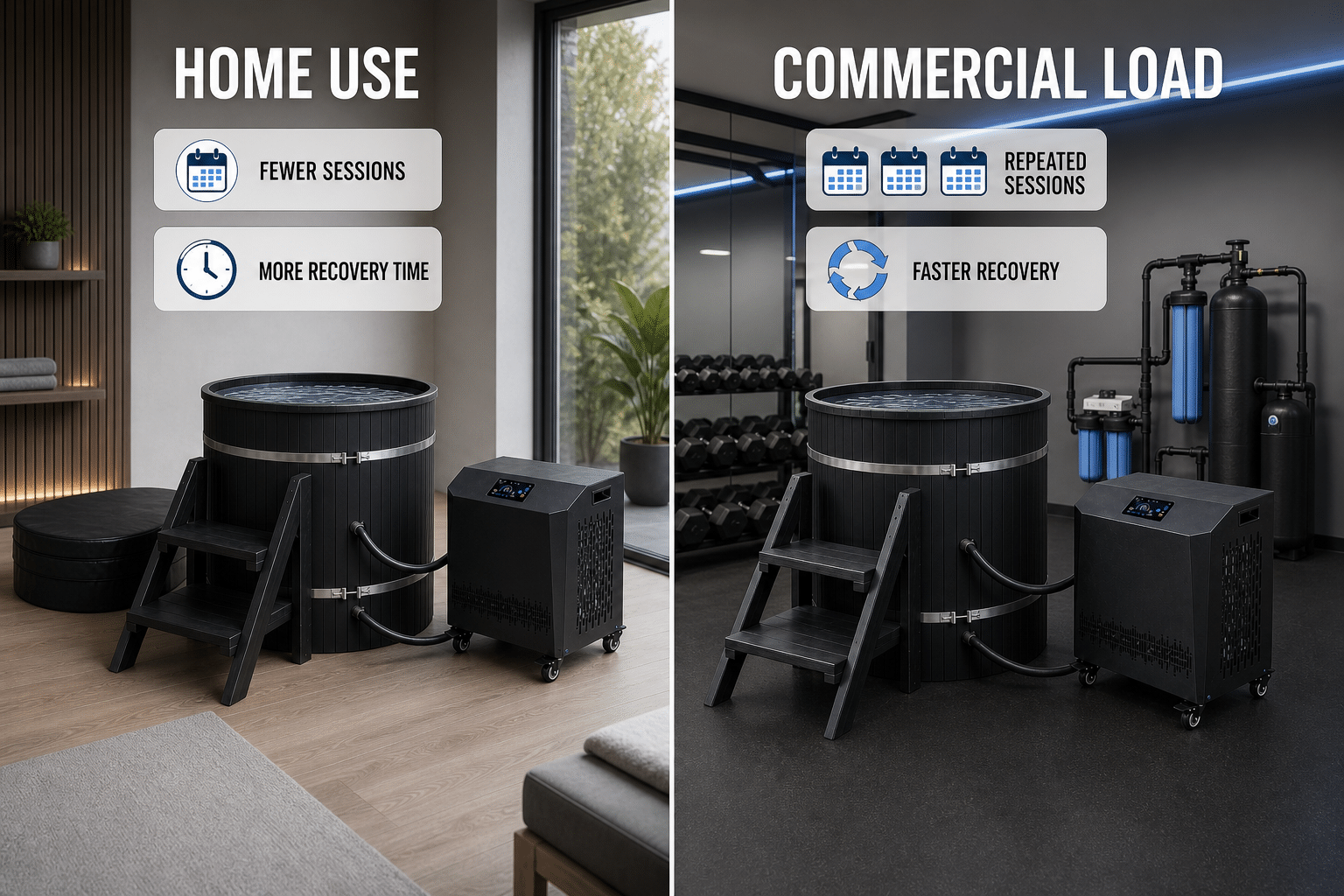
A home cold plunge may serve one or two people and have several hours to recover. A gym, hotel, spa, or recovery center may need continuous circulation, faster recovery between users, stronger filtration, and longer operating hours.
| Factor | Home setup | Commercial setup |
|---|---|---|
| User load | Plunges per day | Users per hour during peak periods |
| Recovery | May recover between widely spaced sessions | May require rapid recovery between users |
| Circulation | Model-dependent schedule | Often longer operating and filtration schedules |
| Electricity tariff | Residential price and time-of-use periods | Commercial price and possible demand charges |
| Downtime | Primarily an inconvenience | Can interrupt paid services |
Commercial buyers should define daily users, peak sessions, water volume, target recovery time, ventilation, filtration, sanitation equipment, and local tariff before selecting a system. Use the cold plunge setup guide for small businesses to prepare these requirements.
Frequently Asked Questions About Cold Plunge Electricity Use
Do cold plunge chillers run at full power 24/7?
Normally, the compressor cycles after the water reaches the set temperature. The pump and sanitation equipment may operate on different schedules, so complete-system measurements are more useful than compressor estimates alone.
How much electricity does a cold plunge use per day?
Daily use equals the electrical input of each component multiplied by its actual operating hours. Measure several normal days after initial cooldown for a more reliable result.
Are cold plunge chillers expensive to run?
They can be economical in a correctly sized, covered, and insulated setup, but there is no universal monthly cost. Equipment power, runtime, climate, water temperature, and local tariffs determine the result.
Does a 1 HP chiller continuously consume 1 HP of electricity?
No. Marketing horsepower does not provide the full electrical input or runtime. Use rated input watts and measured operating time.
Is cooling capacity the same as power consumption?
No. Cooling capacity describes heat-removal output under stated conditions. Power consumption describes electrical input.
Does a larger chiller always use more electricity?
Not necessarily over a complete cooling cycle. A larger unit may draw more power while operating but reach the target faster. Compare kWh under the same water volume, temperatures, ambient conditions, and user load.
Can I leave a cold plunge chiller running overnight?
Only if the manufacturer permits continuous or unattended operation and the installation meets the required electrical, ventilation, drainage, and weather-protection conditions.
Will an insulated cover reduce energy use?
It can reduce heat gain and compressor runtime. The actual saving depends on the full installation and should be verified with kWh measurements.
Should I turn the chiller off between sessions?
It depends on the time between sessions, ambient conditions, insulation, water-treatment schedule, and manufacturer instructions. Repeatedly warming and re-cooling the full volume is not automatically cheaper than maintenance cycling.
How do I compare electricity costs between countries?
Compare monthly kWh first, then multiply by the local electricity price in the relevant currency. This separates equipment consumption from regional tariff differences.
What Information Is Needed for an Accurate Recommendation?
Prepare the following information before requesting a chiller recommendation or operating-cost estimate:
- Country, voltage, and frequency
- Tub water volume in liters or gallons
- Starting and target water temperatures
- Typical ambient temperature and installation location
- Home or commercial application
- Number of users per day and peak users per hour
- Required pull-down or recovery time
- Local electricity price per kWh
With these inputs, a supplier can recommend a system and show the assumptions behind an estimated operating range. Product-specific monthly costs should not be published until rated input and test conditions have been verified.
To estimate cold plunge chiller electricity cost accurately, use verified input power, actual runtime and your local electricity rate.
Bottom line: calculate cold plunge electricity cost from verified input power, actual runtime, and the local electricity rate. Use horsepower and cooling capacity for system comparison, but do not treat either value as the monthly electricity bill.
To connect running cost with the equipment decision, start with the cold plunge chiller selection guide. Use the water chiller sizing guide to assess the correct capacity before estimating energy use. When you are ready to compare current system options, explore OMNI Ice cold plunge chiller products.