Installing a dedicated cold therapy system outdoors is the standard choice for most residential backyards, athletic recovery patios, and commercial wellness facilities. Between wet bathers dripping across concrete, plumbing line routing, and the simple convenience of stepping directly from an outdoor sauna into cold water, placing the equipment in open air makes operational sense. However, setting up a standalone outdoor chiller unit requires a clear understanding of environmental physics. A refrigeration machine is not an inert piece of patio furniture; it is an active mechanical heat pump that breathes ambient air and rejects massive thermal loads under shifting weather conditions.
Contractors and facility managers often run into expensive field failures because they treat outdoor placement as a simple matter of setting the machine on a patio and running an extension cord. When exposed to direct midday summer sun, a 1 HP chiller can lose up to 25% of its effective cooling capacity through solar radiation alone. When placed directly on wet dirt or poorly drained pavers, rain splash and standing puddles can foul baseplate drain ports and corrode fan motor housings. Here is the field-tested engineering guidance for weatherproofing limits, solar derating calculations, pad mounting height, and electrical safety required to keep an outdoor cold plunge chilling system running reliably through every season.
Weatherproofing Realities: IPX4 Ratings vs. Heavy Rainfall
Direct Engineering Specification: Commercial-grade outdoor chillers feature an IPX4 splash-proof rating, meaning the cabinet protects internal components against rain splashing from any angle. However, IPX4 does not protect against standing submersion, high-pressure garden hose spraying during cleaning, or rainwater running into unsealed top-mounted displays. Equipment must be raised off the ground and placed where roof runoff cannot pour directly onto the fan cowl.
When selecting an outdoor chiller unit, the first specification to inspect is the enclosure ingress protection (IP) rating. In industrial refrigeration, machines designed for exterior deployment are built with heavy-gauge galvanized steel or aluminum cabinets finished in outdoor polyester powder coating. Key internal compartments are isolated to handle exterior exposure:
- Dual-Chamber Partitioning: Quality chillers separate the electrical enclosure from the wet refrigeration and water loop compartment. The main printed circuit board (PCB), inverter drive, and run capacitors sit inside a sealed steel sub-box with closed-cell rubber compression gaskets.
- Downward-Slanted Louvers: Air intake and exhaust vents are stamped with downward-facing 45-degree louvers. This geometry allows high-velocity horizontal airflow across the aluminum condenser fins while preventing falling vertical rainwater from penetrating into the fan motor.
- Baseplate Weep Holes: Any wind-driven mist that enters the condenser compartment drains out through stamped gravity weep holes in the base pan. If these weep holes become clogged with wet leaves, soil, or mulch, water accumulates around the compressor rubber isolation mounts.

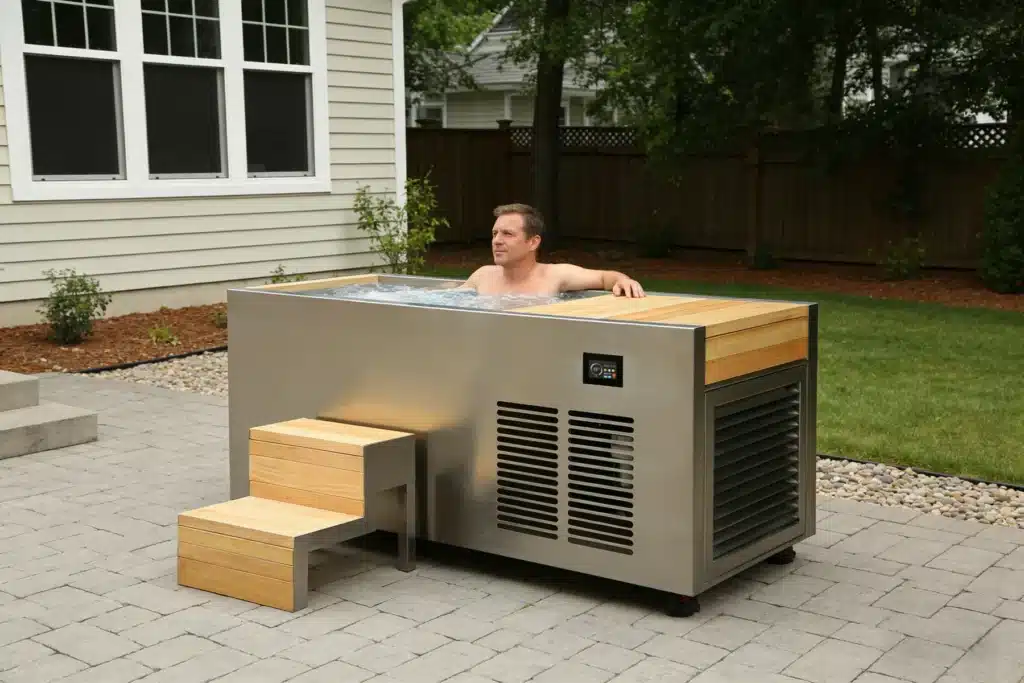
A dedicated outdoor chiller positioned on a clean paved surface with unobstructed airflow clearance next to an exterior plunge tub.
Solar Derating: Why Direct Sun Stalls Compressor Pull-Down
One of the least understood factors in outdoor chilling performance is direct solar radiation. Many buyers assume that if the ambient outdoor air temperature is 85°F, their chiller operates under standard 85°F condensing conditions. If the black or dark-gray metal cabinet sits in unshaded midday sun, this assumption is completely wrong.
Solar radiation striking a dark powder-coated steel casing can raise surface skin temperatures to 135°F–145°F. This radiant heat conducts directly into the internal chassis, preheating the ambient air before it even crosses the condenser coil fins. The impact on refrigeration thermodynamics is severe:
- Condensing Pressure Spike: Refrigerant (such as R32 or R410A) must reject heat by condensing from hot gas into liquid. High ambient air and radiant casing heat force the compressor to pump at significantly higher head pressures (often climbing from 310 PSI up to 395 PSI).
- COP and Efficiency Drop: The Coefficient of Performance (COP) of a typical 1 HP rotary compressor drops from 2.8 down to 2.1 under heavy solar load. The machine draws 200 to 350 additional watts of continuous electrical power while delivering less net cooling into the water barrel.
- Thermal Overload Risk: On scorching summer afternoons (95°F+ ambient), the combination of hot return water (from heavy bather turnover) and direct solar radiation can push the internal compressor dome temperature past the thermal protector limit (typically 220°F), tripping the internal overload switch and locking out the machine.
| Operating Condition | Ambient Air Temp | Cabinet Skin Temp | Head Pressure (R32) | Pull-Down Speed (100 Gal to 39°F) |
|---|---|---|---|---|
| Shaded Outdoor Location | 88°F (31°C) | 89°F (32°C) | 315 – 330 PSI | 3.2 hours (Optimal) |
| Direct Midday Sunlight | 88°F (31°C) | 138°F (59°C) | 385 – 410 PSI | 4.8 hours (+50% longer) |
| Overhead Cantilever Awning | 88°F (31°C) | 88°F (31°C) | 310 – 325 PSI | 3.1 hours (Fastest) |
Building a simple overhead shade canopy or positioning the machine along the north or east wall of a building provides passive thermal protection. It shields the machine from intense solar radiation while preserving complete 360-degree perimeter airflow. For engineering guidelines on heat rejection airflow physics, consult our engineering guide on cold plunge chiller heat rejection.

Heavy-duty commercial outdoor chilling machines feature robust rear exhaust grilles and reinforced stainless bulkheads for exterior plumbing runs.
Clearance Dimensions: Intake, Exhaust, and Enclosure Rules
Air-cooled chillers do not move heat through magic; they move it through cubic feet per minute of ambient air. A typical 1 HP commercial unit moves 500 to 650 CFM through its condenser coil. If you push the machine flush against an exterior stucco wall or box it inside a tight decorative cabinet, you choke the fan, spike static head pressure, and trigger immediate high-pressure alarms.
1. Intake Clearance (Minimum 12 to 16 Inches)
The condenser intake side (where the aluminum finned coil pulls fresh air into the chassis) requires at least 12 to 16 inches of unobstructed clearance from solid walls, privacy fences, or dense shrubbery. Plant branches, leaves, and blowing debris can quickly coat the coil face, reducing heat transfer surface area.
2. Exhaust Clearance (Minimum 24 to 36 Inches)
The fan discharge side expels a continuous column of hot air (often 15°F to 25°F hotter than ambient outdoor air). If this exhaust airstream hits an obstruction within two feet, the hot air deflects back toward the intake louvers, creating a destructive thermal recirculation loop. Maintain at least 24 to 36 inches of open space directly in front of or above the exhaust fan grille.
3. Service Access (Minimum 18 Inches on Plumbing Face)
Water filter canisters, UV-C sterilizer bulbs, and quick-connect hose fittings require regular maintenance. Leave at least 18 inches of clearance on the connection panel so technicians can unscrew the 20-micron filter housing with a spanner wrench without disconnecting the entire plumbing loop. For detailed space planning, review our guide on cold plunge chiller covers and running enclosures.
Mounting Pad Height & Foundation: Preventing Standing Water & Soil Ingress
Never place an outdoor chilling machine directly on raw grass, garden soil, or pea gravel. Rain splashing against soil flings dirt and silt into the lower intake louvers, clogging the condenser fins within a few months. Furthermore, during heavy cloudbursts, temporary ground puddling can submerge the base pan.
- Poured Concrete or Dense Patio Pavers: The optimal foundation is a level concrete equipment pad or high-density concrete patio pavers set on a compacted sand base.
- Anti-Vibration Condenser Riser Pads: Set the chiller cabinet on heavy-duty 2-inch to 4-inch elastomeric rubber or composite equipment risers. This raises the unit above ground splash lines, keeps baseplate weep holes open, and isolates mechanical compressor vibration from transmitting into residential deck joists.
- Plumbing Hose Pitch & UV Insulation: Exterior reinforced PVC hoses or flexible braided lines must be pitched slightly downward toward the drain to prevent airlocks. All exterior water lines must be insulated with closed-cell elastomeric foam pipe insulation protected with UV-resistant wrap to prevent ambient heat gain and sun degradation.
Electrical Safety: Outdoor GFCI and National Code Compliance
Water and electricity in an outdoor environment demand zero-compromise safety engineering. Under US National Electrical Code standards and federal Pool Safely electrical guidelines, cold therapy equipment requires strict circuit protection:
- Dedicated GFCI Branch Circuit: The chiller must plug into a dedicated 120V / 20A or 240V / 15A–20A circuit protected by a Class A Ground Fault Circuit Interrupter (GFCI) breaker that trips at 4–6 milliamps of ground fault current. Never share this circuit with patio string lights or landscape pumps.
- NEMA 3R Weatherproof In-Use Bubble Cover: Standard outdoor spring-flap outlet covers leave receptacles exposed when a heavy three-prong plug is inserted. Code requires a clear plastic “extra duty” in-use bubble box that latches completely closed around the cord while plugged in.
- Absolute Ban on Household Extension Cords: Never connect a continuous-duty refrigeration unit to a standard 16-gauge or 14-gauge household extension cord. Voltage drop across long cords starves the compressor motor of voltage, causing high operating amperage, overheating windings, and fire hazards. If power is distant, have a licensed electrician install a weatherproof outlet within 6 feet of the chiller.
Winter Freezing Boundaries: Active Circulation vs. Decommissioning
How low can outdoor temperatures drop before your chiller is in danger? While the machine is designed to chill water down to 37°F–39°F, ambient winter temperatures dropping below 32°F (0°C) present severe mechanical freezing hazards:
Water expands by approximately 9% upon freezing. If residual water freezes inside the titanium coaxial heat exchanger barrel, the internal copper or titanium tubing splits, allowing high-pressure refrigerant to blow out into the water system and destroying the refrigeration circuit. Operators have two viable paths during sub-freezing weather:
- Continuous Circulation Protocol (Mild Freeze Zones, 25°F–32°F): If your climate only experiences brief nighttime dips slightly below freezing, keep the water pump running 24/7. Moving water carries thermal inertia and resists freezing inside insulated hoses. Many commercial units include automatic freeze-protection algorithms that cycle the water pump if water temperature drops below 36°F.
- Full Drainage & Winterization (Deep Freeze Zones, Below 25°F): In northern climates experiencing extended sub-freezing periods, unpower the machine, open bottom drain ports, and blow residual water out of the titanium barrel with low-pressure compressed air (under 15 PSI). For step-by-step procedures, follow our cold plunge chiller winter storage and drainage protocol.
For facility water sanitization standards and microbiological safety guidelines, refer to official CDC Healthy Swimming operating practices.
Plumbing Line Insulation & Pipe Sizing for Exterior Runs
When an outdoor chiller sits more than five feet away from the plunge vessel, the connecting water lines become a major source of parasitic heat gain during summer and freeze vulnerability during winter. Running bare, uninsulated clear vinyl tubing across an open sunlit patio can warm circulating water by 1.5°F to 2.5°F before it even re-enters the tub, forcing the compressor to cycle continuously under high ambient load.
To maintain peak hydraulic efficiency on exterior equipment runs, contractors follow three piping rules:
- Closed-Cell Elastomeric Rubber Insulation: Wrap all exterior water lines in minimum 1/2-inch to 3/4-inch wall thickness closed-cell rubber pipe insulation. Unlike porous fiberglass, elastomeric rubber will not absorb rainwater or lose thermal resistance when wet.
- Heavy-Duty UV Protection Jacket: Sunlight breaks down standard foam insulation within eighteen months, turning it brittle and powdery. Protect exterior insulated pipe runs using UV-resistant PVC cladding or heavy-duty outdoor aluminum jacketing.
- Generous 1-Inch Internal Diameter (ID) Hose: Keep friction head loss minimal by sizing plumbing runs with 1-inch ID reinforced spiral-wire PVC hose rather than restrictive 3/4-inch garden hose fittings. This ensures the internal circulation pump maintains at least 15 to 20 GPM across the heat exchanger at all times.
Commercial Outdoor Chiller Systems from OMNI Ice
At OMNI Ice, our commercial cold plunge chillers are engineered specifically for exterior demanding duty cycles. Featuring marine-grade powder-coated aluminum cabinets, oversized titanium coaxial heat exchangers, integrated 20-micron filtration, and corona discharge ozone injection, our machines provide turnkey exterior recovery solutions:
Featured Commercial Outdoor Chiller Models
- ProValue CH-08 0.8HP Ice Bath Chiller: Compact exterior-rated cooling unit engineered for residential patios and boutique recovery suites, featuring quiet rotary compression and IPX4 weatherproofing.
- OMNI 1.0HP & 1.5HP Deep Freeze Chiller Lineup: High-capacity commercial recovery machinery designed for commercial sports clubs, wellness spas, and high-turnover bather volumes with dual cooling/heating capability.
To review full facility mechanical drawings, container wholesale pricing, or custom OEM skid integration, explore our OEM cold plunge equipment solutions or submit your project scope through our direct commercial RFQ desk.
Field Installation Checklist for Outdoor Chillers
Before commissioning your exterior cold plunge chiller installation, verify these critical points:
- Foundation Raised: Unit rests on a solid, level pad with 2-inch to 4-inch rubber anti-vibration risers to keep base weep holes raised above ground splash lines.
- Intake & Exhaust Clearances Verified: At least 12 inches on coil intake and 24 inches on fan discharge to prevent thermal air recirculation.
- Overhead Solar Protection: Shaded from harsh midday sun via natural building shadow, pergola, or cantilevered awning to prevent capacity derating.
- Dedicated Weatherproof Power: Plugged into a dedicated GFCI outlet equipped with an extra-duty in-use weatherproof cover (no extension cords).
- Plumbing UV Insulated: Exterior water hoses wrapped in UV-resistant insulation to prevent ambient thermal gain and hose embrittlement.
When installed with proper clearances, solar shading, and dedicated electrical protection, an outdoor chilling system operates at peak thermodynamic efficiency, keeping your plunge tub crystal clear and ice-cold through thousands of recovery sessions.