Cold plunge chiller heat rejection is the heat an operating chiller releases to its surroundings, not the electrical wattage printed on its label. Before approving an indoor position or decorative enclosure, get two things on the same drawing: the heat-discharge data for the specified operating condition and a credible path for removing that heat. A grille drawn beside a machine is not that answer.
This article helps facility designers, installers and OEM buyers prepare that thermal handoff. It separates equipment discharge from whole-room cooling load, then identifies seven inputs to request before the cabinet or room design is accepted. It covers air-cooled equipment in cooling mode; it is not a room air-conditioning sizing service or a substitute for the exact unit’s installation instructions.
To decide whether the condenser should reject heat to air or to a separate condenser-water system, use the air-cooled versus water-cooled site comparison. It separates the bath-water loop from the final heat-rejection route and supporting utilities.
Start a cold plunge chiller heat rejection calculation at the cabinet
Draw a boundary around the complete chiller package. Mark its water inlet, water outlet, electrical supply and air exchange with the surrounding space. If the circulation pump is outside that boundary, show it separately. This simple sketch prevents a common spreadsheet mistake: using a compressor-only power number with a cooling figure measured across the entire water circuit.
For a steady operating condition, with negligible energy accumulation inside the package and no other significant energy paths, the balance is:
Heat released by the package ≈ net heat removed from water across the package + electrical input to that same package.
Use kW for all three rates. The conservation principle is explained in OpenStax’s treatment of refrigerators and heat pumps: heat delivered to the warmer surroundings includes the energy moved from the colder side and the work supplied. The equipment boundary, operating data and example below are the application of that principle to a buyer’s handoff, not a published test of an OMNI model.
Illustrative arithmetic only: if net water cooling across a complete package is 2.4 kW while that same package draws 0.8 kW, its local heat release is approximately 3.2 kW at that operating point. The values are invented to show the calculation. They are not a product specification, a maximum operating case or a recommendation to install a 3.2 kW room air conditioner.
Keep gross evaporator capacity and net package cooling separate. For example, an internal pump can put some energy into the water before it leaves the package. A net measurement across the package already reflects that effect. Adding a pump allowance again without checking the measurement boundary can count it twice. Conversely, a separate pump outside the package is not automatically included in its electrical input. Ask where its heat goes and account for it once.
Ask for cooling and input figures at the same water temperature, entering-air temperature and operating mode. Two attractive numbers from unrelated catalogue conditions do not form a valid pair. If the supplier offers several test points, preserve each row rather than combining the highest cooling capacity with the lowest input. The efficiency test-input guide explains how to keep performance comparisons on matching conditions.
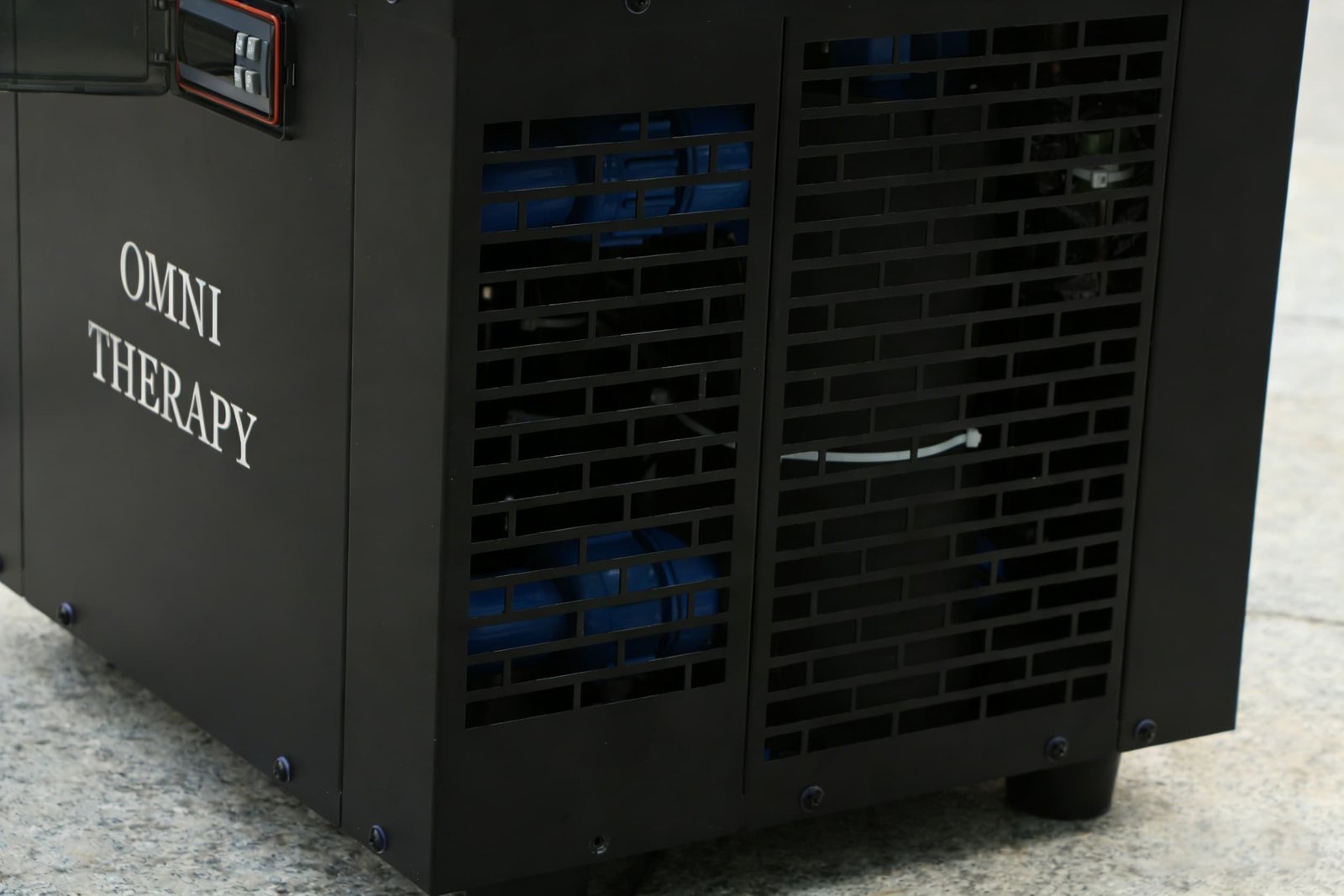
Why 3.2 kW of discharge is not automatically 3.2 kW of room load
The cabinet boundary answers what the machine releases locally. A second boundary around the whole room answers a different question. When both the cold tub and the chiller are in that room, some heat removed from the water may originally have come from the room itself. Returning that heat through the chiller redistributes it; it is not necessarily an additional load entering the room from outside.
During initial pull-down, the water also gives up stored thermal energy. During occupied operation, people, replacement water, exposed surfaces and other equipment can contribute differently. Treating every item as an independent addition to the full condenser discharge can double-count energy. Ignoring the warm discharge because the tub is cold makes the opposite mistake: local intake conditions and occupant comfort still matter.
| Arrangement to draw | What the local discharge tells you | What still needs a room-level decision |
|---|---|---|
| Tub and air-cooled chiller in one room | Where the package sends warm air, including heat transferred out of the water | Which heat flows are internal transfers, which cross the room boundary, and how conditions change during pull-down and use |
| Chiller in a separate equipment room | The equipment room receives discharge from water circulating elsewhere | The equipment-room heat-removal route, adjoining-space effects and acceptable intake conditions |
| Chiller outdoors or in an approved external position | The discharge can be outside the occupied room | Whether the actual enclosure recirculates air, and whether weather, sound and service access are acceptable |
Ask the building-services designer to mark the room boundary on the same drawing as the equipment boundary. Label water entering from another space, water returning to it, electrical supplies and the intended air route. That makes the discussion specific: “Does this heat cross into our room, or are we moving it around inside?” is more useful than arguing over a single wattage.
This distinction does not give permission to subtract cooling capacity from a room-load calculation casually. The room designer must reconcile the actual operating periods and other loads, including moisture where relevant. Use the indoor cold plunge installation guide for the broader room brief, including drainage, access and electrical coordination. Keep the cold plunge chiller heat rejection schedule as one clearly defined input to that brief.
Seven inputs to request before approving the layout
A useful submittal should let the next person reproduce the design decision. “Ventilation provided” is too vague: it does not identify the unit, the condition or the route. Use the following request table as a missing-information register. A blank cell means data is still needed, not that the value can safely be assumed to be zero.
| Input | What to request | Why it changes the decision |
|---|---|---|
| 1. Exact equipment and mode | Model, electrical variant, revision, cooling-only or reversible operation, and the installation document used | A similar cabinet or horsepower label does not identify the selected configuration |
| 2. Defined package boundary | A sketch showing which compressor, fan, pump and auxiliaries the cooling and electrical figures include | Prevents omissions and double-counting between package data and external equipment |
| 3. Matched thermal and electrical data | Net water-cooling rate and complete-package input at each relevant operating point, or a supplier-declared heat-rejection value with its basis | Produces a condition-specific discharge figure instead of an unsupported estimate |
| 4. Entering conditions and duty | Water temperatures, entering-air temperature, expected pull-down and holding periods, and any declared operating limits | Shows which intended conditions the supplied data actually represents |
| 5. Airflow and installation constraints | Identified intake and discharge faces, required clearances, service envelope and any permitted duct or enclosure arrangement | Lets the drawing be checked against the exact equipment instructions |
| 6. Destination of discharged heat | Room or outdoor destination, proposed air path, and the designer responsible for assessing the complete space | A fan moving air within a closed space does not identify how heat leaves that space |
| 7. Acceptance evidence | Agreed operating cases, measurement locations, instruments, limits and the record required before acceptance | Defines what must be demonstrated in the finished arrangement |
Some suppliers may not have a separately published heat-rejection schedule. That is a data gap to resolve, not evidence that the machine produces little heat. Request the matched cooling and input data, its test basis and any limitations on using it for the proposed layout. Mark a calculation from those data as an estimate; mark a supplier measurement as measured only when the supporting record is actually supplied.
If the water-side figure is based on field measurements, its flow and temperature readings need a defensible boundary too. The chiller flow-rate measurement record helps identify where the water reading was taken. A total circulation-pump number may not describe the flow through the chiller when a bypass is present.
Ask for cooling-mode and heating-mode information separately on reversible equipment. The air-side role and operating conditions should not be carried from one mode to the other without confirmation. The water chiller and heater selection guide covers that product distinction. This worksheet does not establish suitability for a mode outside its stated scope.
Put arrows on the drawing before choosing a grille
Start at the proposed intake. Where does its air come from when the door is closed and the room is occupied? Follow the discharge to its destination, then ask whether that warm air can return directly to the intake. Draw partitions, screening, nearby walls and the removable service panel. An attractive elevation drawing can conceal an unresolved air path behind it.
Separate three questions in the design review:
- Equipment clearance: does the selected arrangement satisfy the exact manufacturer’s installation and service requirements?
- Local recirculation: can discharged air short-circuit back into the intake through or around the enclosure?
- Space heat removal: how is the discharged heat handled by the room or external installation under the intended duty?
Passing one question does not answer the others. A cabinet can be accessible for servicing yet have a poor air path. A large room can still place the intake in a warm pocket. An open doorway during a demonstration may hide the condition created by a closed door in normal use.
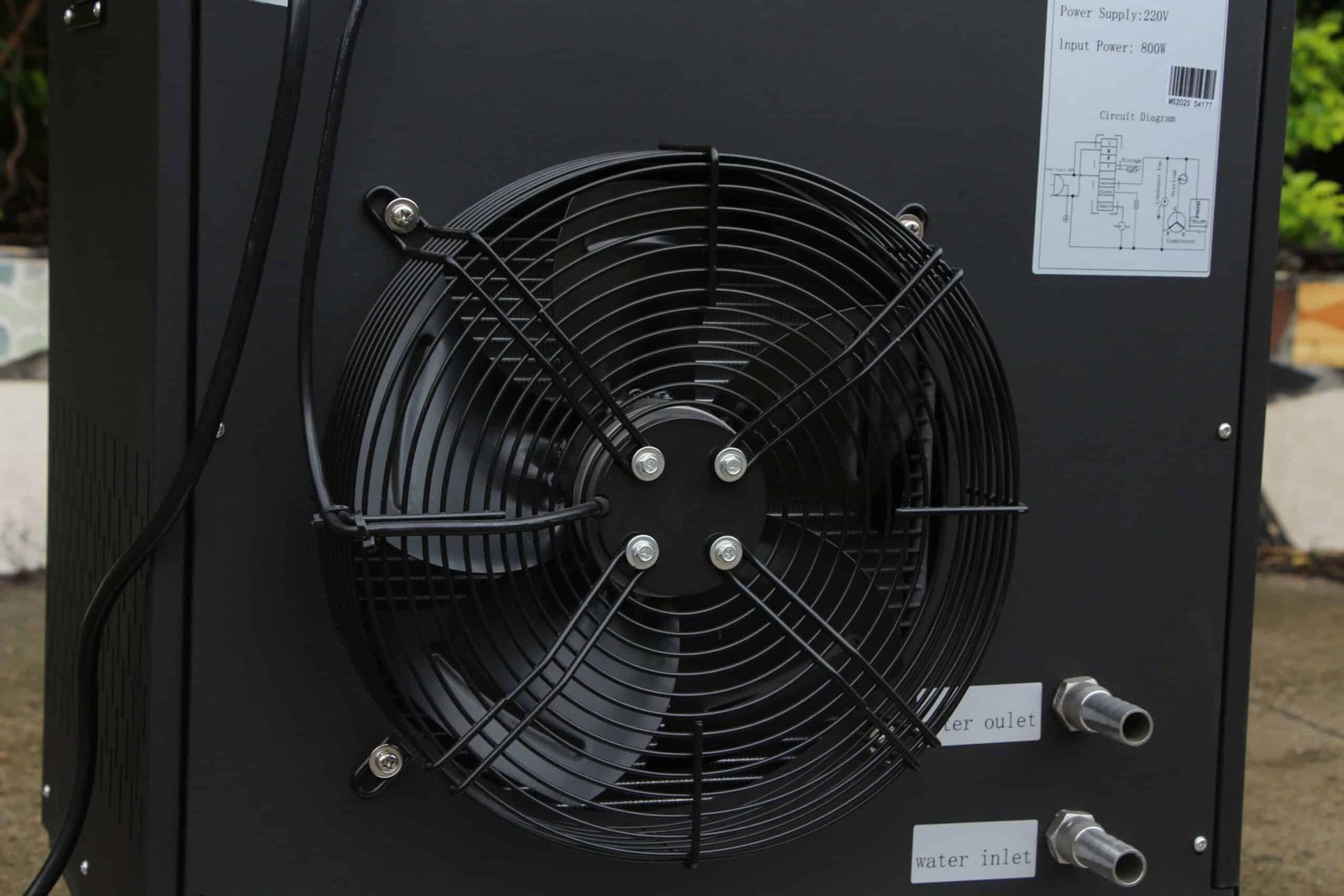
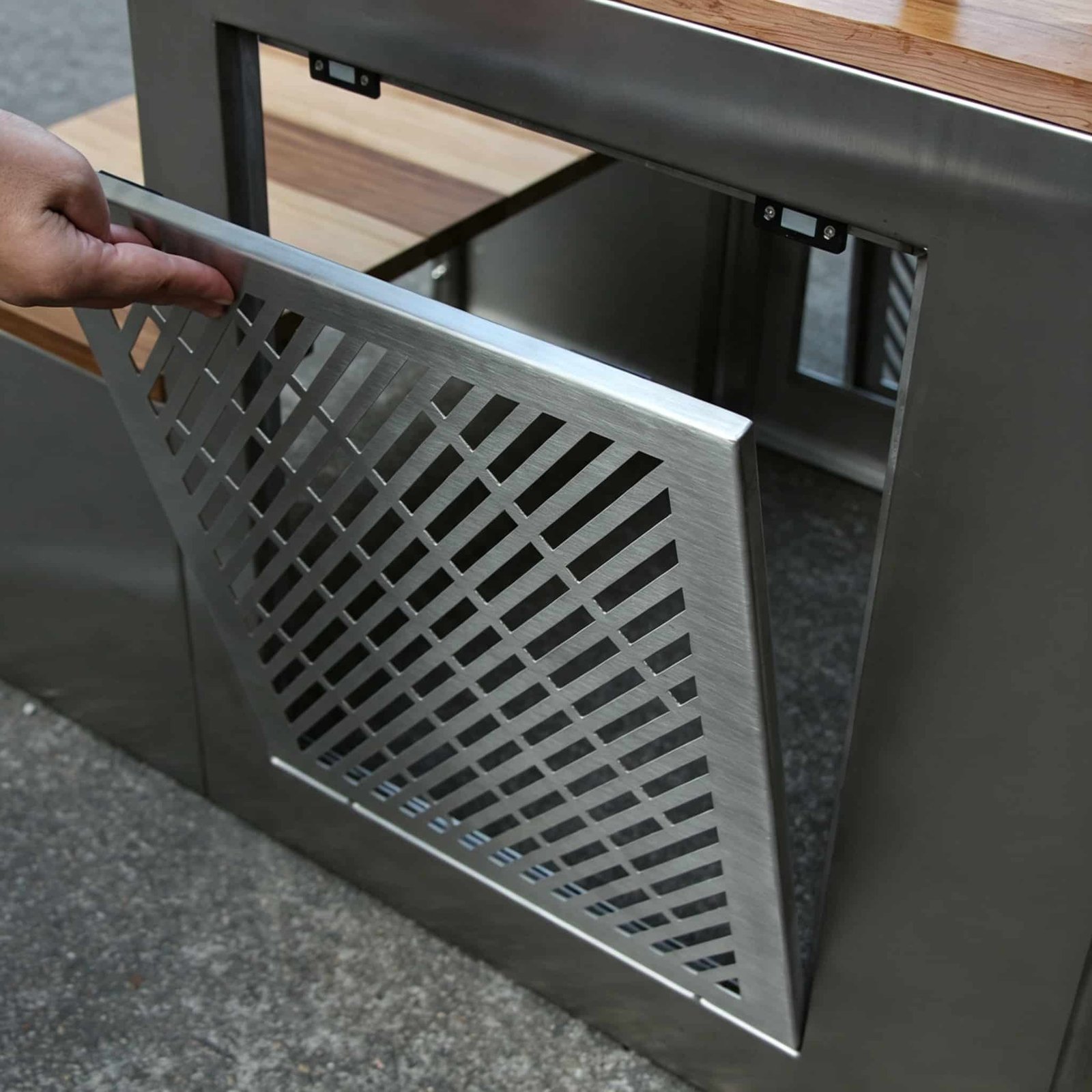
Do not select an extraction fan, duct size or grille free area from a universal cold-plunge rule. Those decisions depend on the intended path and the equipment’s permitted operating conditions. In particular, adding a hose to an existing fan is not automatically an approved exhaust solution. Request explicit manufacturer confirmation of any duct connection and its restrictions before the designer relies on it.
For outdoor screening, review the proposed layout against the outdoor equipment site checks. Moving the machine outside changes the heat destination; it does not remove the need to evaluate nearby walls, screening and service access. For tub and hose insulation, use the separate insulation and heat-gain guide. Insulating the water circuit and wrapping an air-cooled equipment cabinet are not equivalent actions.
Check the finished arrangement, not an open-door demonstration
Agree on the intended acceptance cases before installation is signed off. The aim is to find whether the proposed arrangement keeps the equipment within its documented conditions and satisfies the room design brief. Do not use this article to set a universal temperature-rise limit or to override a manufacturer’s protective control.
Record the cases that matter for the project: initial water pull-down, temperature holding and the expected occupied operating period. Include normal door and panel positions. If more than one unit can run together, state whether the test represents simultaneous operation. A single machine running briefly cannot establish the final combined condition.
The observation record should identify entering-air measurement locations rather than simply saying “room temperature.” Note the water condition, machine operating state, time stamps and any alarms. Keep the instrument identity and measurement method with the result; the test-instrument calibration guide explains how to check whether an instrument record supports the measurement being claimed.
| Finding | Decision to record |
|---|---|
| Required equipment data, layout and acceptance evidence are available and meet the agreed criteria | Accept the specifically documented arrangement and operating scope; retain the drawings and records |
| A cooling demonstration works, but heat data or the room-level assessment is missing | Keep thermal-design acceptance open; identify the missing evidence and responsible party |
| The unit operates outside documented conditions, alarms, or depends on an unapproved open panel | Do not accept the proposed operating arrangement; follow the equipment instructions and obtain a qualified review |
Retain a before-and-after drawing if an enclosure is changed after the test. Replacing a screen, adding another machine or changing room ventilation can alter the basis of the original decision. The useful record is not a photograph captioned “working”; it is a defined configuration with observed conditions, agreed criteria and any unresolved items.
A thermal handoff you can copy into the RFQ
Send the drawing and this record together. They should make it possible for the equipment supplier to answer the machine questions and for the building-services designer to answer the room questions without silently assuming the other party has completed them.
- Project and location: room or outdoor position; drawing number; proposed enclosure and panel arrangement.
- Equipment: model; electrical variant; revision; operating mode; included and external auxiliaries.
- Operating cases: intended water temperatures; entering-air conditions; pull-down, holding and occupied duty; simultaneous units.
- Discharge basis: supplier-declared heat rejection or matched net water-cooling and complete-package electrical input; units; measurement or calculation basis; source document.
- Air route: marked intake and discharge faces; heat destination; model-specific clearance and enclosure restrictions.
- Room assessment: responsible designer; equipment-versus-room boundary; unresolved thermal or moisture questions.
- Acceptance: measurement locations; instruments; agreed limits; observation period; records required; unresolved items and responsible people.
Use the OEM chiller RFQ template for the wider commercial and technical request. For an OMNI project, send your equipment layout and operating brief to OMNI and request the applicable model information. Identify missing values openly. A cold plunge chiller heat rejection request is ready for a useful response when it names the machine, the conditions and the proposed destination of the heat—not merely the desired water setpoint.
Questions buyers ask about discharged heat
Is electrical input the same as heat rejected by the chiller?
No. For a steady air-cooled package in cooling mode, local heat release includes the net heat removed from water and the electrical input to the same package, provided other energy paths and internal storage are negligible. Use matching operating conditions and a consistent boundary.
Can I size the room air conditioner from that discharge figure?
Not by itself. Local equipment discharge and the whole-room load are different accounting boundaries. When the tub and chiller share a room, some heat is transferred internally. A building-services designer must assess the complete space, operating periods and other loads without double-counting.
Does a vented cabinet prove that ventilation is sufficient?
No. The layout must satisfy the exact equipment instructions and address intake air, discharge recirculation and removal of heat from the surrounding space. A grille or removable service panel alone does not demonstrate those conditions.
Can I duct a chiller fan directly outdoors?
Only if the manufacturer permits the proposed connection and specifies its conditions. Do not assume an existing fan can serve an added duct. Obtain model-specific approval and have the complete air path assessed before relying on it in the design.
What should a cold plunge chiller heat rejection request include?
Include the exact model and mode, package boundary, matched cooling and electrical data, operating conditions, installation constraints, heat destination and acceptance evidence. Attach a layout showing intake, discharge, enclosure panels and the room boundary.