Cold plunge chiller flow rate should be accepted against the permitted range for the exact chiller and connected water loop, using a measurement taken at the correct point. A pump’s maximum-flow label, a strong-looking return jet or an unlabeled number on a controller does not establish how much water passes through the chiller. Before signing off an installation, identify the required range, measurement location, units, operating state and evidence behind the reading.
This is a field-record method for installers, equipment integrators and OEM buyers. It answers a specific handover question: can another person reproduce and interpret the reported flow? It does not select a replacement pump, prescribe one flow value for every cold plunge, or authorize changes to an electrical or pressurized water system. Use the selected equipment’s instructions and a qualified installer for the measurement arrangement.
On this page
Find the required cold plunge chiller flow rate first
Start with the chiller model, electrical variant where relevant, connected pump, filter and approved water-loop arrangement. Request the manufacturer’s permitted water-flow range and the conditions attached to it. Distinguish a minimum needed for operation, a recommended operating range and a maximum allowed by the equipment. Those are not interchangeable numbers.
Put the source beside the requirement: manual revision and page, an approved specification or a dated response for the named configuration. If the range has not been supplied, write “requirement not confirmed.” A measured value cannot establish compliance with a limit nobody has defined. Do not borrow a figure from a visually similar machine or from a pump offered with another product.
Also separate the chiller’s needs from the rest of the installation. The pump, filter, fittings and tub connections must work within their own applicable limits. A chiller-compatible reading does not automatically establish that a different filter or hose is suitable. The filter-system planning guide covers the complete loop; this article concentrates on the flow measurement used to judge it.
A large pump number is a starting point for checking a specification, not an installed test result. Ask what that number means and at what conditions it applies. Actual delivery depends on the pump and the connected system together. If the unit has no circulation or repeatedly loses prime, stop the measurement exercise and use the no-flow troubleshooting sequence within the model’s service limits.
Before field measurement, use the cold plunge chiller pump-head duty-point method to combine the required flow, chiller and filter pressure drop, hose route, fittings and pump curve into clean and service-condition system curves.
Make six details travel with every reading
A useful cold plunge chiller flow rate record can be short. Its value comes from keeping the number attached to the setup that produced it. The six checks below give purchasing, installation and service teams the same basis for deciding whether a reading is usable.
| Field check | Record this | What becomes unclear without it |
|---|---|---|
| 1. Requirement | Exact model, permitted range, units and the source document or written confirmation. | Whether the measured result is inside an applicable range. |
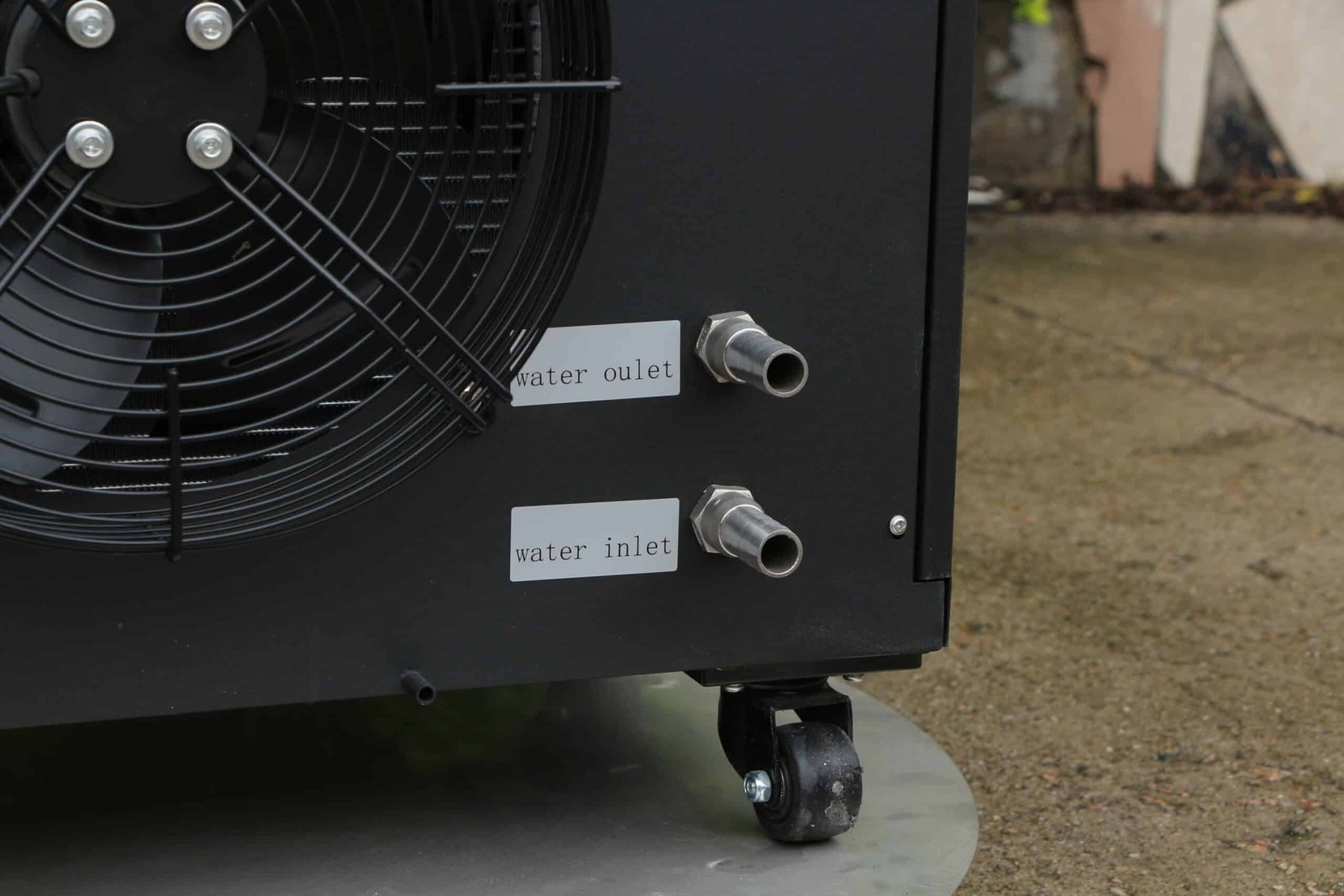
| 2. Measurement point | A marked location on the as-installed loop, flow direction and all branches or bypasses. | Whether the number describes chiller flow, total pump flow or another branch. |
| 3. Units and quantity | L/min, L/h, m³/h, US gal/min or another explicit unit; instantaneous, averaged or totalized value. | Whether two apparently similar numbers can be compared. |
| 4. Instrument and method | Meter ID, relevant range, installation requirements, settings, status and reading procedure. | Whether the device and its installation can support this result. |
| 5. Operating state | Pump setting, valve positions, filter identity and condition, fill level, water temperature and relevant mode. | Whether a later change is a measurement difference or a different system state. |
| 6. Result and decision | Raw readings and timestamps, variation, acceptance basis, unresolved items and the person accepting the record. | Whether the loop passed, needs review or must remain out of operation. |
Photograph the measurement point and the display, then connect those photographs to the same record identifier. Avoid collecting close-ups that cannot be located on the system. One wide view with a marked point and one readable instrument view can be more useful than several unconnected screenshots.
Locate the flow you are trying to approve
Follow the water route from the tub through the installed equipment and back to the return. Mark the chiller path separately from any bypass, treatment branch, drain or parallel connection. A reading upstream of a split may include water that never enters the chiller. A reading in the chiller branch answers a different question from total pump delivery.
A branch example: 24 is not automatically 24 through the chiller
Illustrative calculation, not an OMNI measurement or recommended setting: suppose a steady water stream splits into only two paths, with no leakage or accumulation at the junction. Total flow is 24 L/min and the bypass carries 8 L/min. The flow balance gives 24 − 8 = 16 L/min through the chiller branch. The total-flow number cannot be reported as the chiller’s flow.
That arithmetic assumes the readings describe the same steady condition and compatible measurement boundaries. In real work, instrument uncertainty, changing valve positions or readings taken at different times can make subtraction misleading. A suitable direct measurement in the relevant branch is preferable to an unsupported estimate. Have the installer choose the arrangement and document any calculated result as calculated.
Changing the test connection can change the result
Removing a hose or filter to collect water may alter the resistance and route you meant to measure. The result then describes the altered setup, unless a qualified procedure demonstrates otherwise. Do not disconnect energized or pressurized equipment to perform an improvised bucket test. Keep electrical parts dry, isolate equipment before permitted water-loop work, and follow the model’s shutdown, pressure-relief and restart instructions.
For the same reason, a demonstration on short factory hoses does not automatically establish the cold plunge chiller flow rate at a site with different fittings, hose lengths or branches. Keep both records, but label the configurations instead of treating them as interchangeable. The site commissioning checklist places this field record within the wider installation handover.
Resolve GPM, GPH and L/min before comparing quotes
Write the time basis and gallon definition in full. “GPM” should state US or Imperial gallons per minute; “GPH” is per hour. The NIST unit-conversion table distinguishes US and Imperial gallons. The rounded factors below are suitable for illustrating the differences; retain the original reading and use appropriate precision for the actual decision.
| Conversion | Operation | Illustrative result, not a target flow |
|---|---|---|
| US gal/min to L/min | Multiply by approximately 3.785412. | 5 US gal/min ≈ 18.93 L/min. |
| Imperial gal/min to L/min | Multiply by 4.54609. | 5 Imperial gal/min ≈ 22.73 L/min. |
| US gal/h to L/min | Multiply by approximately 3.785412, then divide by 60. | 300 US gal/h ≈ 18.93 L/min. |
| L/h to L/min | Divide by 60. | 1,200 L/h = 20 L/min. |
| m³/h to L/min | Multiply by 1,000, then divide by 60. | 1.2 m³/h = 20 L/min. |
A totalizer presents a further distinction. A display of 300 liters may be accumulated volume, not 300 liters per minute. Calculating an average from a change in totalized volume requires the elapsed time and the correct start and finish values. Preserve those inputs rather than entering the calculated value as if it were a direct instantaneous reading.
For a simple arithmetic illustration, 60 liters counted over three minutes represents an average of 20 L/min over that interval. It does not show whether the flow was steady throughout. Short interruptions or changes can disappear inside an average, so retain time-series observations when stable operation matters to the acceptance decision.
Check what the meter can actually establish
Choose a device and method suitable for the fluid, pipe, expected range and decision. Ask the responsible installer to verify the exact meter’s requirements, including pipe fill, orientation, pipe-size settings, fluid settings and any required straight lengths. Requirements differ across measurement technologies and models; a generic installation distance copied from another meter is not a substitute for its instructions.
Confirm whether an installed display reports measured flow, an estimate, a control command or just a flow-switch state. A switch can indicate that its switching condition has been met without providing a calibrated numerical flow value. Describe that evidence honestly. Do not turn “flow detected” into a number the equipment did not measure.
NIST’s description of its liquid-flow standard illustrates the distinction between a flow indication and a reference measurement: the standard determines water flow from the changing mass collected on a scale. That laboratory method is not a field installation instruction. It shows why a credible result needs a defined measured quantity and method rather than a pump label.
For the calibration and instrument-identity questions, use the test-instrument evidence guide. Here, retain the meter ID, relevant status and method reference beside the cold plunge chiller flow rate. Do not claim that a certificate validates an unsuitable installation or that extra decimal places make an uncertain reading reliable.
Agree how to handle a reading near an acceptance limit. The instrument’s applicable accuracy or uncertainty, the variability of the system and the agreed decision rule may matter. Mark the result for review when those inputs are missing. Rounding a borderline number until it appears inside the range is not a sound acceptance method.
Keep the setup fixed when comparing flow
Suppose the initial commissioning record used a clean cartridge and one pump setting. A later reading taken with a different cartridge, another valve position or a different pump speed is not directly comparable. Record what changed before deciding that the pump has deteriorated or the original result was wrong.
For repeat readings, retain the measurement point, instrument and method where practical. Note the actual pump setting, filter identity and condition, valve positions, tub fill level, water temperature and operating mode. Allow the setup to reach the condition specified by the method, then record the observation interval. Do not invent a universal stabilization time for every system.
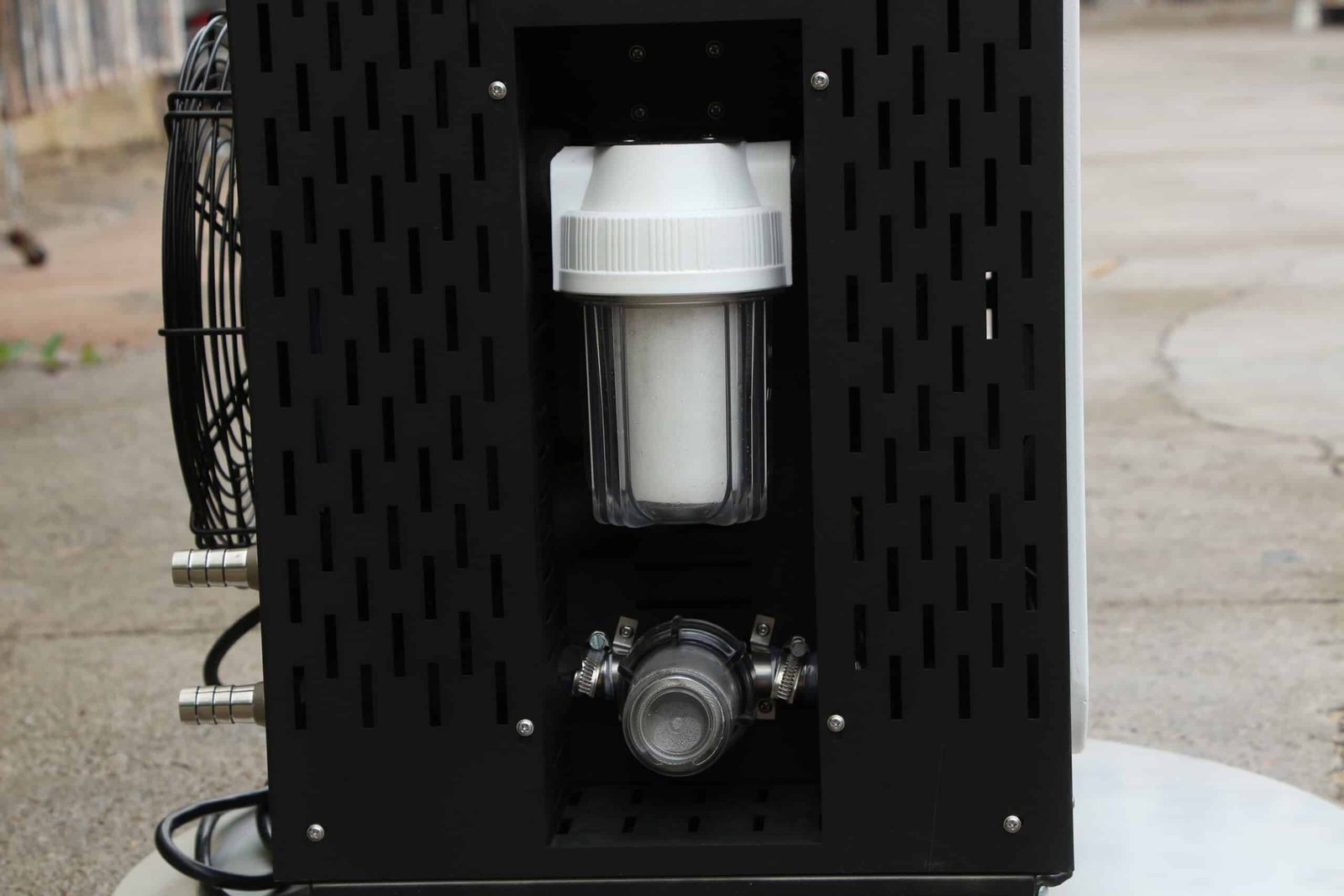
The filter inspection guide helps assess restrictions and the condition of the filter. A change in measured flow may justify investigating that condition, but it does not by itself identify the failed component. If operation is unstable, preserve the observations and follow the pump troubleshooting guide rather than bypassing a protective device to obtain a more favorable number.
During performance comparisons, keep water flow tied to the same run as temperature and electrical observations. Otherwise the buyer may compare cooling results produced under different water-side conditions. The efficiency test-input guide covers that broader comparison. Flow measurement is one input, not a standalone cooling-capacity or efficiency test.

Decide what the recorded flow allows you to conclude
A cold plunge chiller flow rate inside the confirmed range supports only that flow-related decision under the recorded conditions. It does not independently establish electrical safety, leak integrity, water hygiene, cooling performance or readiness for unrestricted commercial use. Those need their own applicable evidence.
| Finding | Appropriate disposition | Next evidence needed |
|---|---|---|
| Required range, measurement and setup are identified; the result satisfies the agreed rule. | Accept the flow item for the recorded configuration and conditions. | Keep the record with the wider commissioning package. |
| A reading exists, but the model’s required range is unknown. | Hold the flow acceptance decision. | Obtain a configuration-specific requirement and its source. |
| The meter measures total flow before a bypass split. | Do not label the reading as chiller-branch flow. | Establish a suitable branch measurement or a justified calculation. |
| Units, meter settings or installation conditions are unclear. | Treat the numerical result as unverified. | Resolve the ambiguity and repeat the reading as needed. |
| Flow is outside the allowed range, unstable, or associated with a protection event. | Follow the model’s safe stop and troubleshooting instructions; do not force continued operation. | Identify the cause and obtain an acceptable repeat result before release. |
Do not convert a nominal circulation calculation into a water-quality promise. Dividing tub volume by a flow value gives a simple theoretical circulation time for the stated boundary. It does not prove complete mixing, filtration of every part of the water, disinfection effectiveness or a safe operating schedule. Keep those claims outside the flow sign-off.
Copy this cold plunge chiller flow rate record
Use one record per configuration and measurement condition. Attach a marked loop photograph or drawing and retain the raw observations. Blank fields remain open items; filling them with data from another model weakens the record.
PROJECT / SITE / DATE / RECORD ID:
CHILLER MODEL / VARIANT / UNIT ID:
PUMP / FILTER / CONNECTED COMPONENT REFERENCES:
REQUIRED FLOW RANGE / UNITS / DOCUMENT SOURCE:
MEASUREMENT POINT / DIRECTION / LOOP PHOTO REFERENCE:
BRANCHES OR BYPASSES / VALVE POSITIONS:
METER ID / METHOD / RANGE / STATUS / SETTINGS:
INSTALLATION REQUIREMENTS CHECKED:
PUMP SETTING / FILTER CONDITION / FILL LEVEL / WATER TEMPERATURE:
READING TYPE: INSTANTANEOUS / AVERAGE / TOTALIZER-BASED
RAW VALUES / UNITS / TIMESTAMPS / OBSERVATION INTERVAL:
CALCULATION AND ORIGINAL INPUTS, IF USED:
VARIATION / UNCERTAINTY / ACCEPTANCE RULE:
RESULT: ACCEPT FLOW ITEM / HOLD / INVESTIGATE
LIMITATIONS / CORRECTIVE ACTION / REPEAT-TEST REFERENCE:
RECORDED BY / REVIEWED BY / ACCEPTED BY:
Store the accepted version with the as-installed drawing. When the pump, filter type, hose route, valve arrangement or chiller changes, determine whether a new baseline is needed. Keeping the old record remains useful: it identifies what was previously accepted and gives the next reviewer a meaningful comparison.
Send a reviewable water-loop requirement to OMNI Ice
For a new project, send the tub volume, intended water temperatures, chiller configuration, pump and filter references, hose dimensions and route, branches, electrical supply and destination. Include any existing measured flow with its units and measurement point. If the number comes from a catalogue rather than a test, label it as a catalogue value.
Add these inputs to the OEM RFQ template and ask OMNI Ice to review the proposed loop. Request the applicable flow requirements and installation information for the actual model before final acceptance. A useful reply should connect the proposed equipment to the system you intend to install, not simply repeat its pump’s headline rating.
Cold plunge chiller flow rate questions
What flow rate does a cold plunge chiller need?
Use the permitted range for the exact chiller and connected system. There is no responsible universal value for every model. Obtain the requirement and its source, then compare a suitable measurement at the relevant point under documented operating conditions.
Is the pump’s maximum flow the flow through my chiller?
Not necessarily. A pump rating is tied to its stated conditions, while installed flow depends on the connected system. A bypass or parallel branch can also separate total pump delivery from flow through the chiller. Identify the measurement boundary before comparing numbers.
Are GPM and GPH interchangeable?
No. GPM is gallons per minute and GPH is gallons per hour; also specify US or Imperial gallons. For the same gallon definition, divide GPH by 60 to obtain GPM. Preserve the original units and readings when converting a result.
Can a strong return jet replace a flow-meter reading?
A visible jet can show water movement, but it does not establish an unknown numerical flow rate. If the approved procedure requires measured flow, use an appropriate instrument and method. If it permits a qualitative indicator, record that indicator without inventing a numerical value.
Does acceptable flow prove the cold plunge is ready for use?
No. It supports the flow-related acceptance item for the documented configuration and conditions. Electrical safety, leak checks, controls, cooling performance, water-care requirements and the wider commissioning handover still need their own applicable evidence.