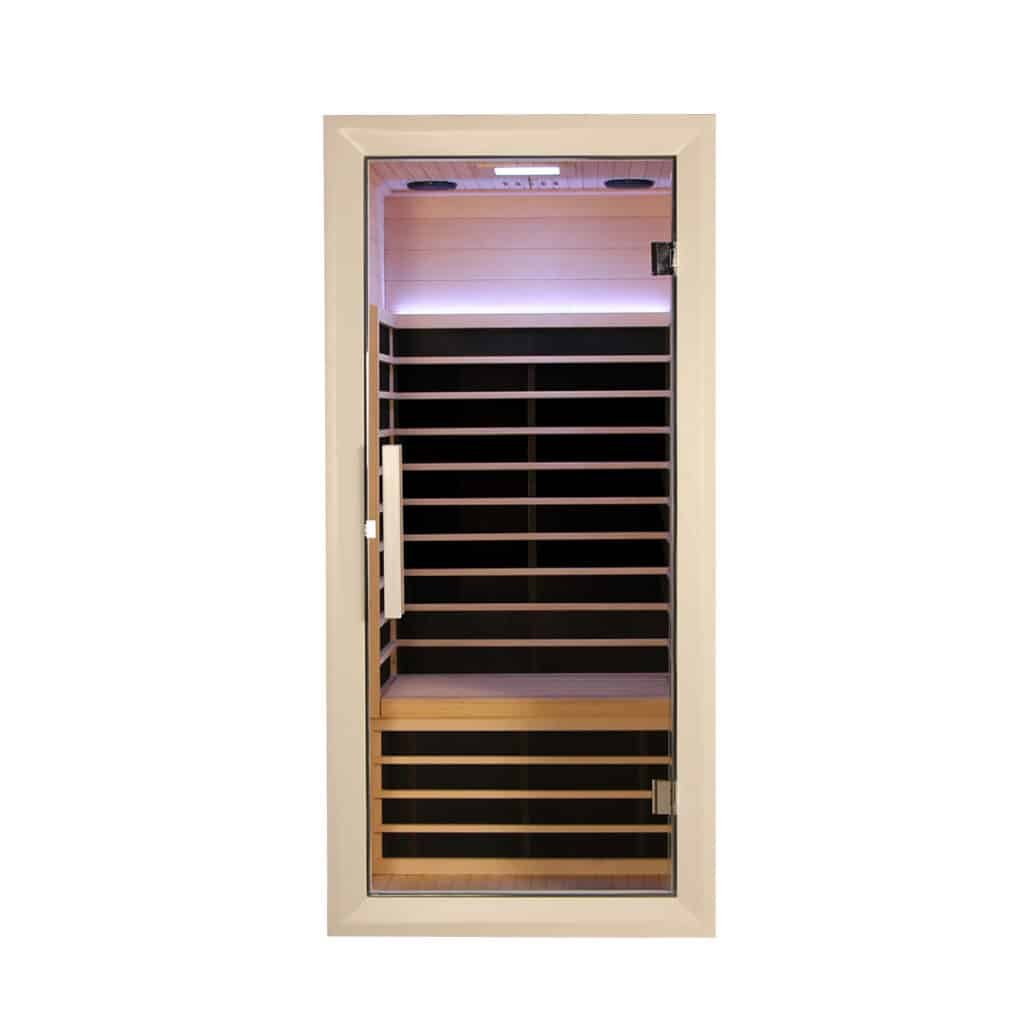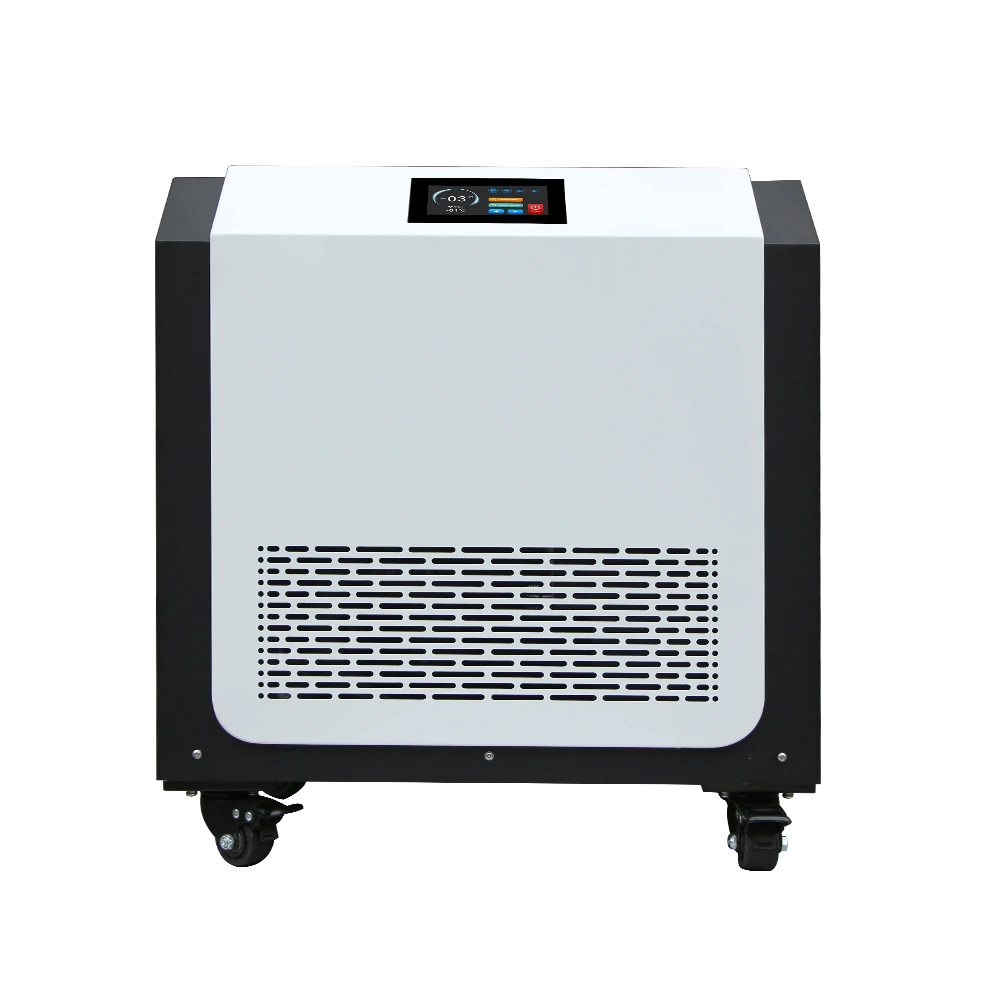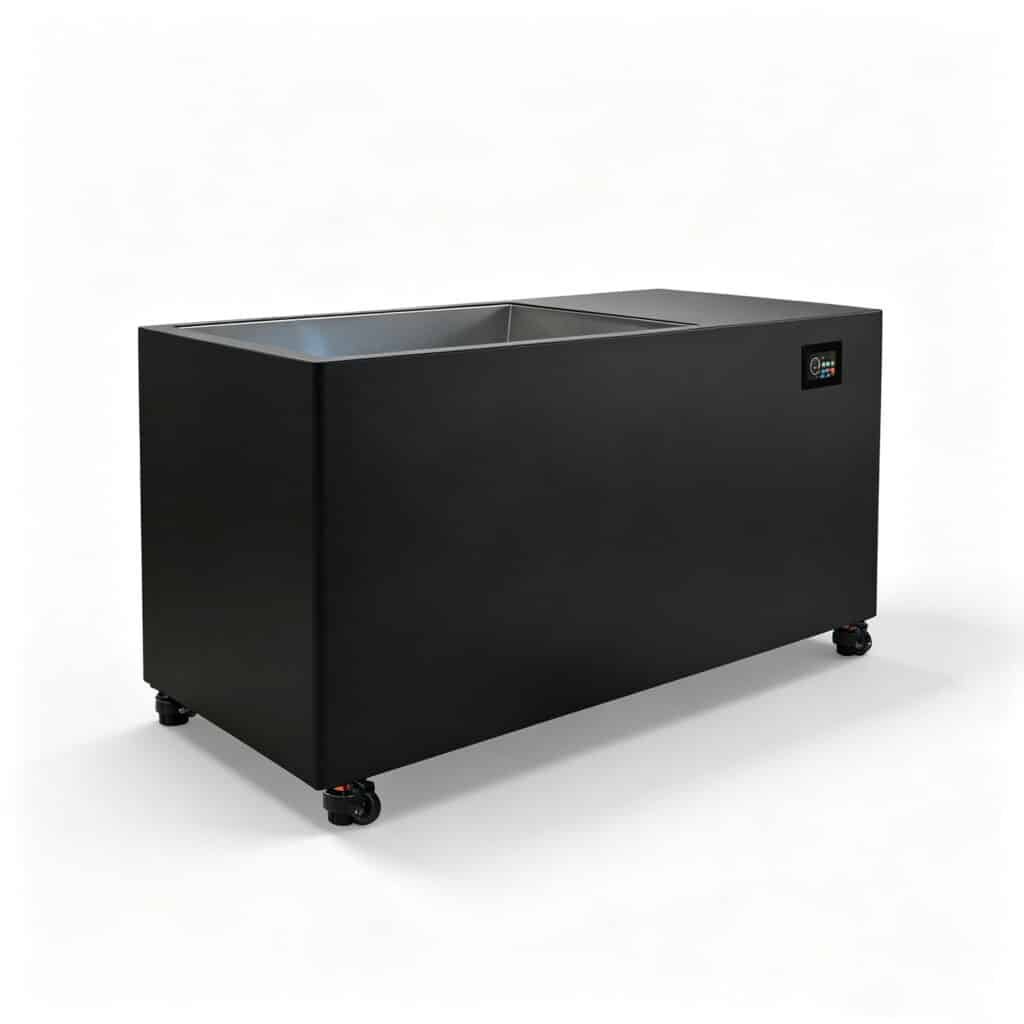
Cold plunge chiller efficiency is not proved by one horsepower label, one expansion-valve claim or one fast-cooling video. It is the measured relationship between useful heat removed from a defined water loop and the electrical energy used under stated conditions. A buyer should compare the complete operating point: water volume, starting and target temperatures, ambient air, pump and filter, hose layout, insulation, cover, electrical configuration, test duration and measured input.
This guide owns the efficiency-evidence decision. It does not replace the cold plunge chiller horsepower guide, which organizes capacity inputs; the electricity-use worksheet, which converts measured power and time into kWh; or a model-specific quotation. Its purpose is to help importers, distributors, OEM brands and facility buyers request comparable cold plunge chiller efficiency evidence without turning one component into an unsupported performance promise.
Cold plunge chiller efficiency: the short answer
A more capable metering device may improve refrigerant control at some operating points, but it cannot by itself prove better cold plunge chiller efficiency. Compressor selection, heat exchangers, fan airflow, pump power, refrigerant charge, controls, setpoint, ambient condition and water-loop resistance all affect the result. Even an efficient refrigeration package can waste energy when connected to an uninsulated tub, an open cover or a restricted filter.
Use a four-part decision rule:
- Define the duty: state the water volume, temperatures, ambient range and usage pattern.
- Define the system boundary: state whether pump, fan, heater, sanitation and controls are included in electrical input.
- Measure the result: record temperature, time and energy with identified instruments.
- Compare like with like: reject comparisons made at different water volumes, ambient conditions or system boundaries.
The U.S. Department of Energy’s chiller purchasing guidance separates full-load and part-load performance because one machine can perform differently across those conditions. The capacities in that federal guidance are much larger than most plunge systems, so its numerical thresholds should not be copied into a small cold-plunge specification. The useful principle is to compare documented performance at the load pattern that matters. See the DOE electric-chiller efficiency guidance.
How to measure cold plunge chiller efficiency
For a cooldown test, the useful thermal change in the water can be estimated from mass, specific heat and temperature change. A practical comparison can record:
Water heat removed ≈ water mass × water specific heat × temperature drop
Measured electrical energy = average measured input power × elapsed time
The first expression is only a water-side estimate. The test instrument calibration checklist helps determine whether temperature, time, flow and electrical readings are suitable for the comparison. It does not automatically include the tub wall, plumbing, heat entering from ambient air, user load, condensation, pump heat or instrument uncertainty. Therefore, label the calculation and preserve the test conditions instead of presenting it as a certified coefficient of performance.
Cold plunge chiller efficiency can also be evaluated during temperature maintenance. In that case, measure electrical energy over a representative period while recording ambient conditions, cover position, setpoint, circulation schedule and use events. A short test in an empty, covered tub cannot represent a busy commercial facility. The ice bath chiller cost worksheet shows how measured energy can be combined with the buyer’s actual tariff without inventing a monthly bill.
AHRI publishes performance-rating standards for defined water-chilling and heat-pump packages. Its current scope page identifies equipment categories and exclusions, including a separate reference for smaller water-to-water heat pumps. Buyers should ask which standard, if any, covers the exact proposed configuration and should not treat a general reference as proof of certification. Review AHRI 550/590 and 551/591 scope and AHRI/ASHRAE/ISO 13256-1&2 information.
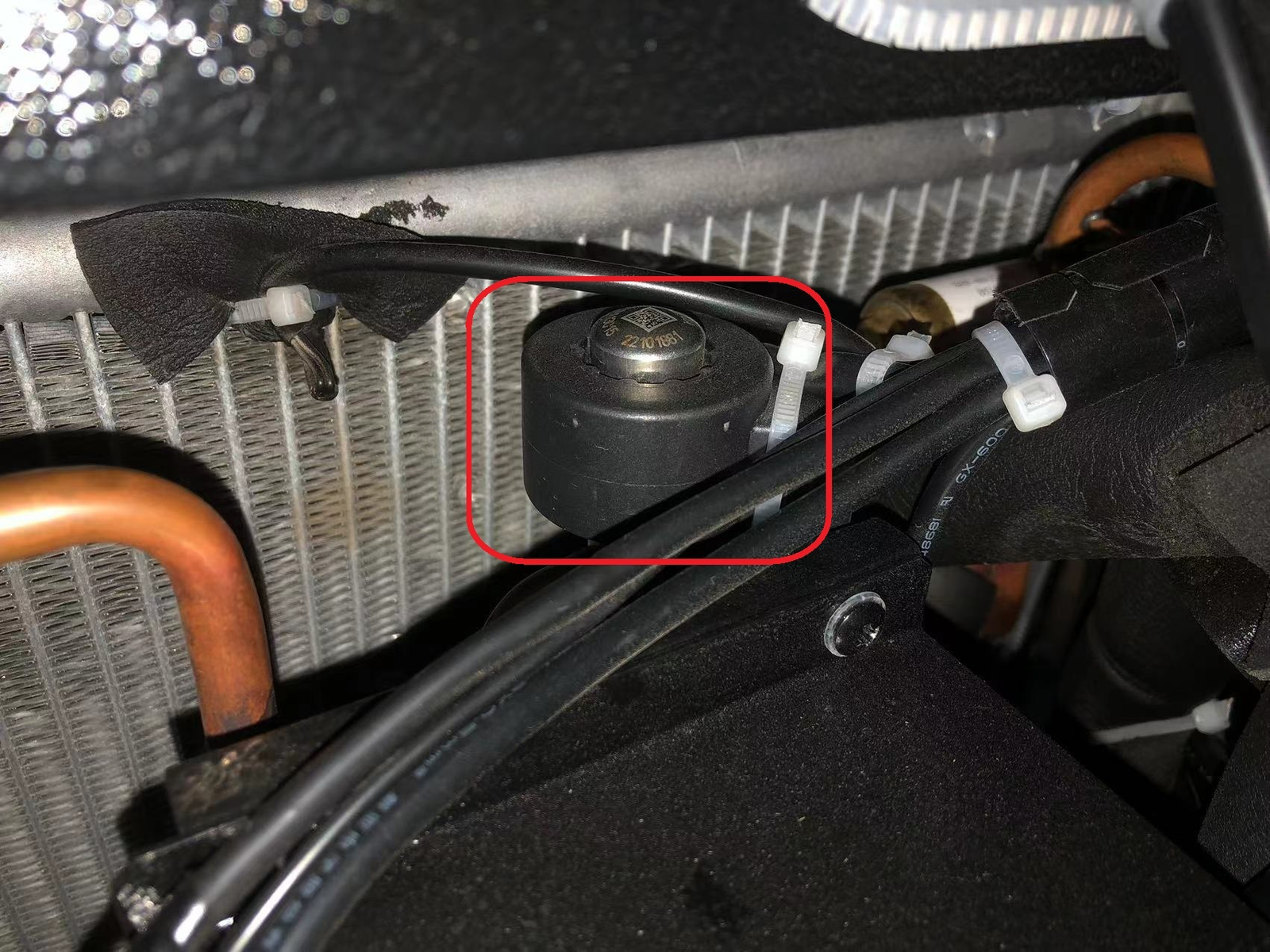
Does an electronic expansion valve improve cold plunge chiller efficiency?
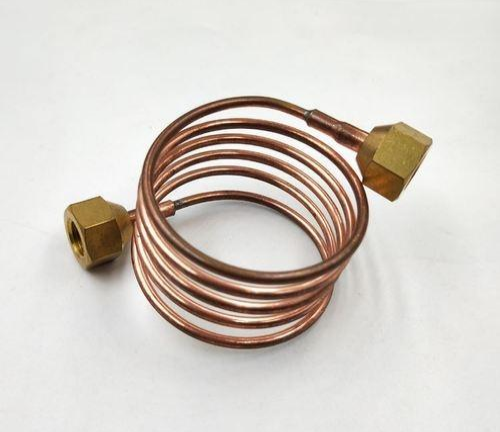
An expansion device meters refrigerant into the evaporator. A fixed capillary arrangement is simple and selected around an intended operating envelope. A thermostatic or electronic expansion valve can modulate flow using its sensing and control logic. That wider control capability may help a properly engineered system maintain suitable evaporator operation across changing conditions. It is not a standalone guarantee of faster cooling, lower kWh, deeper temperature or longer life.
To support an electronic-expansion-valve claim, request an A/B test or equivalent engineering evidence in which the relevant system, refrigerant charge, instruments and test conditions are controlled. Record water-side performance and total electrical input, not only valve position or suction pressure. Ask whether the comparison includes the pump and fan. Ask what happens at startup, near setpoint and during part-load cycling. Cold plunge chiller efficiency should be judged from the complete result.
12 critical cold plunge chiller efficiency checks
1. Water volume and usable volume
Cold plunge chiller efficiency begins with the filled volume used in the test, not only a tub’s maximum geometric volume. If two systems cool different water masses, their elapsed times are not directly comparable. For project inputs, use the cold plunge sizing and water-volume guide.
2. Starting temperature, target and ambient condition
A larger temperature drop or hotter ambient air generally changes the duty. Record start, target, ambient dry-bulb condition, sun exposure and whether the space is ventilated. Cold plunge chiller efficiency claims without those fields cannot be reproduced, and cold plunge chiller efficiency comparisons should reject missing ambient data.
3. Tub insulation and cover state
The vessel and cover control heat gain as well as evaporation and debris entry. State wall construction, insulation, cover type and when the cover was open. Do not attribute every cold plunge chiller efficiency difference to the refrigeration package. Use the cold plunge insulation audit to map the tub, cover and exposed water loop before comparing systems.
4. Complete water-loop configuration
List pump, filter, strainer, sanitation components, hose inside diameter, total hose length, fittings, valves and elevation differences. A restrictive loop can reduce flow and alter heat-exchanger performance. The cold plunge filter-system guide separates filtration decisions from refrigeration efficiency.
5. Total electrical boundary
State whether measured input includes compressor, fans, pump, controller, heater, UV device, ozone generator and standby power. Comparing package input with compressor-only input creates a false cold plunge chiller efficiency result. Record voltage, frequency and measured energy rather than assuming the nameplate equals every operating moment.
6. Full-load and near-setpoint behavior
Measure the active cooldown and the maintenance period. A system that looks strong at full load may cycle inefficiently near setpoint; a part-load strategy may perform differently during a large pull-down. One number cannot describe both.
7. Airflow and heat rejection
For an air-cooled unit, record condenser clearance, inlet-air temperature, recirculation, dust and ventilation. OSHA’s general electrical rule also notes that equipment relying on air circulation must be mounted so cooling airflow is not prevented. Site-specific installation must follow the product instructions and applicable local requirements. See OSHA 1910.303.
8. Heat-exchanger condition and flow
Record clean baseline flow, inlet and outlet water temperatures where instrumentation permits, filter condition and any fouling evidence. Diagnose a dirty or restricted loop before concluding that a valve or compressor is inefficient. Use the not-cooling diagnostic for an active fault.
9. Refrigerant circuit configuration
Ask for refrigerant designation, charge information required by the applicable market, compressor and metering-device configuration, and the service boundary. Do not open or adjust a sealed circuit as an owner experiment. In the United States, refrigerant service can fall under EPA Section 608 requirements; other destinations have their own rules. Review the EPA Section 608 overview.
10. Instrument identification and uncertainty
List the energy meter, temperature instruments, flow measurement method and timestamps. Record calibration or verification status appropriate to the project. More decimal places do not create accuracy. Cold plunge chiller efficiency evidence should state what was measured and how.
The cold plunge chiller flow rate record provides the water-side measurement details needed to compare test runs: location, units, instrument, branch arrangement and the operating condition attached to each reading.
11. Repeated runs and stabilization
A single run can be distorted by starting conditions or operator choices. Define stabilization, test duration, logging interval and repeat rule. Preserve raw readings and any excluded run with the reason for exclusion.
12. Model and revision traceability
Tie every result to the exact model, electrical variant, controller/refrigeration revision and connected accessories. If an OEM modification changes fan, pump, heat exchanger, firmware or enclosure ventilation, decide whether the earlier test still represents the order. The factory acceptance test checklist provides a controlled evidence record.
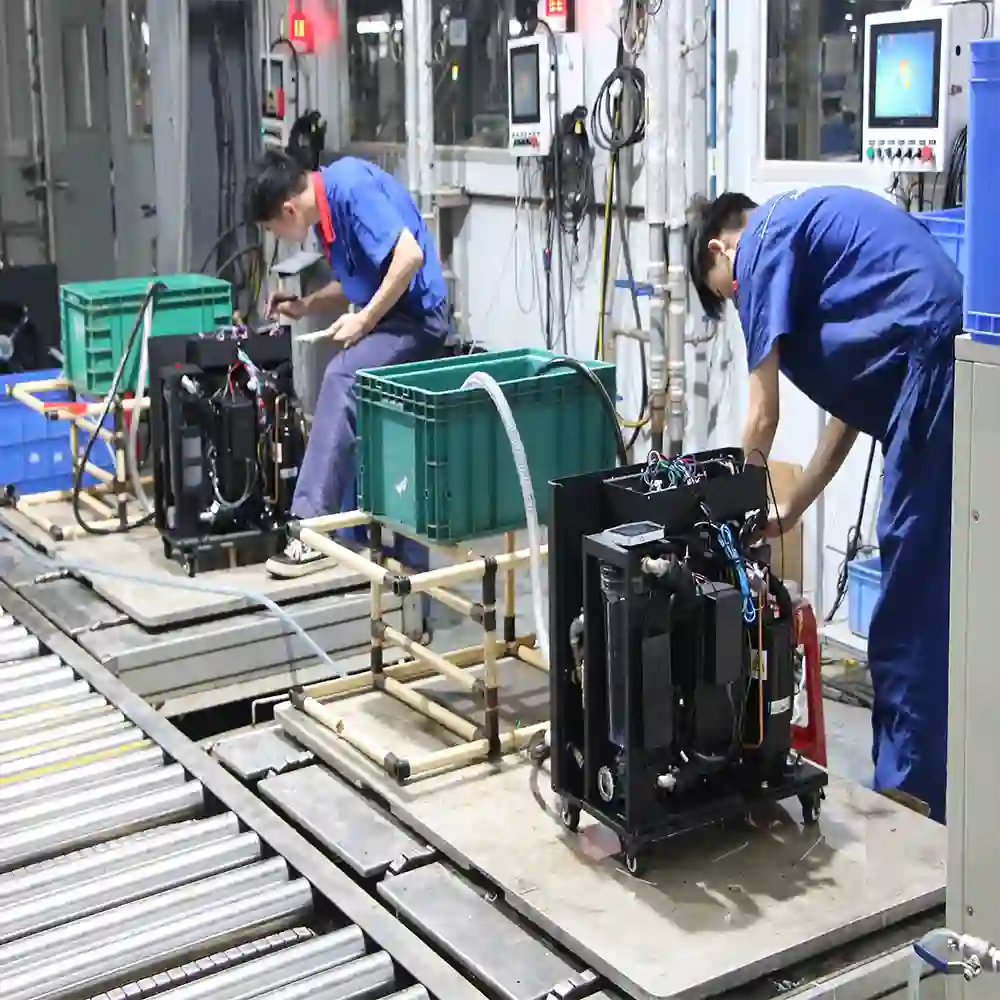
Copyable cold plunge chiller efficiency test protocol
COLD PLUNGE CHILLER EFFICIENCY COMPARISON
PROJECT / BUYER:

MODEL / REVISION / SERIAL:

VOLTAGE / FREQUENCY:

REFRIGERANT AND CONFIGURATION:

TUB / USABLE WATER VOLUME:

TUB INSULATION / COVER STATE:

AMBIENT CONDITION / SUN EXPOSURE:

PUMP / FILTER / SANITATION / HOSES / FITTINGS:

SYSTEM ELECTRICAL BOUNDARY:

ENERGY METER / TEMPERATURE INSTRUMENTS / FLOW METHOD:
START TIME / WATER TEMPERATURE / AMBIENT TEMPERATURE / METER:

INTERVAL READINGS:

TARGET TIME / WATER TEMPERATURE / AMBIENT TEMPERATURE / METER:

TOTAL ELAPSED TIME:

TOTAL MEASURED kWh:

OBSERVED FLOW / ALARMS / CYCLING / COVER EVENTS:
MAINTENANCE-PERIOD START AND END:

USE EVENTS AND COVER-OPEN TIME:

MAINTENANCE-PERIOD kWh:
ASSUMPTIONS / DEVIATIONS / UNCERTAINTY:

COMPARISON CONFIGURATION:

REVIEWER / DATE:
Do not delete conditions that appear inconvenient. They explain the result. If the supplier cannot reproduce a claim under the proposed operating envelope, classify the claim as unverified for that project.
How to diagnose a cold plunge chiller efficiency claim
| Claim | Evidence to request | Common comparison error |
|---|---|---|
| “Cools faster” | Temperature-time curve, water mass, ambient, loop and electrical variant | Different volume or starting temperature |
| “Uses less energy” | Measured kWh for the same duty and complete system boundary | Compressor input compared with total package input |
| “EEV is more efficient” | Controlled whole-system A/B evidence across relevant conditions | Treating a component label as a measured result |
| “Maintains temperature cheaply” | Representative-period kWh, cover state, ambient and usage log | Empty covered test compared with occupied use |
Efficiency also changes over time. Keep a commissioning baseline for flow, cooldown curve, ambient condition and measured kWh. If performance drifts, inspect water care, filters, airflow and connections through the cold plunge chiller maintenance plan before altering sealed refrigeration controls.
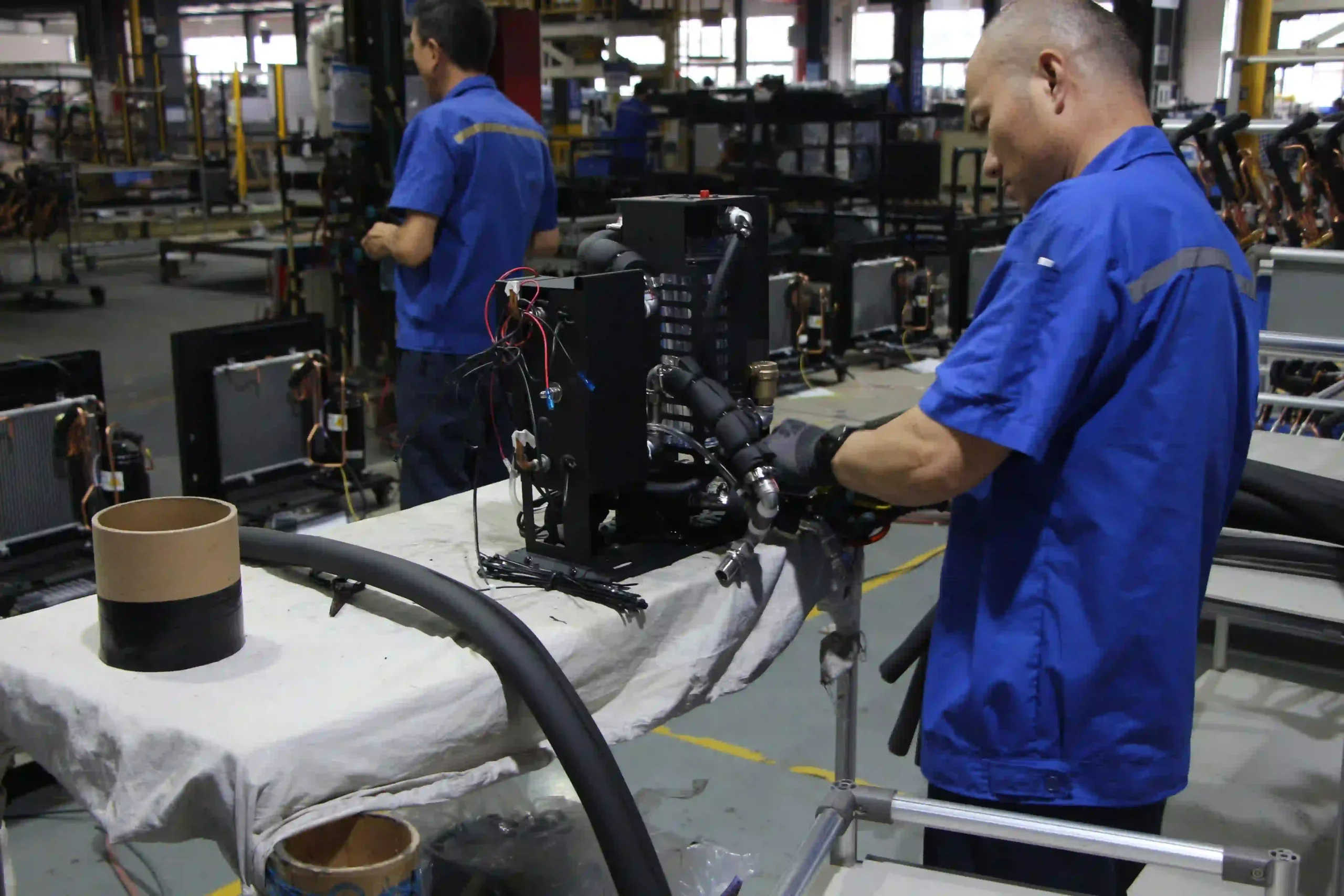
Cold plunge chiller efficiency RFQ evidence table
Place the following fields in the quotation request so suppliers answer the same question:
- usable water volume and vessel type;
- starting, target and maintenance temperatures;
- minimum and maximum expected ambient conditions;
- indoor/outdoor location, sun and ventilation;
- usage events, recovery interval and cover practice;
- pump, filter, sanitation, hose and connection scope;
- destination voltage, frequency, plug or terminal requirement;
- requested cooldown and maintenance test conditions;
- total electrical measurement boundary;
- instrument and report format;
- model/revision traceability and approved-deviation process;
- service, spare-parts and refrigerant-support boundary.
Use the OEM cold plunge chiller RFQ template to collect these fields and the chiller buyer guide to compare the resulting proposals. A supplier should return assumptions and exclusions, not only a headline cold plunge chiller efficiency claim.
Frequently asked questions about cold plunge chiller efficiency
What is the best way to compare cold plunge chiller efficiency?
Compare measured heat-removal or temperature-maintenance results and total electrical energy under the same water volume, temperatures, ambient condition, tub, cover, water loop and electrical boundary. Preserve the raw readings and exact model revision.
Does an electronic expansion valve always make a chiller more efficient?
No. It can provide modulating refrigerant control in a properly engineered system, but whole-system performance also depends on the compressor, heat exchangers, charge, airflow, water flow, controls and operating point. Request comparable test evidence.
Can horsepower show cold plunge chiller efficiency?
No. Horsepower is not a complete efficiency result. Buyers need the defined cooling duty, measured electrical input, test conditions and system boundary. Two nominally similar units can be tested under different loads and loops.
Should pump power be included in an efficiency comparison?
Include every component inside the stated comparison boundary. For an installed-system comparison, pump, fan, controls and connected treatment devices may matter. If a value excludes an item, label that exclusion clearly.
How can a buyer verify an efficiency improvement after an OEM change?
Freeze the baseline and revised configurations, run the same documented test, identify instruments and units, compare raw temperature-time and kWh records, and record uncertainty and deviations. Do not infer the result from a component name alone.
For an evidence-led cold plunge chiller efficiency review, send OMNI Ice the water volume, temperature duty, ambient range, connected water loop, electrical configuration, use pattern and requested test record through the official project contact page. Any performance, efficiency, lead-time or documentation statement should be confirmed for the exact quoted configuration.