Cold plunge chiller sizing is not as simple as choosing a horsepower number from a catalogue. Tub volume matters, but so do ambient temperature, target water temperature, insulation, daily user load, plumbing, electrical supply and the time available for cooling.
For distributors, wellness brands, gyms, hotels and commercial recovery operators, a better cold plunge chiller sizing method is to define the complete operating scenario first and then compare model-specific performance. This checklist combines a transparent water-load calculation with the project information a supplier needs before recommending a chiller configuration.
Cold plunge chiller sizing: the quick answer
Start with the usable water volume, then document the target temperature, starting temperature, required pull-down time, ambient conditions, operating schedule and expected number of users. Add installation details such as voltage, plumbing length, filtration, heating and control requirements. The final selection should be confirmed against the performance data for the exact chiller model and installation setup.
Do not select a chiller by tub volume or horsepower alone. Two projects with the same tub can require different configurations when one is indoors with light use and the other is outdoors in a hot climate with frequent sessions.

1. Calculate usable water volume, not just the tub’s outside dimensions
Manufacturers often list the maximum capacity of an empty tub. The actual operating volume is usually lower because the water level sits below the rim and each user displaces water. Internal steps, seats and sloped walls also reduce usable volume.
Record the following:
- Internal length, width and water depth
- Normal operating water line
- Estimated displacement when occupied
- Whether the tub is drained, topped up or refilled during the day
- Insulation thickness and cover type
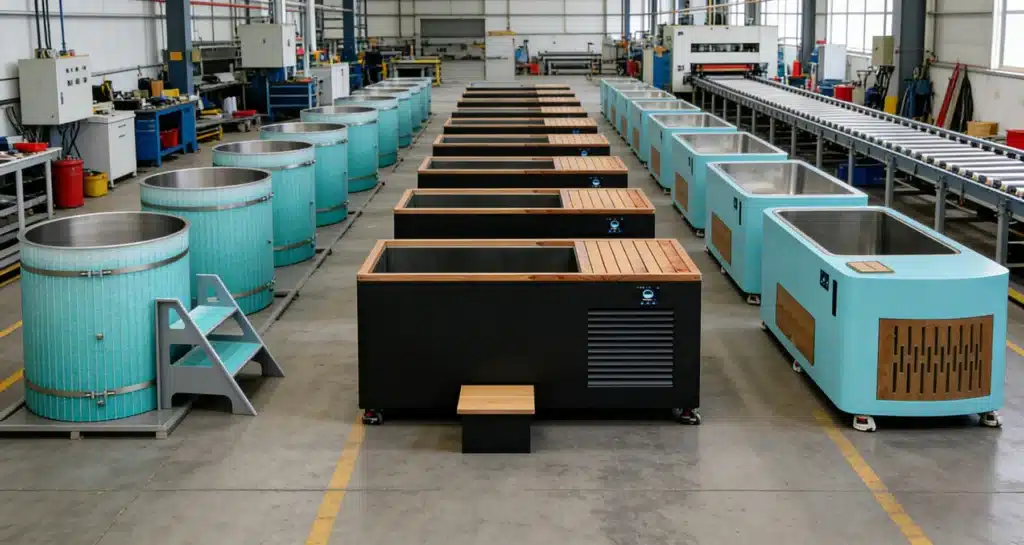
Use litres or US gallons consistently throughout the project brief. The NIST SI conversion guide defines one US gallon as 3.785412 litres. If the tub has an irregular shape, ask the tub supplier for its recommended operating volume rather than estimating from exterior dimensions. Buyers comparing materials and operating volumes can also review our cold plunge tub manufacturing options.
Cold plunge chiller sizing calculation: water heat load
A useful first-pass calculation is the thermal energy that must be removed from the water:
Thermal energy (kWh) = water mass (kg) × specific heat of water (kJ/kg·K) × temperature change (°C) ÷ 3,600
For planning, one litre of water can be treated as approximately one kilogram and the specific heat can be approximated as 4.186 kJ/kg·K. The NIST Chemistry WebBook provides temperature-dependent density and heat-capacity data for water and other fluids.
| Usable water volume | Approx. US gallons | Thermal energy: 25°C to 10°C | Thermal energy: 25°C to 5°C |
|---|---|---|---|
| 200 L | 52.8 gal | 3.49 kWh | 4.65 kWh |
| 300 L | 79.3 gal | 5.23 kWh | 6.98 kWh |
| 500 L | 132.1 gal | 8.72 kWh | 11.63 kWh |
These are theoretical water-load values, not promised cooling times. They exclude heat entering through the tub, open water surface, pipework, pumps, users and ambient air, and they do not account for equipment cycling or system efficiency.
Cold plunge chiller sizing example for a 300-litre tub
Cooling 300 litres from 25°C to 10°C requires approximately 5.23 kWh of thermal energy removal. If a complete system delivered a verified net cooling capacity of 2.0 kW under the same conditions, the ideal no-loss calculation would be 5.23 ÷ 2.0 = 2.62 hours. Real pull-down time will be longer because heat continues to enter the system. This is why buyers should request cooling-capacity data and test conditions rather than estimating runtime from horsepower.
2. Define the temperature requirement precisely
“Cold” is not a complete specification. A supplier needs to know the starting water temperature, target temperature and the time available to reach that target. Maintaining already-cold water is a different load from cooling freshly filled warm water before opening.
Some OMNI Ice models can support water temperatures down to 0°C or ice-making configurations. That capability is model-specific and depends on the complete setup. Buyers should confirm the exact model, tub volume, ambient conditions, circulation and operating procedure before treating 0°C as a project requirement.

Include these four values in the RFQ:
- Typical starting water temperature
- Required operating temperature or range
- Maximum acceptable cooling time
- How long the system must maintain the target each day
3. Account for ambient temperature and installation location
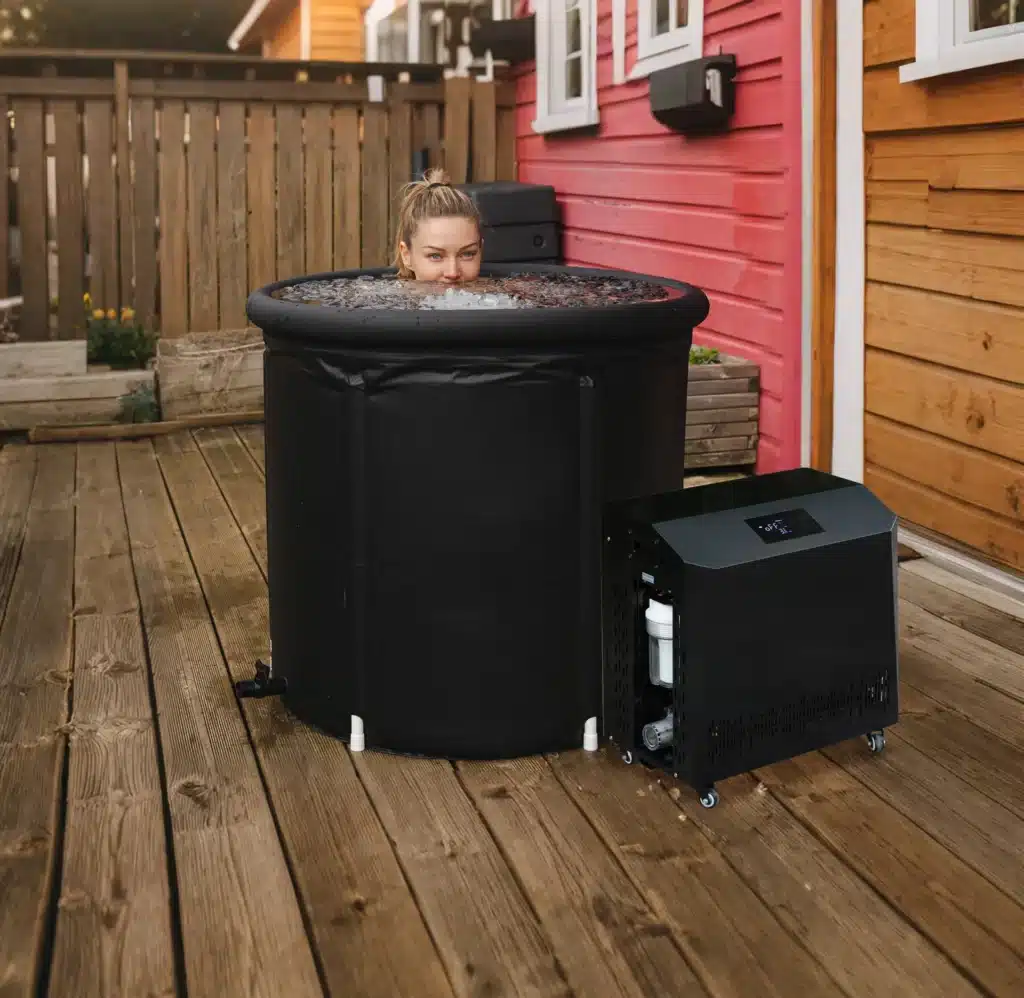
A chiller rejects heat into the surrounding air. High outdoor temperatures, direct sunlight, restricted ventilation and enclosed plant rooms can increase the cooling load or reduce performance. Cold climates create a different set of requirements, including freeze protection and weather exposure.
| Project factor | Why it matters | What to provide |
|---|---|---|
| Ambient temperature | Affects heat gain and condenser performance | Typical and peak temperature near the equipment |
| Indoor or outdoor placement | Changes ventilation and weather-protection needs | Photos, dimensions and shelter details |
| Direct sunlight | Can add heat to the tub and pipework | Hours of sun and whether shading is available |
| Ventilation clearance | Insufficient airflow can reduce heat rejection | Clearances around the chiller and exhaust direction |
4. Estimate user load and daily operating schedule
Each user introduces body heat and may require water replacement, cleaning or recovery time between sessions. A home installation used once or twice per day has a different load profile from a commercial facility serving multiple users per hour.

Tell the supplier:
- Expected users per hour and per day
- Average immersion duration
- Opening hours and peak periods
- Whether the cover remains on between sessions
- Water replacement and cleaning schedule
For supervised or commercial installations, user protocols, contraindication screening and sanitation procedures should be established by qualified professionals. Equipment sizing should not be used as a substitute for operating and safety procedures.
5. Review insulation, cover and heat gain
A well-insulated tub and pipe loop can reduce unwanted heat gain. Thin walls, an uncovered water surface, long uninsulated hoses and sun exposure can all increase the workload placed on the chiller. The US Department of Energy’s pool-efficiency guidance identifies evaporation as a major source of pool heat transfer; its published pool-heating savings should not be copied directly to cold-plunge projects, but the evidence reinforces why the water surface and cover belong in the project brief.
Ask for the tub’s material, wall construction, insulation details and cover specification. If the tub and chiller are sourced separately, confirm that the connections, flow requirement and operating volume are compatible before ordering.
6. Confirm plumbing, circulation and filtration
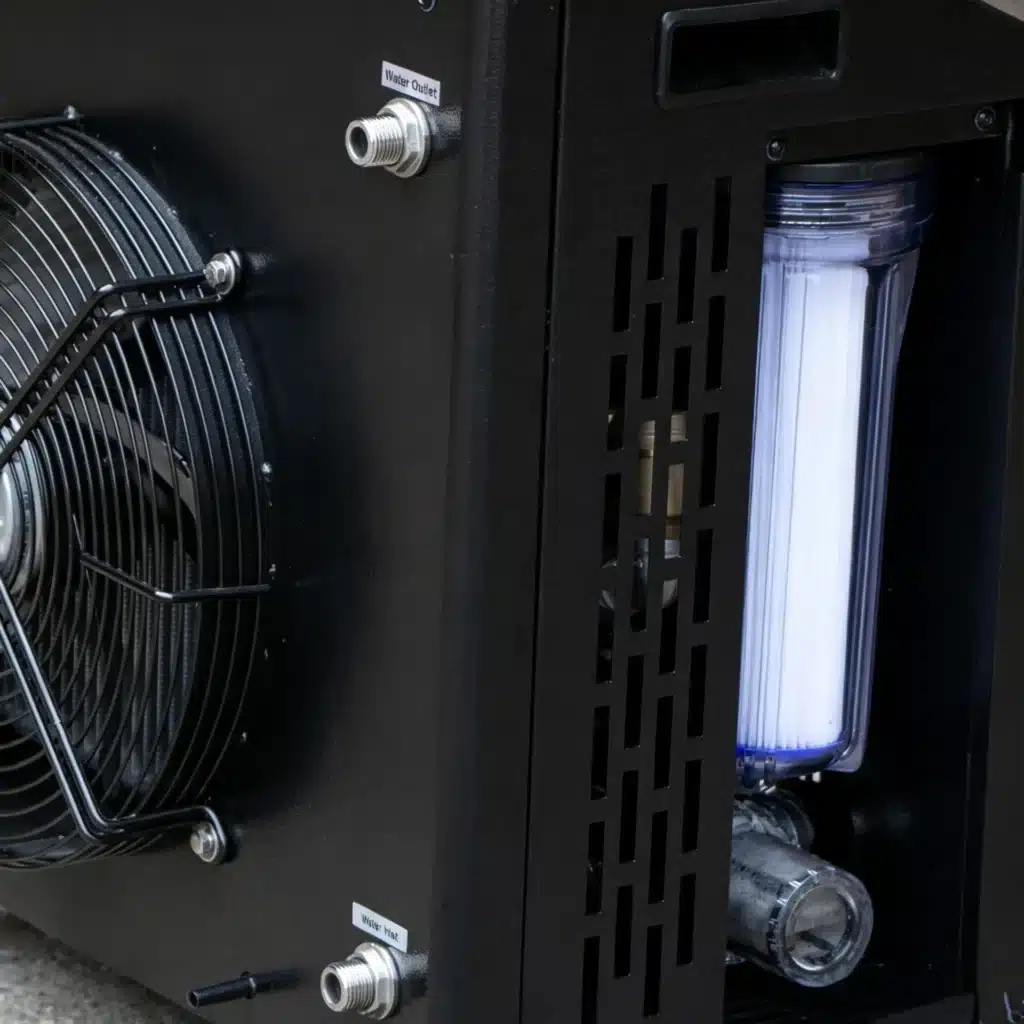
Cooling performance depends on adequate water circulation. Pipe diameter, hose length, elevation change, bends, filters and accessories can affect flow. A system may also include a pump, cartridge or sand filter, ozone, UV or other water-management components depending on the selected model and facility requirements.
The project drawing should identify:
- Chiller-to-tub distance
- Pipe or hose diameter
- Number of bends and elevation difference
- Pump location and rated flow
- Filter, sanitation and bypass components
- Drainage and service access
Do not assume that Wi-Fi, heating, filtration, ozone or ice-making is standard across every chiller. These features should be confirmed against the selected configuration.

7. Verify electrical supply and destination-market requirements
Before choosing a model, confirm voltage, frequency, plug or hard-wiring requirements and available circuit capacity. The same product family may use different electrical configurations for different markets.
For a model-level decision, use the 110V vs 220V cold plunge chiller buyer guide before approving the voltage/frequency variant and nameplate.
Ask for documentation tied to the exact model and electrical configuration. Certification or test documents should identify their scope; a general supplier statement does not prove that every model is covered in every destination market. The US Consumer Product Safety Commission’s pool and spa electrical-safety guidance explains why wet areas, electrical equipment and GFCI protection require qualified installation and local-code review.
For supplier verification, use our cold plunge chiller supplier due-diligence guide together with the OMNI Ice company and documentation profile.
A practical B2B chiller-sizing workflow
- Prepare the project brief. Record tub volume, temperature targets, ambient conditions, usage, electrical supply and installation constraints.
- Shortlist model-specific configurations. Compare operating range, circulation needs, controls, heating, filtration and sanitation options on the OMNI Ice chiller configuration page.
- Review the complete system. Check tub insulation, pipework, pump, accessories, clearances and drainage together.
- Confirm a sample or test plan. Define the test conditions and acceptance criteria before bulk approval.
- Record the approved specification. Freeze the model, voltage, components, branding, packaging, documentation and change-control process through the OEM cold plunge chiller solutions project path.
Cold plunge chiller RFQ checklist
Include the following information when requesting a recommendation or quotation:
- Buyer type and intended application
- Destination country
- Tub model, material and usable water volume
- Starting and target water temperatures
- Required pull-down time
- Indoor or outdoor installation
- Typical and maximum ambient temperature
- Expected users per hour and per day
- Voltage and frequency
- Plumbing distance and elevation
- Heating, Wi-Fi, filtration, ozone or ice-making requirements
- Branding, packaging and documentation requirements
- Expected order quantity and project timing
Common cold plunge chiller sizing mistakes to avoid
- Choosing by horsepower without reviewing test conditions
- Using maximum tub capacity instead of operating volume
- Ignoring high ambient temperature or direct sunlight
- Assuming every model can reach 0°C
- Adding restrictive filters or long pipe runs without checking flow
- Failing to define commercial user load
- Approving bulk production without a written sample and specification record
Frequently asked questions
How many horsepower does a cold plunge chiller need?
There is no universal horsepower-to-volume rule. Cold plunge chiller sizing depends on usable water volume, temperature pull-down requirement, ambient conditions, insulation, circulation and user load. Compare model-specific performance under conditions that resemble the real installation.
Can a cold plunge chiller reach 0°C?
Selected models and ice-making configurations can support temperatures down to 0°C. Confirm the exact model and operating conditions because the capability does not apply automatically to every chiller, tub or installation.
Is a larger chiller always better?
No. An oversized configuration may increase purchase cost, electrical requirements, noise or cycling without solving installation and flow problems. The objective is an appropriate system match with practical operating margin.
Should a B2B buyer test a sample?
Yes. Test the selected chiller, tub and accessories under agreed conditions. Record target temperature, ambient temperature, water volume, cooling time, flow, controls and acceptance criteria before approving bulk production.
Can the tub and chiller come from different suppliers?
Yes, but the buyer must confirm water volume, connections, flow, pump, filtration, electrical requirements and operating range across the complete system. Responsibility for integration and after-sales support should be documented.
Define the project before selecting the model
A reliable chiller recommendation starts with a complete project brief, not one tub-volume number. When buyers document the operating conditions and approval criteria, suppliers can compare configurations on the same basis and reduce avoidable changes later.
Use this cold plunge chiller sizing checklist before comparing commercial terms. Explore OMNI Ice cold plunge chiller configurations, review compatible cold plunge tub options, compare wholesale pricing factors, understand private-label project approvals, or define a custom project through our OEM cold plunge chiller solutions.
Assumption register
Cold plunge chiller sizing: record the assumptions behind the shortlist
Quick answer: Cold plunge chiller sizing is defensible only when the recommendation names its water volume, starting and target conditions, ambient range, pull-down window, repeated user load, insulation, flow and electrical assumptions.
Before quotation
Use cold plunge chiller sizing to identify the thermal and hydraulic inputs that are still unknown. Ask suppliers to state which values were assumed rather than presenting a model as universally suitable.
Before approval
Recheck cold plunge chiller sizing against the selected tub, water loop, installation location and exact electrical variant. A changed assumption should trigger a revised recommendation.
The final cold plunge chiller sizing record should travel with the quote, approved configuration and commissioning baseline so the buyer and supplier are reviewing the same duty.