In high-traffic commercial wellness clubs, athletic recovery suites, and private residential installations, procurement decisions often stall at the physical installation boundary. Buyers fall in love with digital temperature displays, titanium heat exchangers, and cold recovery protocols, but when the wooden shipping crate arrives on-site, practical installation realities emerge: Where does the machine breathe? Which way do the water ports face? Does the electrical panel have dedicated breaker capacity? And how much service clearance is required to swap a water filter without draining the tub? Sizing an installation correctly requires mastering exact cold plunge chiller installation requirements.
In field deployments, treating a high-performance water chiller like a plug-and-play household mini-fridge leads directly to equipment lockouts, water damage, and premature compressor failure. Commercial and residential chillers (such as the OMNI CHU external-filter series and CHM internal-filter series) combine high-pressure R290 refrigeration circuits, 88W DC water circulation pumps, and active heat rejection fans inside a compact 50 kg metal chassis. If an installer ignores manufacturer-specified perimeter clearances, runs undersized plumbing lines, or shares a branch circuit with heavy gym equipment, the unit will trip high-pressure safety switches within minutes. Here is the operational engineering checklist facility managers, plumbing contractors, and buyers need to verify footprint dimensions, hydraulic pipe loops, electrical drops, and plant room airflows before uncrating.
Cabinet Footprint & Structural Placement: CHU vs. CHM Series Clearances
The first physical constraint in any cold plunge layout is physical cabinet volume and operational orientation. In our manufacturing records, OMNI chillers are divided into two primary structural formats: the CHU series (utilizing an external 5-inch filtration canister for rapid commercial cartridge inspection) and the CHM series (housing internal filtration for streamlined aesthetic footprints).
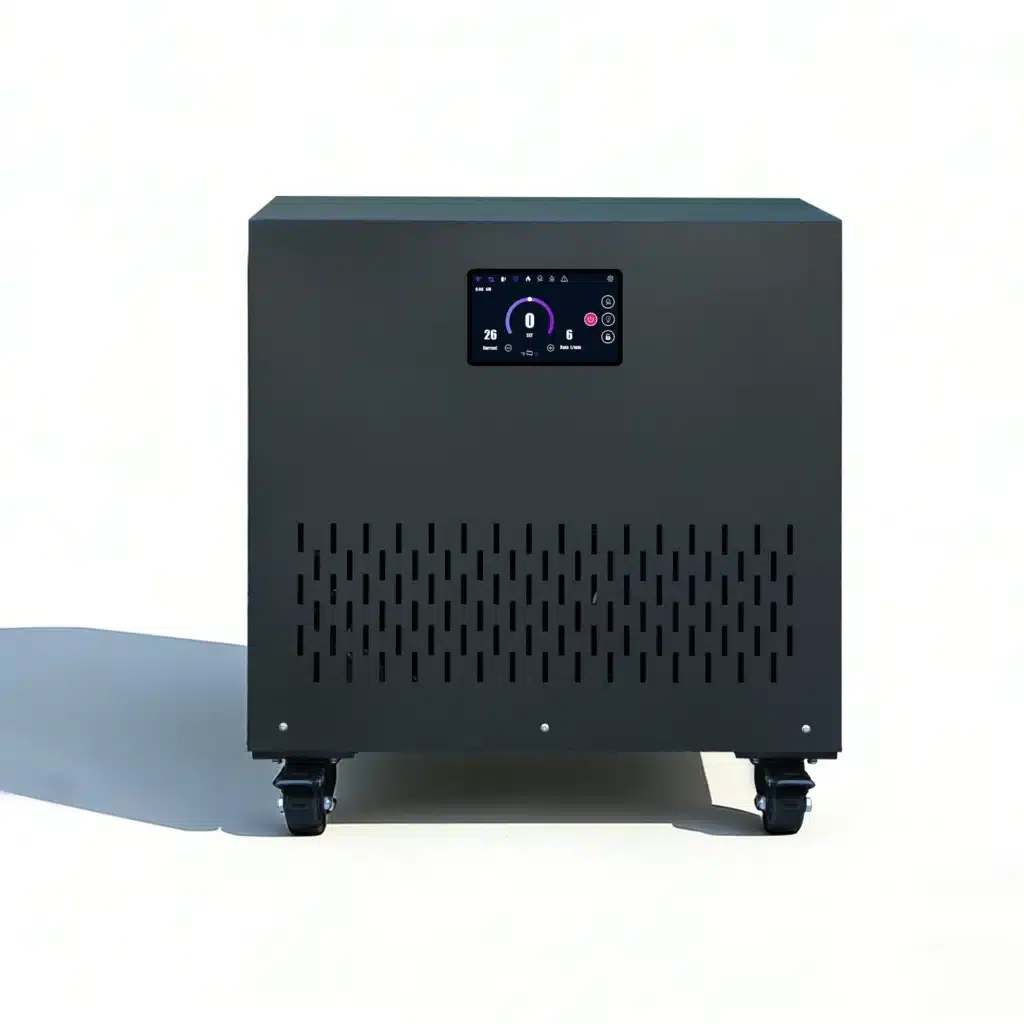
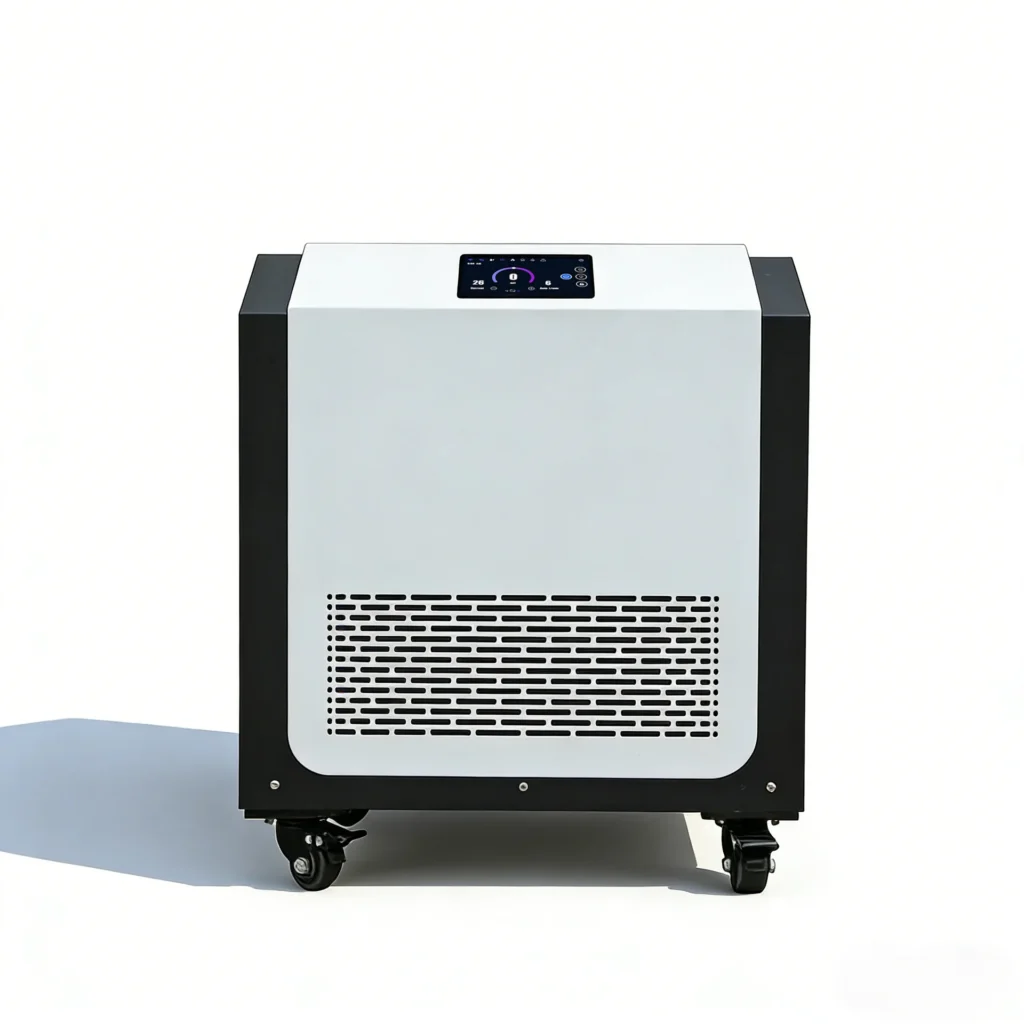
For a standard 1.5 HP commercial unit (such as model CHU-15-RW), the factory chassis dimensions measure 580 mm wide by 390 mm deep by 635 mm high (roughly 22.8″ x 15.4″ x 25.0″), with a net dry weight of 50.1 kg (110.5 lbs). Operating this footprint requires three spatial clearance buffers:
- Condenser Intake Clearance (Minimum 18 Inches / 450 mm): The louvered flank where ambient air enters across the aluminum condenser fins must never sit flush against a wall, drywall partition, or dense landscaping. Choking the intake drops airflow volume, starving the heat exchanger and raising compressor head pressures.
- Fan Exhaust Clearance (Minimum 30 to 36 Inches / 750–900 mm): The high-velocity axial fan expels a continuous stream of hot rejected air (often 15°F to 25°F hotter than room ambient). If this discharge airstream strikes a solid wall within two feet, the hot air deflects back into the intake louvers, triggering a closed-loop thermal runaway that locks out the machine on high-pressure error codes.
- Filter Maintenance Access (Minimum 16 Inches / 400 mm on Port Face): The side or rear panel housing the water inlet/outlet ports and external filter canister requires clear arm clearance. Technicians must be able to slide a dedicated filter wrench around the 5-inch housing to replace sediment cartridges without unbolting the chiller from its pad.
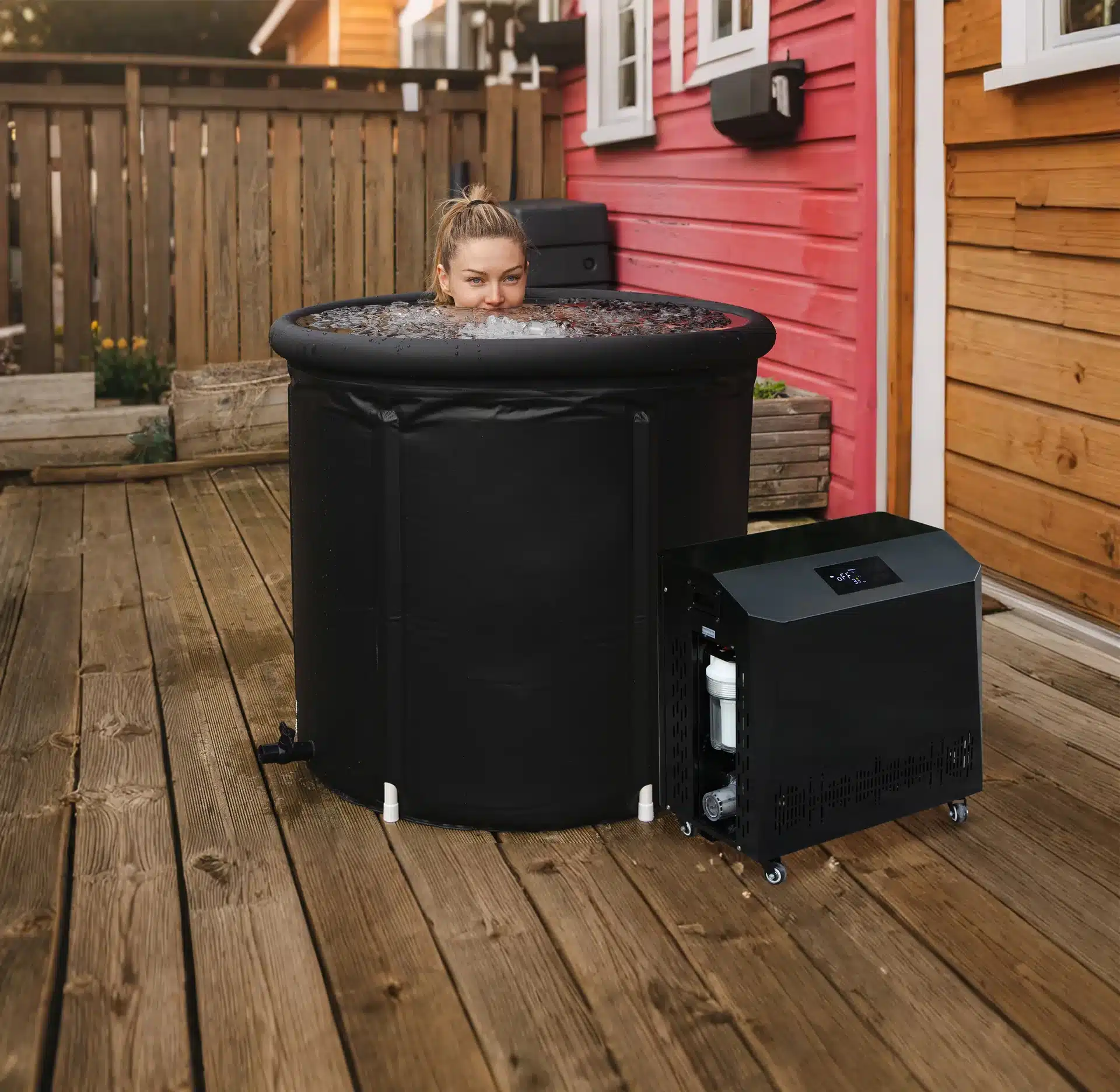
A dedicated cold plunge chiller installed on a raised, level patio pad with proper perimeter airflow clearance and accessible water hose routing.
Hydraulic Plumbing Connections: Sizing, Pipe Runs, and Pump Head Limits
In manufacturer technical data, a 1.5 HP chilling unit incorporates an 88-watt DC circulating pump engineered to push water through pure titanium coaxial heat exchangers, integrated ozone venturi injectors, and pleated filter elements. To prevent hydraulic cavitation, the external piping loop must be sized to minimize dynamic friction head loss.
Contractors and facility plumbing installers must adhere to three hydraulic rules:
- 1-Inch Internal Diameter (ID) Hose Minimum: Standard catalog accessories supply reinforced water hoses equipped with rapid quick-connectors and hose clamps. Installers must never downsize water lines to 1/2-inch or 3/4-inch garden hose fittings. Restrictive fittings cause severe friction loss, dropping flow rate below 15 GPM (to verify flow rate impacts during factory validation, see our cold plunge chiller cooling performance test guide) and causing localized freeze-ups inside the titanium barrel.
- Maximum Distance & Height Rules: Keep the chiller within 5 to 8 feet of the tub basin. If the chiller must be placed in an adjacent equipment closet, total equivalent pipe run (including elbows and valves) should not exceed 15 feet without installing a secondary booster pump. The chiller should sit level with or slightly below the tub water line to maintain positive suction head on self-priming circulation pumps.
- Isolation Ball Valves & Unions: Install commercial true-union ball valves on both the water supply and return lines immediately adjacent to the chiller ports. This enables staff to isolate the machine for seasonal filter replacement, ozone injector inspection, or winter storage without draining hundreds of gallons of cold water from the tub.
For installations pairing external chillers with heavy-gauge metal vessels, review our engineering specifications on metal tubs for ice baths, or examine timber stave compatibility in our guide on cedar cold plunge tub maintenance.
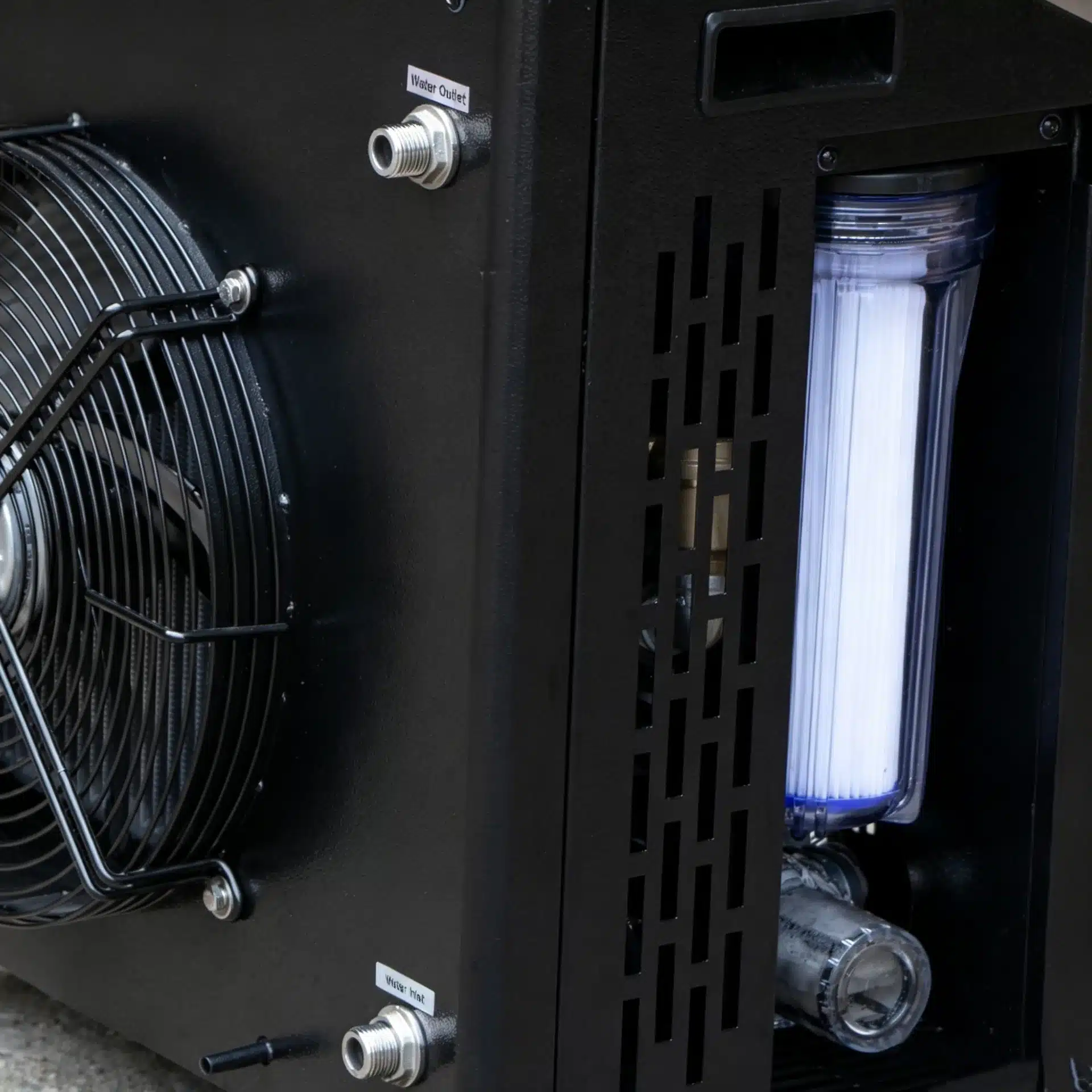
Detailed view of quick-connect water fittings, 5-inch sediment filter canister, and isolation valves engineered for rapid commercial maintenance.
Electrical Specification & Power Sizing: 110V/60Hz vs. 220-240V/50Hz
In catalogue engineering sheets, cold plunge chillers are manufactured across two distinct power supply configurations: 110V–120V / 60Hz (standard North American market) and 220V–240V / 50Hz (European, Asian, and Australasian international markets). These voltage specifications are factory-built options, not universal dual-voltage switchable power supplies.
When reviewing exact cold plunge chiller installation requirements, electrical engineering parameters documented for commercial chillers:
| Chiller Model | Compressor Power | Power Supply Spec | Cooling Input Power | Dedicated Breaker Requirement |
|---|---|---|---|---|
| CHU-05-RV | 0.5 HP Rotary | 110V / 60Hz or 220V / 50Hz | ~ 550 W | Dedicated 15A Circuit (Class A GFCI) |
| CHU-10-RV / CHM-10 | 1.0 HP Commercial | 110V / 60Hz or 220V / 50Hz | ~ 850 W – 950 W | Dedicated 20A Circuit (NEMA 5-20R) |
| CHU-15-RW (Heavy Duty) | 1.5 HP Commercial | 220-240V~ / 50Hz (or 60Hz optional) | 1.18 kW (Cooling / Heating) | Dedicated 20A Double-Pole GFCI |
Under National Electrical Code continuous load requirements, an appliance running for hours at a time must not exceed 80% of circuit breaker capacity. A 1.5 HP machine drawing 1.18 kW must never share an outlet with patio heaters, commercial laundry, or treadmill banks. For outdoor installations, code mandates an industrial NEMA 3R weatherproof in-use bubble cover that latches closed over the plug. For exterior electrical guidelines, review our report on an outdoor chiller unit for cold plunge setups.
For public pool and spa electrical safety protocols, reference the federal standards outlined by Pool Safely guidelines.
Environmental Operating Ranges: 15°C to 43°C Temperature Boundaries
In manufacturer technical specifications, the certified operating ambient temperature envelope for cooling mode is 15°C to 43°C (59°F to 109°F), with an adjustable water setpoint range between 0°C and 40°C (32°F to 104°F). Operating outside these boundaries requires specific mechanical precautions:
- High Ambient Summer Operation (>38°C / 100°F): When outdoor ambient air approaches 43°C, refrigerant condensing efficiency derates significantly. Ensure the chiller sits in full shade or beneath an open-air awning to prevent radiant solar skin heating. For detailed derating calculations, review our analysis on cold plunge chiller heat rejection.
- Sub-Freezing Winter Operation (<0°C / 32°F): If outdoor temperatures drop below freezing, standing water inside the titanium coaxial barrel will freeze and burst internal tubing. In mild freeze zones, maintain continuous 24/7 pump circulation. In deep winter conditions, unpower the unit, open the lower drain plug, and purge standing water using low-pressure compressed air (under 15 PSI). Follow complete winterizing protocols in our guide on cold plunge chiller winter storage and drainage.
- Dual-Mode Heating Mode Limits: On reverse-cycle models featuring heating capabilities, certified ambient operating temperatures for heating mode are 15°C to 35°C (59°F to 95°F). For reverse-cycle engineering, check our technical breakdown on a water chiller heater.
For commercial water sanitation and bacteriological control standards, follow established CDC Healthy Swimming operating practices.
Pre-Commissioning Priming & Air Bleeding Procedures
In factory technical documentation, running a chiller circulation pump without water will overheat and melt internal carbon-ceramic mechanical face seals in under 90 seconds. Self-priming circulation pumps require clean, solid water columns free of trapped air pockets before electrical power is energized.
Contractors follow five step-by-step pre-flight priming checks:
- Pre-Fill the Tub Beyond the Upper Inlet: Always fill the plunge basin with water until the waterline covers the upper discharge return port by at least 2 inches. This ensures positive atmospheric head pressure floods the inlet hose naturally.
- Bleed Air from the 5-Inch Filter Canister: The external filter housing includes a red pressure relief button or top air bleed screw. Open the bleed screw while water flows into the tub until a steady stream of water escapes with zero sputtering air bubbles, then tighten securely.
- Inspect Hose Clamp Torque: Verify that all reinforced spiral water lines are pushed fully over barbed hose nipples and that stainless steel worm-gear hose clamps are torqued past 35 in-lbs to prevent suction air leaks. Suction micro-leaks cause the pump to lose prime intermittently, generating cavitation gurgling.
Condensate Management & Equipment Pad Drainage
In humid indoor or outdoor environments, chilling 120 gallons of water down to 39°F creates external condensation on uninsulated plumbing fittings, quick-connects, and filter canisters. A commercial installation requires active water management underneath the chassis:
- Direct-Gravity Baseplate Drain Lines: The lower steel chassis features stamped drain ports designed to route incidental water and condensation away from internal electronics. Connect a 1/2-inch flexible condensate tube to the base drain nipple, directing runoff into a nearby floor drain or exterior gravel bed.
- Anti-Vibration Equipment Risers: Set the chiller on heavy-duty 2-inch to 4-inch elastomeric rubber risers. Raising the unit above surrounding ground prevents patio rain runoff from contacting bottom sheet-metal seams and isolates rotary compressor motor vibration from echoing through residential subfloors.
Indoor Plant Room & Commercial Gym Integration
When installing a cold plunge chiller inside a commercial athletic club, yoga studio, or high-end residential basement, the machine must coexist with indoor ventilation and quiet recovery spaces:
- Active Mechanical Plant Room Exhaust: A 1.5 HP chiller discharges up to 13,000 BTU/hr of warm rejected air. If installed inside an enclosed equipment closet, the room requires dedicated mechanical exhaust providing at least 10 to 12 air changes per hour (ACH) to keep room temperatures below 85°F.
- Integrated All-in-One Cabinet Options: For studios seeking to eliminate exposed water hoses, consider turnkey furniture-grade tubs where the chiller, pump, and filtration are pre-plumbed inside a ventilated cedar cabinet. Compare self-contained configurations in our report on an all in one ice bath for gym use, or review combined hot-and-cold suites in our guide on a sauna and cold plunge for gym setup.
- Acoustic Isolation Pads: Set the 50 kg metal chassis on 2-inch dense elastomeric rubber anti-vibration waffle pads. This prevents rotary compressor motor resonance from transmitting into commercial subfloors or adjacent treatment rooms.
Factory-Direct Commercial Cold Plunge Systems from OMNI Ice
At OMNI Ice, our engineering team manufactures high-capacity commercial and residential cold plunge chillers, insulated stainless plunge tubs, and modular saunas for athletic training centers, luxury spas, and residential wellness spaces worldwide. We eliminate distributor markups and supply turnkey equipment backed by comprehensive technical documentation:
Featured Commercial Chilling & Plunge Hardware
- OMNI CHU & CHM Commercial Cold Plunge Chillers (1.0HP & 1.5HP): High-capacity commercial recovery machinery engineered with pure titanium coaxial barrels, 88W DC circulation pumps, integrated ozone, and R290 refrigerant.
- ProValue CH-08 0.8HP Ice Bath Chiller: Compact exterior-rated cooling unit engineered for private recovery suites and residential patios.
- WT-13 Cedar Cold Plunge Tub with Built-In 1.0 HP Chiller: Integrated luxury timber-clad recovery tub with enclosed dual-temp hardware, eliminating loose exterior hoses entirely.
If your project requires private-label equipment manufacturing, full containerload wholesale distribution, or custom engineering submittals, explore our complete OEM cold plunge equipment solutions or connect directly with our engineering team through our commercial equipment RFQ desk.
The Contractor Installation & Commissioning Checklist
Before uncrating your cold plunge chiller and filling the tub, complete these seven physical site verifications:
- Foundation Pad Leveling: Verify that the equipment pad is flat, rigid, and lifted at least 2 inches off surrounding dirt or grass.
- Perimeter Clearances Checked: Confirm at least 18 inches of clearance on condenser intake louvers and 30+ inches in front of fan discharge.
- Dedicated Power Drop Confirmed: Coordinate with a licensed electrician to verify an isolated 20A GFCI circuit with an extra-duty weatherproof in-use bubble box.
- Plumbing Diameter Verified: Ensure connecting water hoses maintain a minimum 1-inch internal diameter (ID) without restrictive reducers.
- Purge Air from Pump Loop: Fill the plunge tub with water before powering on the chiller; never run the 88W DC circulating pump dry.
- Filter Canister Pre-Seated: Inspect the 5-inch pleated sediment filter housing, apply plumber’s tape to threads, and tighten securely with the supplied wrench.
- Wi-Fi App Pairing: Connect the machine to local 2.4 GHz Wi-Fi using the digital controller interface to enable remote temperature scheduling and diagnostic telemetry.
When planned with proper airflow clearances, dedicated electrical capacity, and unhindered hydraulic circulation, a commercial cold plunge chiller operates with flawless thermodynamic efficiency—delivering crisp, 39°F water recovery through thousands of demanding athletic sessions.