For most cold plunge owners, chilling water down to 39°F is the primary operational mission during humid summer months. But as autumn arrives and outdoor temperatures dip below freezing, or when an athlete wants soothing 104°F hot-water therapy following a grueling training session, a cooling-only machine becomes half an appliance. Facility operators, athletic trainers, and luxury wellness buyers increasingly seek versatile machines that handle both extreme chill and restorative warmth from a single refrigeration circuit. The search volume for a dedicated water chiller heater platform has surged as buyers look to eliminate seasonal equipment storage and avoid maintaining two separate hot and cold tubs.
However, achieving true dual-temperature performance inside a compact water loop involves serious refrigeration thermodynamics, hydraulic switching valves, and electrical safety constraints that single-mode units never face. Running a reverse-cycle heat pump between 37°F cold plunge mode and 104°F hot tub mode is not merely a software setting on a digital display. You must account for 4-way reversing valve pressure drops, coefficient of performance (COP) derating in freezing ambient air, titanium heat exchanger expansion tolerances, and transition time physics between thermal extremes. Here is the operational engineering guide contractors, facility managers, and residential buyers need to evaluate dual-temp sizing, electrical demand, and seasonal winterization protocols before ordering.
How Reverse-Cycle Heat Pumps Work: 4-Way Reversing Valve Dynamics
In standard cooling mode, a cold plunge machine operates like a miniature industrial air conditioner: the rotary compressor pumps high-pressure refrigerant through an air-cooled condenser coil to dump heat into ambient air, then sends chilled liquid through an electronic expansion valve (EEV) into a titanium coaxial heat exchanger to chill the circulating bath water. In a dedicated water chiller heater, the refrigeration loop incorporates an electromechanical 4-way reversing valve that physically swaps the refrigerant flow path:
- Chilling Cycle (Cooling Mode): The titanium coaxial barrel acts as the evaporator, absorbing thermal energy from tub water. The outdoor finned coil functions as the condenser, discharging rejected heat into ambient air through high-velocity axial fans.
- Heating Cycle (Heat Pump Mode): When the user selects heating mode (typically between 85°F and 104°F), an electrical solenoid energizes the 4-way valve slide piston. Hot discharge gas from the compressor bypasses the air coil and flows directly into the titanium water barrel, transforming the water heat exchanger into a high-efficiency submerged condenser. The air-cooled finned coil now acts as an evaporator, extracting latent heat from outdoor air.
- Defrost Bypass Cycling: In freezing ambient winter conditions (below 40°F / 4°C), extracting heat from damp outdoor air causes frost and ice to coat the exterior aluminum fins. Quality dual-temp machines incorporate automated hot-gas bypass defrost cycles, temporarily redirecting warm refrigerant to melt frost buildup within 3 to 5 minutes without disrupting tub water heating.
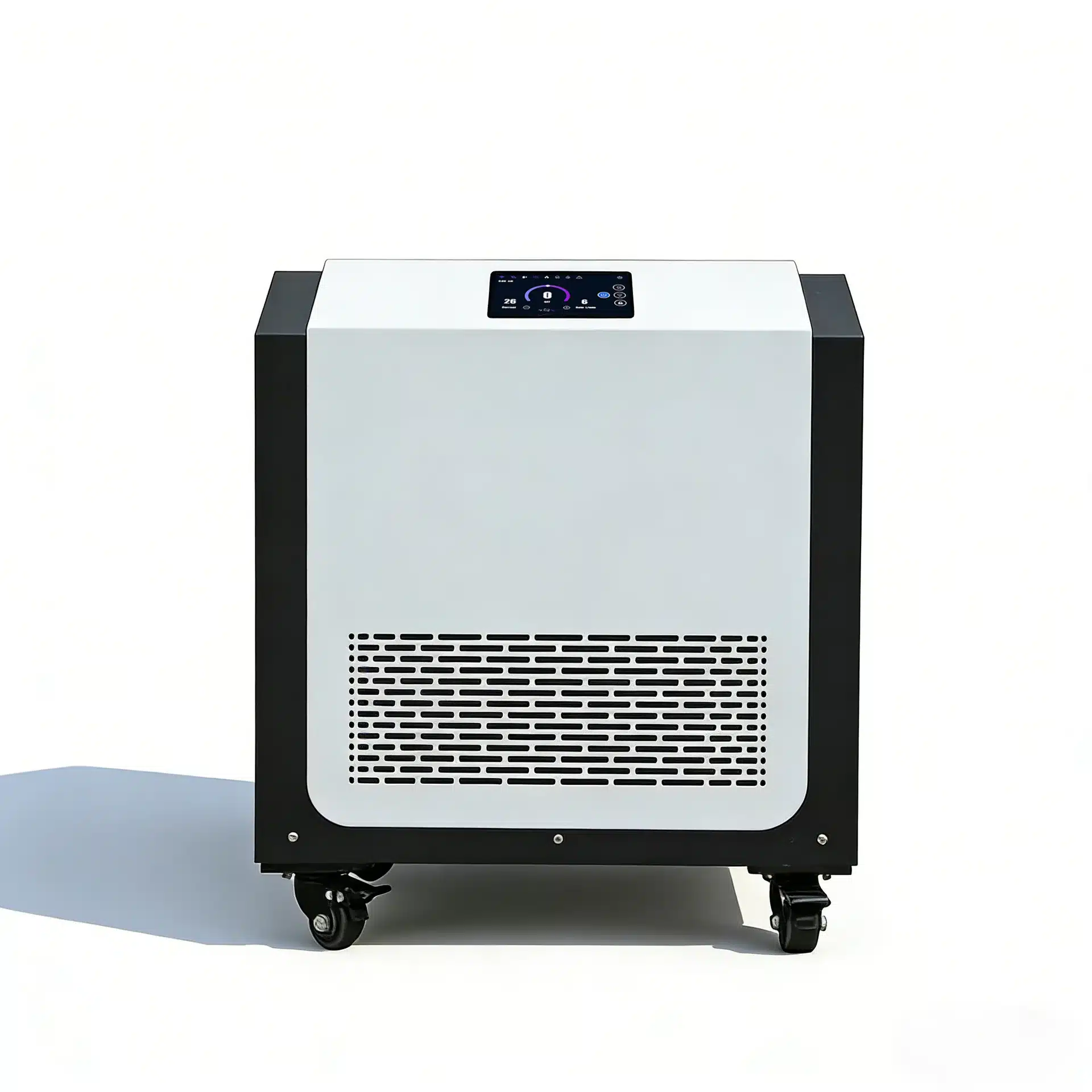
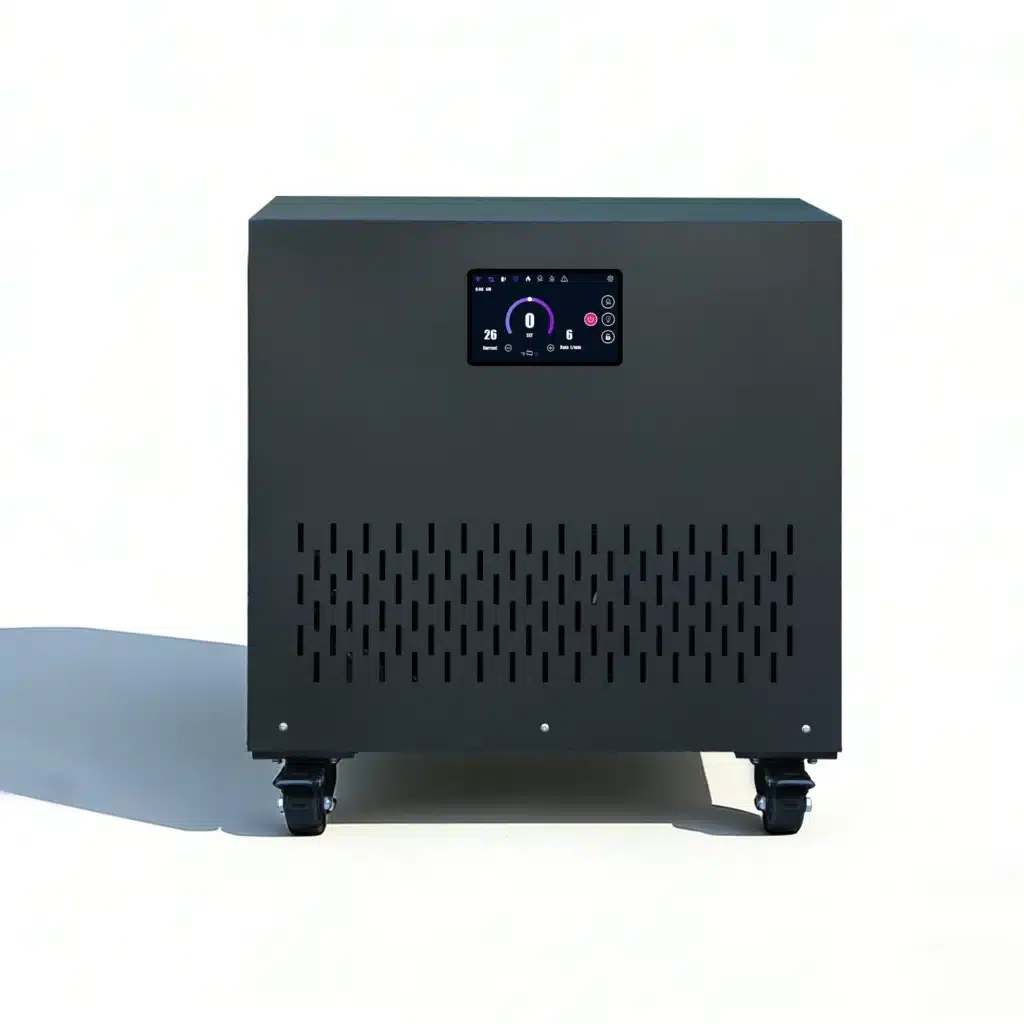
A dual-temp 1HP water chiller heater engineered with internal 4-way reversing valves and pure titanium heat exchangers for year-round cooling and heating.
Transition Times: The Real Physics of Switching from 39°F to 104°F
One of the most persistent misconceptions among new buyers is assuming a dual-mode machine can toggle instantly between freezing ice bath temperatures and soothing hot tub soaks in fifteen minutes. In reality, thermal inertia and specific heat capacity govern the speed of water temperature shifts.
Water has an exceptionally high specific heat capacity: heating one pound of water by 1°F requires exactly 1 BTU of energy. A standard 120-gallon cold plunge holds roughly 1,000 pounds of water. Shifting that water mass from a 39°F (4°C) plunge baseline up to a 104°F (40°C) hot soak requires overcoming a 65°F temperature differential, demanding 65,000 BTUs of net thermal input (not accounting for ambient surface radiation losses):
| Chiller/Heater Power Rating | Heating Output (COP 3.2 @ 60°F) | Hourly Temperature Rise (100 Gal) | Transition: 39°F to 104°F | Recommended User Scheduling |
|---|---|---|---|---|
| 0.8 HP Dual-Temp | ~ 8,500 BTU/hr | 8.5°F to 10.0°F per hour | 6.5 to 7.5 hours | Seasonal switching: run cold all summer, switch to hot for winter months. |
| 1.0 HP Commercial Dual-Temp | ~ 11,500 BTU/hr | 12.0°F to 14.0°F per hour | 4.5 to 5.2 hours | Weekly switching: morning cold plunge, evening hot soak with automated timers. |
| 1.5 HP High-Capacity Dual-Temp | ~ 16,000 BTU/hr | 17.0°F to 19.5°F per hour | 3.2 to 3.8 hours | Fast commercial turnover: rapid seasonal changeovers and athletic contrast suites. |
Understanding these transition rates clarifies that a dual-mode machine is designed for scheduled transitions rather than on-demand rapid cycling. For commercial gyms needing simultaneous hot and cold modalities every ten minutes, operators pair a standalone cold plunge with a dedicated sauna room. To explore simultaneous commercial contrast setups, review our layout guide on a sauna and cold plunge for gym setup.

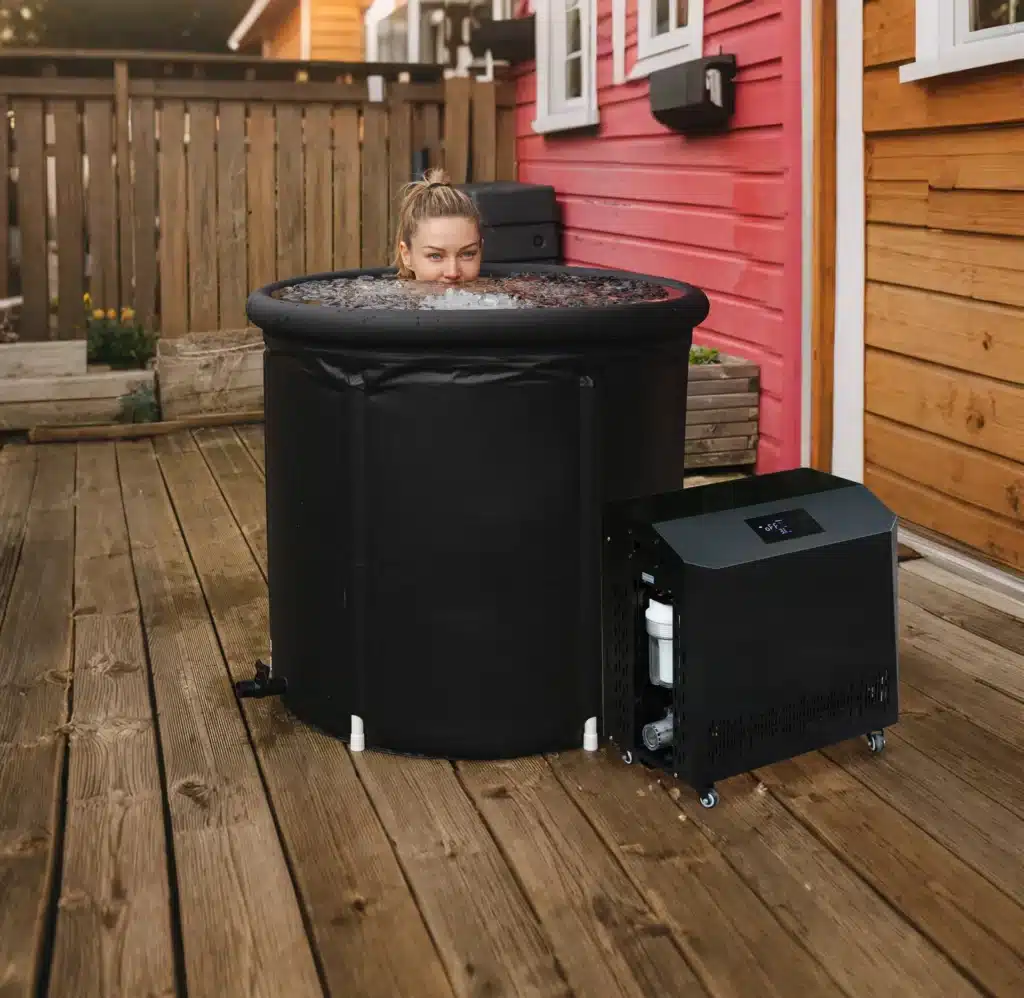
Heavy-duty water connection ports and high-surface finned coils allow dual-temp machines to maintain efficient heat transfer in both cooling and heating modes.
Titanium Heat Exchangers: Why Stainless Steel Barrels Fail in Heated Water
In single-mode cold plunge units that only chill water down to 39°F, biological growth and chemical corrosion kinetics are relatively sluggish. But when an operator switches a dual-mode machine into 104°F heating mode, chemical reaction rates increase exponentially.
Under higher water temperatures, warm water saturated with dissolved chlorides, bromine, or Epsom salts becomes aggressively corrosive. Low-cost import chillers constructed with 304 or 316 stainless steel coaxial heat exchanger tubes often suffer severe crevice corrosion and micro-pitting within a few heating cycles. Quality dual-mode chillers eliminate this risk by specifying pure Grade 1 or Grade 2 titanium tubing:
- Titanium Chemical Inertness: Titanium forms an extraordinarily durable, non-porous passive titanium dioxide (TiO2) oxide film that resists pitting attack from chlorine concentrations up to 50 PPM, dissolved salt pools up to 35,000 PPM, and aggressive ozone sanitizers across all temperature ranges up to 140°F.
- Thermal Expansion Tolerance: Shifting water from 37°F to 104°F subjects the metal evaporator tubing to severe thermal shock and dimensional expansion. Continuous extruded titanium spiral tubes flex safely without fatigue cracking along weld seams.
- Dual-Sided Flow Geometry: The fluted spiral groove inside the titanium tubing creates turbulent fluid flow on both the refrigerant and water sides, disrupting stagnant boundary layers and boosting heat exchange efficiency by up to 30%.
To inspect material durability boundaries across different tub liner metals, consult our engineering report on metal tubs for ice baths, or check our tub material comparisons in the cold plunge tub material guide.
Electrical Circuit Engineering: Dedicated Lines & In-Use Safety
Operating a dual-temp heat pump requires careful coordination with your electrical panel. Because heat pumps mechanically move heat using a compressor rather than burning pure electrical resistance (like a toaster-style hot tub heater), they deliver roughly 3.0 to 3.5 times more heat energy than they consume in electrical watts (Coefficient of Performance = 3.0–3.5):
- Continuous Electrical Load: A 1.0 HP dual-temp chiller draws approximately 900 to 1,150 electrical watts during continuous operation, translating to roughly 9.5 to 11.0 amps at 120 volts. A 1.5 HP commercial unit draws 1,400 to 1,800 watts, running at 13.0 to 15.0 amps on 120V (or 7.5 amps on 240V).
- Dedicated 20-Amp Branch Circuit: Under National Electrical Code continuous load requirements (the 80% rule), heating appliances operating for hours at a time must not exceed 80% of circuit capacity. A 1.0 HP or 1.5 HP machine requires a dedicated 120V / 20A circuit (using 12 AWG copper wire) protected by an industrial Class A GFCI breaker. Never share this line with patio lighting or landscape equipment.
- Weatherproof Exterior Protection: For outdoor patio installations, code mandates a NEMA 3R extra-duty in-use bubble box that latches completely closed over the heavy power plug during rainstorms. For full weatherproofing parameters, see our guide on an outdoor chiller unit for cold plunge setups.
For official public pool and spa electrical safety protocols, reference the federal standards outlined by Pool Safely guidelines.
Hydraulic Pipe Sizing & Thermal Insulation for Heated Loops
When operating a dual-temp system in 104°F heating mode, connecting water hoses carry significant thermal energy. Running uninsulated plumbing across a cold outdoor concrete patio creates severe radiant heat loss, dropping water temperature by 2°F to 3°F before it reaches the plunge tub.
Contractors follow three plumbing standards for dual-mode installations:
- High-Temperature Reinforced Hoses (Rated to 140°F): Standard clear vinyl tubing softens and kinks when subjected to 104°F hot water under pump pressure. Specify reinforced spiral-wire PVC hose or braided EPDM lines rated for continuous 140°F (60°C) operating temperatures.
- Closed-Cell Elastomeric Pipe Insulation: Wrap all exterior water lines in minimum 1/2-inch wall thickness closed-cell rubber pipe insulation. This prevents parasitic cooling losses during winter heating cycles and parasitic heat gain during summer chilling runs.
- Generous 1-Inch Internal Diameter (ID): Maintain water flow rates of 18 to 28 GPM across the titanium heat exchanger by using 1-inch ID plumbing. Restrictive fittings cause water to move too slowly, creating localized boiling hot spots across the heat exchanger during heating cycles.
Energy Efficiency & Operating Cost Comparison: Heat Pump vs. Electric Heater
Facility directors evaluating operational budgets should compare the energy economics of a reverse-cycle heat pump against traditional electric resistance heating elements found in standard hot tubs.
Electric immersion heaters operate at a static Coefficient of Performance (COP) of 1.0, converting 1,000 watts of electricity into exactly 3,412 BTUs of heat. In contrast, an air-source heat pump extracts free ambient heat from outdoor air, delivering a COP of 3.0 to 3.5 under 60°F ambient conditions:
- 65% Lower Electrical Draw: Heating a 100-gallon plunge tub with an electric resistance heater consumes roughly 15 to 18 kWh of power. A reverse-cycle heat pump achieves the same temperature rise consuming only 5 to 6 kWh, saving facility operators hundreds of dollars per month on commercial utility bills.
- Lower Peak Electrical Demand: Resistance heaters require 40A to 50A dedicated 240V breakers that strain facility electrical panels. A heat pump machine operates comfortably on a standard 20A branch circuit.
- Single Mechanical Asset: Facility operators maintain, filter, and sanitize a single tub and refrigeration unit rather than purchasing, plumbing, and servicing two separate hot and cold vessels.
Winter Operation & Anti-Freeze Protection
One of the greatest operational benefits of a dual-mode chiller heater is outdoor winter survivability. In single-mode cooling-only machines, sub-freezing ambient winter temperatures pose a severe risk: if standing water freezes inside the heat exchanger barrel, the metal tubing bursts, destroying the machine.
A reverse-cycle heat pump machine prevents winter freezing through two automated safeguards:
- Automated Smart Anti-Freeze Circulation: The digital controller monitors real-time return water temperatures. If the water temperature drops below 36°F (2°C), the internal pump automatically engages, circulating warm thermal mass through external hoses to prevent ice dam formation. If water continues dropping toward freezing, the compressor engages in heat pump mode to gently warm the loop back to 42°F.
- Winterization for Extended Sub-Zero Storage: If you decommission an outdoor tub for deep northern winters (below 15°F / -10°C), follow complete drainage protocols: disconnect water quick-connects, open the bottom drain plug, and use low-pressure compressed air (under 15 PSI) to purge standing water from the titanium coaxial coil. For step-by-step winterizing procedures, review our guide on cold plunge chiller winter storage and drainage.
For commercial water sanitation and bacteriological control standards, follow established CDC Healthy Swimming operating practices.
Factory-Direct Dual-Mode Chiller Systems from OMNI Ice
At OMNI Ice, our engineering team manufactures high-efficiency commercial and residential reverse-cycle water chilling platforms designed for year-round temperature management. Built with titanium coaxial heat exchangers, Panasonic and Mitsubishi rotary compressors, multi-barrier filtration, and corona discharge ozone, our equipment provides turnkey performance without distributor markups:
Featured Dual-Temp Cooling & Heating Equipment
- OMNI Deep Freeze 1.0HP & 1.5HP Dual-Temp Units: Commercial-grade reverse-cycle heat pump machines featuring pure titanium coaxial barrels, dual cooling/heating (37°F to 104°F), 20-micron filtration, and digital touchscreen controls.
- ProValue CH-08 0.8HP Ice Bath Chiller: Compact exterior-rated cooling unit engineered for private recovery suites and residential patios.
- WT-13 Cedar Cold Plunge Tub with Built-In 1.0 HP Chiller: Integrated luxury timber-clad recovery tub with enclosed dual-temp hardware, eliminating loose exterior hoses entirely.
If your project requires private-label equipment manufacturing, full containerload wholesale distribution, or custom engineering submittals, explore our complete OEM cold plunge equipment solutions or connect directly with our engineering team through our commercial equipment RFQ desk.
The Buyer Procurement Checklist for Dual-Temp Units
Before placing a purchase order for a dual-mode water chilling and heating machine, confirm these six technical specifications with your supplier:
- Reversing Valve Mechanism: Confirm that heating is generated by a true reverse-cycle 4-way refrigeration valve rather than an inefficient electric immersion coil that burns high wattage.
- Titanium Heat Exchanger Coils: Ensure the coaxial heat exchanger is manufactured from 100% pure titanium to resist chemical pitting in 104°F warm water.
- Dedicated Power Drop: Verify that a dedicated 20A GFCI circuit is pulled within 6 feet of the equipment pad before freight delivery.
- Airflow Heat Rejection Clearances: Maintain at least 18 inches of clearance on intake and 30 inches on exhaust fans to prevent thermal recirculation lockouts in both cooling and heating modes.
- Automated Defrost Logic: Confirm the machine includes automated hot-gas bypass defrost for reliable heating performance in sub-45°F outdoor ambient air.
- Multi-Stage Water Sanitation: Ensure integrated 20-micron pleated filtration and automated ozone injection are standard to handle biological bather loads at higher water temperatures.
When properly engineered with reverse-cycle heat pump efficiency, pure titanium metallurgy, and dedicated electrical protection, a dual-mode water chiller heater delivers year-round recovery versatility—keeping water freezing cold in summer, soothingly warm in winter, and operationally reliable through every season.