An air-cooled vs water-cooled cold plunge chiller decision starts with the condenser, not the tub-water connection. An air-cooled condenser sends refrigerant heat into ambient air through a coil and fan. A water-cooled condenser sends that heat into a separate condenser-water circuit, which still needs a heat-rejection device and operating plan. The bath-water loop is the load being cooled; it does not make a chiller water-cooled.
This article helps facility designers, commercial operators, installers and OEM buyers choose the heat-rejection route before they compare catalogue capacity. It covers eight site decisions: system boundaries, heat destination, utilities, water use, maintenance, noise, operating responsibility and acceptance evidence. It does not claim that OMNI currently offers every architecture or that one route is always more efficient.
Air-cooled vs water-cooled cold plunge chiller: draw three loops first
A comparison becomes confused when every pipe is called a cooling-water pipe. Draw three boundaries before discussing equipment:
- Bath-water loop: water travels from the tub through the pump, filter and evaporator side of the chiller, then returns to the tub.
- Refrigerant circuit: refrigerant moves heat between the evaporator and condenser inside the refrigeration system.
- Condenser heat-rejection path: the condenser releases heat to ambient air or to a separate condenser-water circuit.
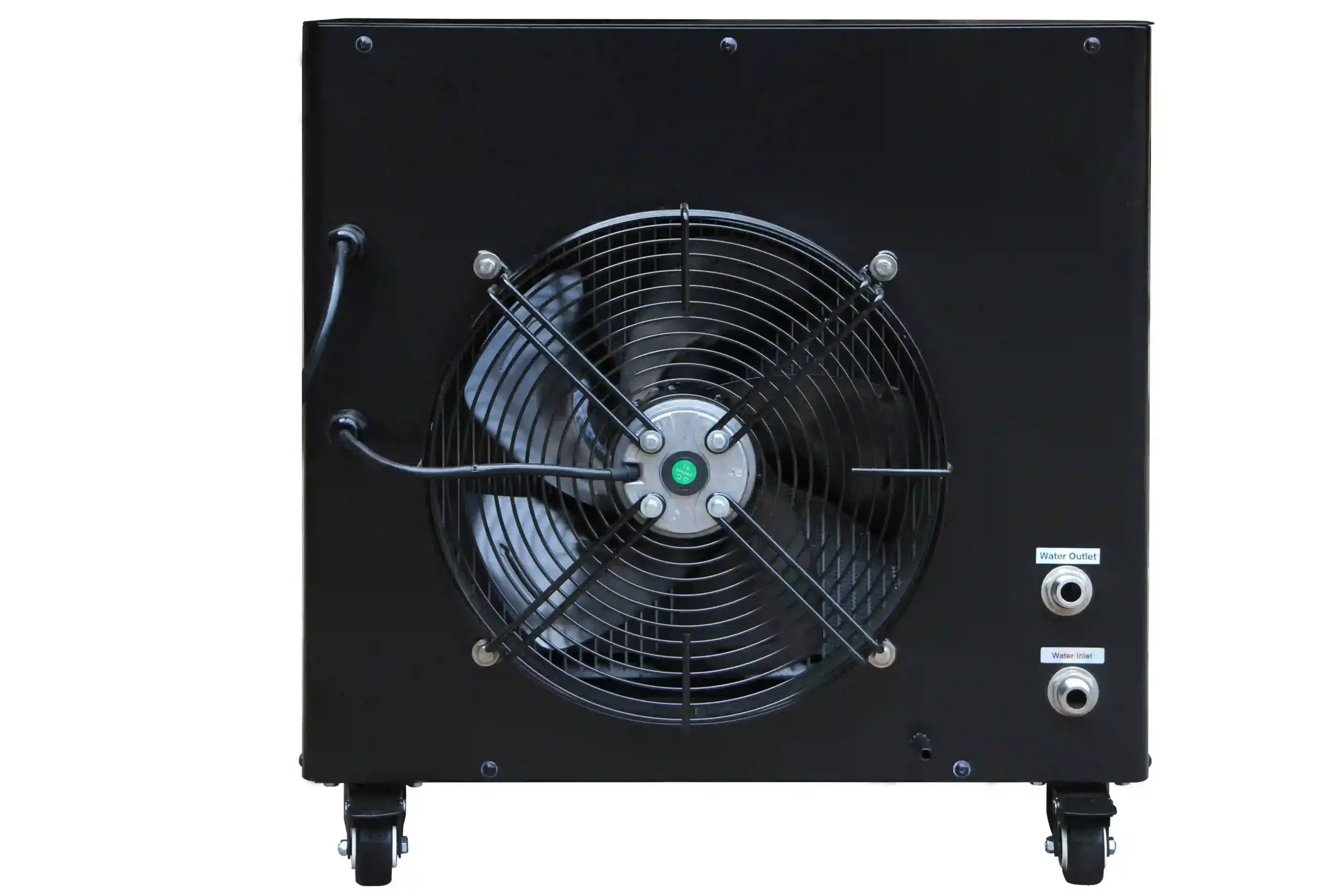
The first loop exists in both routes. A product photograph may show water inlet and outlet ports next to a large fan. That machine can still be air-cooled because the fan and condenser coil handle the heat-rejection side while the ports serve the bath-water side. Calling it water-cooled because tub water enters the cabinet changes the meaning of the term and can lead to a completely wrong site brief.
| Boundary | Air-cooled condenser route | Water-cooled condenser route | Buyer evidence |
|---|---|---|---|
| Bath-water loop | Tub water transfers heat at the evaporator side | Tub water transfers heat at the evaporator side | Flow diagram, pump/filter responsibility, water temperatures and service points |
| Refrigerant circuit | Moves heat from evaporator to an air-side condenser | Moves heat from evaporator to a water-side condenser | Exact offered architecture and service boundary |
| Final heat rejection | Fan moves ambient air across the condenser coil | Condenser water carries heat to a cooling tower, dry cooler or other approved system | Air path or condenser-water diagram, design conditions and responsible operator |
Use the cold plunge chiller flow-rate record for the bath-water side and the heat-rejection worksheet for the condenser boundary. Those pages answer different measurements. Neither should be replaced by one unlabeled arrow marked “water.”
What the air-cooled cold plunge route requires
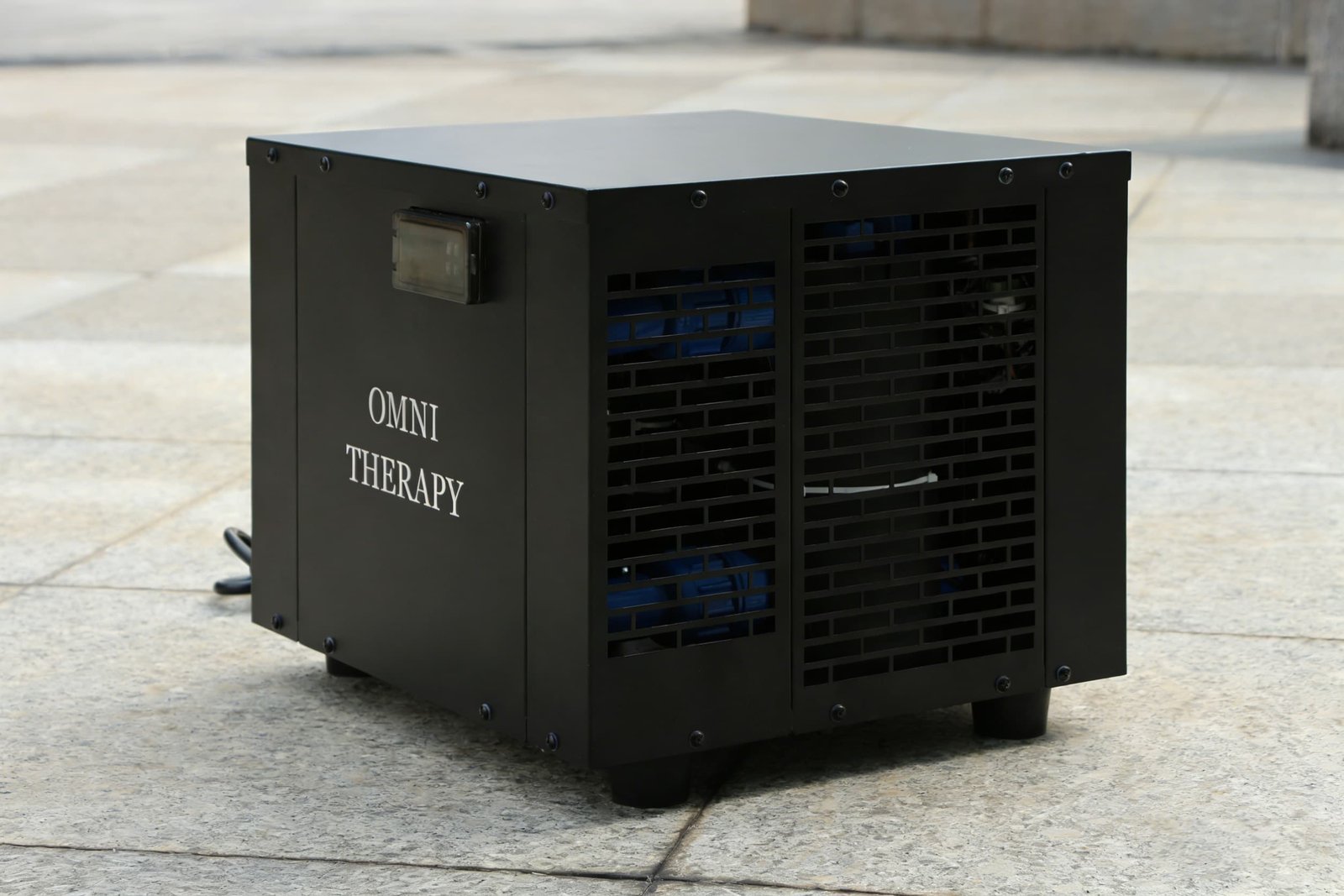
An air-cooled package is usually easier to recognize: the condenser coil and fan exchange heat with the surrounding air. The site must provide suitable entering air, a discharge path, model-specific clearances and a way to keep warm discharge from returning directly to the intake. An air-cooled vs water-cooled cold plunge chiller comparison should therefore treat room air and equipment placement as project utilities, even when no condenser-water pipe is required.
The local heat release is not the same as the building’s complete room load. The package rejects heat removed from the bath water plus relevant electrical input across the defined equipment boundary. If the tub and chiller share a room, part of that heat is being moved within the same room boundary. A building-services designer still needs to reconcile operating periods, other loads and the path by which heat leaves the space.
For indoor installations, record the intended air path with normal doors, panels and decorative cabinets in place. A demonstration with a joinery door open does not prove the normal arrangement. Available documents can use different orientation conventions in the manual and heat-placement drawing. Until the exact model, version and discharge direction are reconciled, do not choose the smaller clearance or publish one universal front/rear number.
Air-cooled equipment can also move heat outdoors, but outdoor location introduces weather, debris, drainage, corrosion, access and sound questions. Use the outdoor cold plunge site checklist rather than assuming outdoor air automatically solves every heat-rejection problem.
What a water-cooled condenser route adds
A water-cooled condenser does not remove the need for heat rejection. It moves that job into a second water circuit. The project must define the condenser-water supply and return, flow, temperatures, pressure boundary, water quality, isolation, controls and the final device that rejects heat. That device may be shared building infrastructure or dedicated project equipment. The supplier should identify the exact arrangement instead of writing only “water-cooled.”
Trane’s chiller overview distinguishes air-cooled equipment, which rejects heat through air, from water-cooled equipment that uses a cooling tower and condenser-water circuit. That commercial-HVAC source explains the architecture; it is not an OMNI product specification or proof that a building condenser-water loop suits a cold-plunge project.
A shared condenser-water system introduces coordination with the building operator. Available water temperature and flow can change by season or plant loading. Water treatment, tower maintenance and shutdown windows may sit outside the cold-plunge operator’s control. The project also needs a response when the central system is unavailable. A small wellness facility without existing infrastructure may find this burden disproportionate. A larger site with an established plant may evaluate it differently.
Do not connect bath water to a building condenser loop. These circuits have different functions, water-quality conditions, pressures and ownership. The bath loop serves human-immersion equipment and its water-care plan. The condenser loop serves heat rejection. A heat exchanger may separate circuits, but the complete design and local requirements need qualified review.
Eight decisions for an air-cooled vs water-cooled cold plunge chiller
Use the following table before requesting price. It turns the route choice into a site-and-operations comparison rather than a claim that one condenser type is always better.
| Decision | Air-cooled route | Water-cooled route | Approval evidence |
|---|---|---|---|
| 1. Existing infrastructure | Requires an acceptable air location and electrical supply | Requires an approved condenser-water and final heat-rejection system | Site utility drawing and capacity/availability statement |
| 2. Heat destination | Warm air is released where the condenser operates | Heat moves into condenser water and then to another device/location | Marked heat path from bath water to final environment |
| 3. Design conditions | Entering-air condition and recirculation affect the package | Condenser-water supply/return conditions and plant operation affect the package | Condition-linked supplier performance information |
| 4. Water use | No cooling-tower make-up water for the condenser route | Open evaporative heat rejection can require make-up, blowdown and water management | Water balance, treatment and discharge responsibility |
| 5. Maintenance | Coil, fan, air path and debris control | Condenser circuit, heat exchanger, tower/dry cooler, treatment and pumps | Task list, access, spares and responsible operator |
| 6. Sound and placement | Fan and compressor sound occur at the package location | Package sound plus pumps and remote heat-rejection equipment | Condition-linked sound and site assessment |
| 7. Failure and redundancy | Local fan/coil or ambient problem can affect operation | Package plus shared condenser plant availability can affect operation | Alarm, shutdown, backup and service plan |
| 8. Commercial boundary | Often a more self-contained package, but still needs site heat and access decisions | More interfaces may sit with the building operator or another supplier | Responsibility matrix, exclusions and commissioning plan |
An air-cooled vs water-cooled cold plunge chiller evaluation should keep cooling capacity, energy input and site utility consumption in separate columns. A package efficiency figure does not include every pump, fan, tower or treatment burden unless the stated boundary says so. Ask each supplier to identify what its number includes.
Two site briefs can produce different route decisions
Illustrative comparison, not an OMNI customer case: a small recovery studio has no condenser-water plant, limited mechanical staff and a direct path to place an air-cooled package outside the treatment room. Its air-cooled vs water-cooled cold plunge chiller review should focus on discharge recirculation, weather protection, sound, service access and the room boundary. Adding a cooling tower only to change condenser type would introduce a separate water and maintenance system.
A hotel project may already have an operating condenser-water plant with recorded supply/return conditions, treatment, alarms, seasonal capacity and named facilities staff. Its air-cooled vs water-cooled cold plunge chiller review can test whether a water-cooled package is compatible with that plant and whether the plant is available during the wellness area’s operating hours. Existing pipework alone is not approval; the operator must confirm capacity, connection and shutdown responsibility.
The two briefs use the same bath-water inputs but reach different infrastructure questions. The studio cannot treat “water-cooled” as automatically more efficient without counting the added tower, pumps and water management. The hotel cannot treat an air-cooled package as self-contained without deciding where warm air and sound go. The air-cooled vs water-cooled cold plunge chiller decision changes because the site boundary changes, not because one label wins everywhere.
Write the route recommendation with its conditions: selected architecture, included equipment, design point, utility assumptions, heat destination and responsible teams. If one of those conditions is unknown, keep the air-cooled vs water-cooled cold plunge chiller choice open and request the missing site evidence.
Water-cooled heat rejection needs named water-management responsibility
The U.S. Environmental Protection Agency’s WaterSense water-efficiency management guide explains that cooling towers lose water through evaporation, blowdown and drift and require make-up water and management of cycles of concentration. The guide addresses facility water management, not cold-plunge product approval. It shows why a water-cooled route needs a water balance and operating responsibility rather than a line item labelled “tower available.”
Ask whether the heat-rejection device is open evaporative, closed-circuit, dry or another configuration. Record treatment responsibility, seasonal operating limits, water-quality limits, corrosion/scale control, bleed or discharge arrangements and what happens during maintenance. Do not infer these from the presence of two condenser-water connections.
Air-cooled equipment avoids cooling-tower water on the condenser side, but it still needs coil cleanliness and an unobstructed air path. Dust, lint, landscaping debris or a cabinet can reduce heat transfer. The maintenance comparison should therefore list real tasks for each route rather than describing one as maintenance-free.
The bath-water sanitation and filtration plan remains separate in both cases. Use the cold plunge filter-system guide for the immersion-water loop. Cooling-tower treatment does not sanitize bath water, and bath-water chemistry is not a substitute for condenser-water management.
Move heat and sound together on the site plan
Air-cooled package fans put heat movement and part of the sound source at the chiller location. A water-cooled route may reduce or change package airflow, but pumps and remote heat-rejection equipment introduce other sources and locations. The comparison must use the complete system boundary and operating state.
Do not use an unqualified dB number. The cold plunge chiller noise-test record identifies the equipment state, instrument, distance, background and room conditions needed to compare sound evidence. Historical C-type noise records exist, but the measurement distance, method, date and current-model mapping remain unresolved; those records do not establish a current product rating.
For an indoor project, place the heat-rejection path, sound-sensitive rooms, service space and removal route on the same plan. A location that works thermally may still be poor for occupants. An acoustic enclosure that appears helpful can obstruct airflow or service. Use the indoor installation guide to coordinate those interfaces.
Compare complete submittals, not route labels
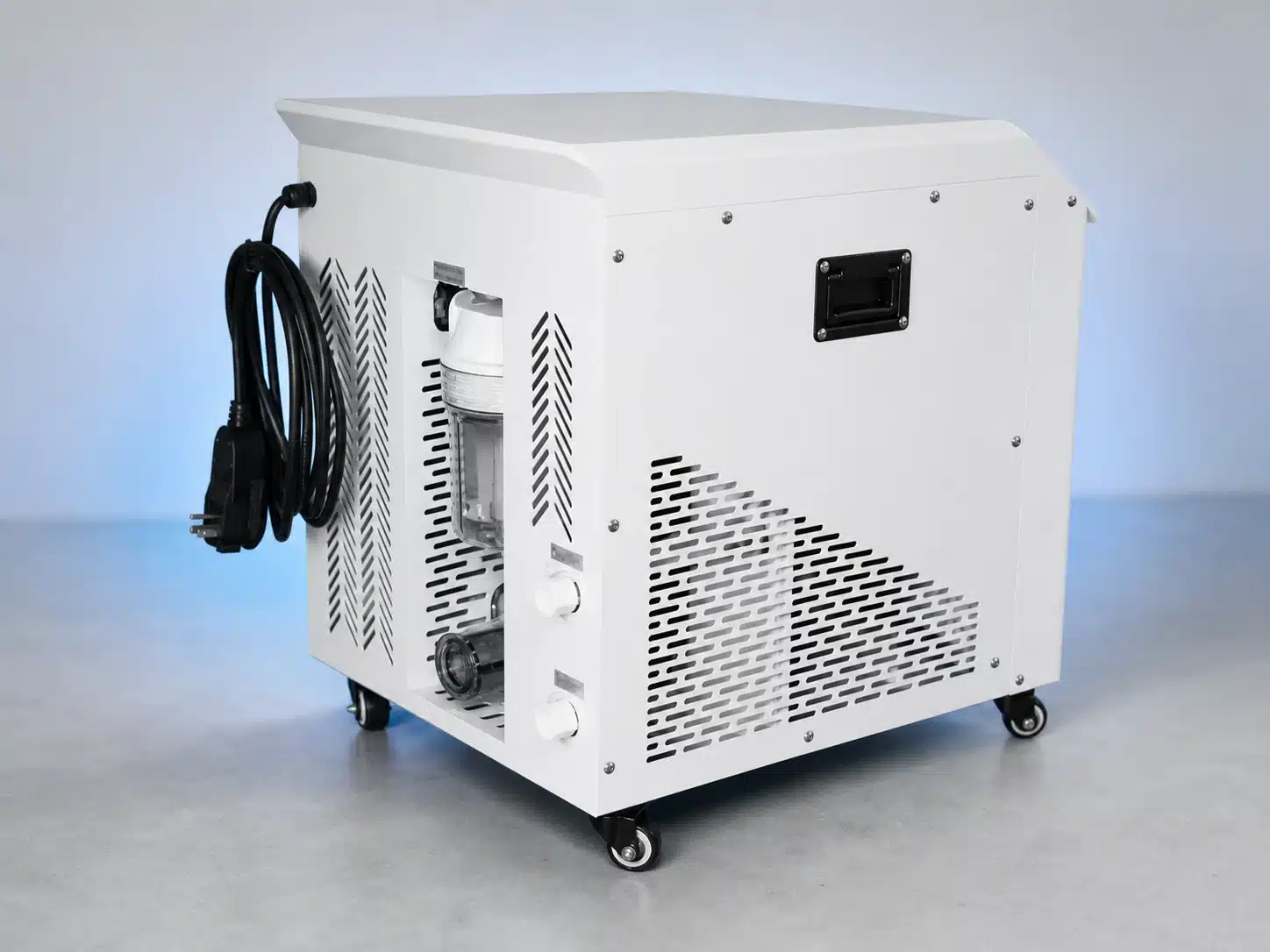
Request one boundary diagram from each supplier. An air-cooled vs water-cooled cold plunge chiller submittal should identify the tub-water circuit, refrigerant package and final condenser heat-rejection route. Mark every pump, fan, heat exchanger, tower or dry cooler that affects operation. Then attach the conditions used for performance and sound information.
For an air-cooled proposal, require the intake/discharge faces, ambient conditions, clearance drawing, local heat release, enclosure restrictions and maintenance access. For a water-cooled proposal, require condenser-water temperatures, flow/pressure requirements, water-quality limits, circuit diagram, heat-rejection equipment assumptions and control/plant interface.
Compare responsibilities as carefully as specifications. Who designs the room or plant connection? Who supplies pumps and treatment? Who can shut down the central loop? Who services each side? Who records commissioning values? The lower equipment price is not a complete commercial answer when another contractor or plant must carry substantial scope.
| Submittal status | Buyer decision |
|---|---|
| Exact architecture, conditions, utilities, heat path and responsibilities are documented | Compare the two routes against the real site and operating plan |
| The proposal says “water-cooled” but shows only bath-water inlet/outlet | Hold classification and request the condenser boundary |
| The air-cooled unit has no approved heat destination or normal-panel air path | Hold location approval even if a short demonstration cools water |
| The water-cooled route depends on unconfirmed building water or tower capacity | Hold equipment approval until the facility operator confirms the interface |
RFQ fields for the condenser route
- Project: destination, site type, indoor/outdoor equipment positions and operating schedule.
- Bath duty: usable water volume, start/target temperatures, pull-down/holding duty, users, cover and insulation.
- Requested architecture: supplier to state air-cooled, water-cooled or another defined condenser route.
- Boundary diagram: bath-water loop, refrigerant package and final heat-rejection equipment.
- Design conditions: air or condenser-water conditions used for capacity and input data.
- Utilities: electrical supply, condenser water, make-up/discharge, treatment and controls where applicable.
- Installation: airflow or pipe route, clearances, drainage, noise, service and replacement access.
- Responsibilities: supplier, installer, facility operator and commissioning authority for each interface.
- Evidence: drawings, manuals, condition-linked performance, sound method, alarms and acceptance record.
Use the OEM cold plunge chiller RFQ template to send the complete requirement and the OMNI chiller configuration page to review currently offered product routes. To discuss a specific project, send OMNI the site utilities, bath duty and heat-rejection boundary. Do not select an air-cooled vs water-cooled cold plunge chiller from the condenser label alone.
The air-cooled vs water-cooled cold plunge chiller choice is ready for approval only when the drawing, design conditions, utilities, maintenance scope and final heat destination describe the same proposed system.
Questions about air-cooled and water-cooled chillers
Does tub water flowing through a chiller make it water-cooled?
No. Tub water is the load loop. Water-cooled describes the condenser heat-rejection side, which uses a separate condenser-water circuit and final heat-rejection system.
Is a water-cooled cold plunge chiller always more efficient?
No universal answer is supported. Compare condition-linked package performance and include the pumps, tower or other supporting equipment inside the stated system boundary.
Can an air-cooled cold plunge chiller operate indoors?
Only when the exact model’s air path, clearances, ambient limits, local heat release, room assessment and service access are resolved. A vented cabinet by itself is not proof.
Does a water-cooled condenser eliminate heat rejection?
No. It transfers condenser heat into water, which must release that heat through a cooling tower, dry cooler or another approved system.
What should an air-cooled vs water-cooled cold plunge chiller quotation include?
It should identify the exact condenser architecture, bath-water and condenser boundaries, design conditions, utilities, heat destination, controls, maintenance, sound basis, responsibilities and acceptance evidence.