A portable water chiller for cold plunge use is portable only when the complete move cycle is defined: drain, disconnect, handle, transport, reconnect, prime, leak-check and restart at an approved destination. Wheels or a pull handle solve one part of that cycle. They do not prove that the filled system, electrical supply, hoses, airflow or recommissioning steps are suitable at the next location.
This article helps distributors, mobile-service operators, installers and buyers compare portable chiller proposals without treating “plug and play” as a specification. It provides ten mobility checks, a move-cycle record and clear boundaries between a portable tub, a movable chiller and a transportable complete system. Exact weights, orientations, electrical requirements and handling instructions must come from the selected model.
Decide what “portable” means for this project
Portable can describe four different jobs. A person may carry a small dry unit. Staff may roll a heavier machine between nearby rooms. A transport crew may move equipment between venues. A supplier may simply mean that the chiller is not permanently built into the tub. Define what portable water chiller for cold plunge use means for the intended project before comparing products.
Use mobility classes instead of one unqualified label:
| Mobility class | Decision it answers | Evidence to request |
|---|---|---|
| Carryable dry equipment | Can the identified dry unit be lifted and carried through the route using the approved handling method? | Dry weight, dimensions, lift points or grips, personnel/equipment requirement and orientation limits |
| Wheeled local relocation | Can staff roll the drained unit between defined positions on one site? | Caster and handle arrangement, route survey, thresholds, slope, turning space and parking restraint |
| Transportable between sites | Can the complete equipment package be secured, protected and recommissioned after vehicle transport? | Packing/restraint method, permitted orientation, drain-down state, accessory inventory and restart procedure |
| Installed but disconnectable | Can qualified personnel remove the unit for service or seasonal storage? | Isolation points, hose and electrical connection method, service clearance and removal path |
A portable tub and portable chiller are separate decisions. The inflatable ice bath tub page covers a collapsible vessel category. A portable water chiller for cold plunge projects has its own equipment move cycle. A compact tub does not make its water-filled circuit easy to relocate, and a wheeled chiller does not make the tub portable.
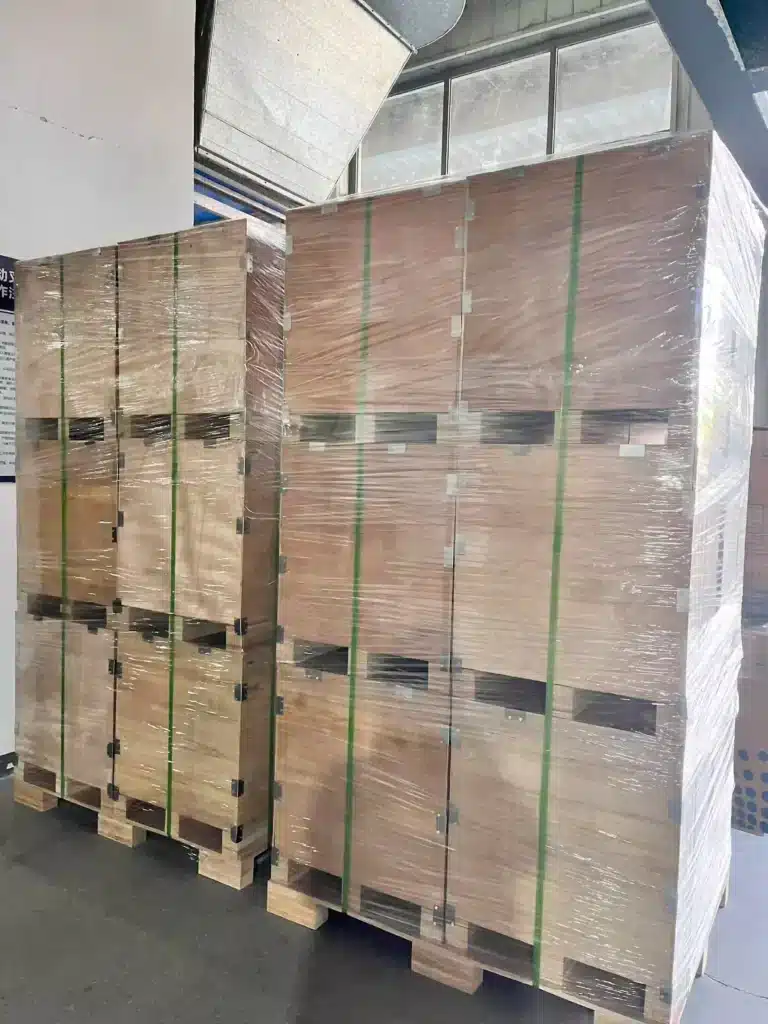
Also separate shipping from routine movement. Export packaging protects equipment under a defined logistics plan. It does not automatically become a road case for repeated events. A product that arrived safely on a pallet may still require a different restraint, orientation and protection method before mobile use.
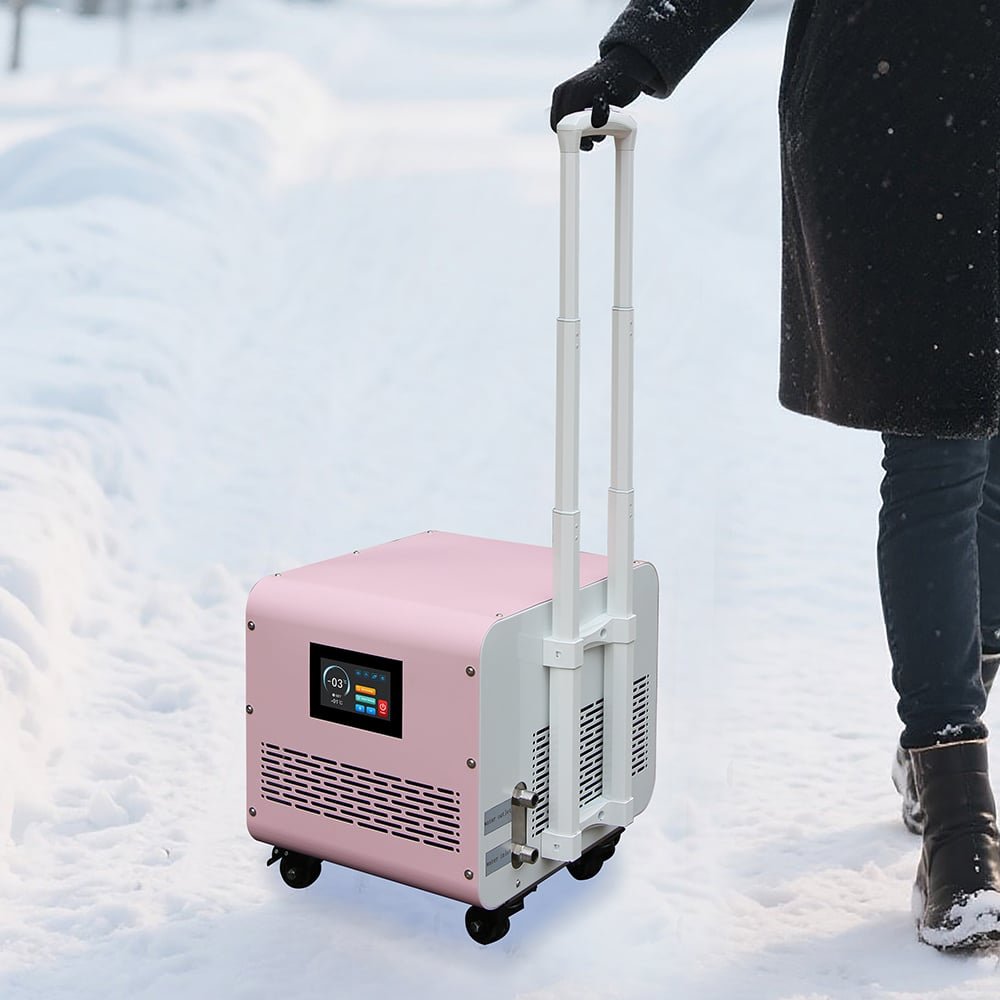
Ten checks for a portable water chiller for cold plunge use
Ask the supplier and site team to complete the same portable water chiller for cold plunge checklist. A blank field is an unresolved interface, not permission to assume the most convenient answer.
| Check | What to confirm | Common mistake |
|---|---|---|
| 1. Exact mobility task | Carry, roll on one site, vehicle transport, seasonal removal or service exchange | Using portable without naming where or how often the unit moves |
| 2. Transport state | Dry/drained condition, residual water points, accessories removed, covers and permitted orientation | Moving a connected or water-retaining system because the cabinet has wheels |
| 3. Weight and handling | Verified dry and transport weight, center of mass, handles/lift points, people or handling equipment required | Estimating lift safety from cabinet dimensions |
| 4. Route envelope | Overall dimensions, handle extension, turning radius, doors, lifts, ramps, thresholds, slopes and surface capacity | Checking only the final floor footprint |
| 5. Water connections | Port size/type, hose specification, isolation, caps, spill control, connection labeling and spare seals | Assuming any quick connector is compatible and sanitary |
| 6. Drain and prime method | Approved drain points, lawful discharge location, residual-water management, pump/chiller priming and air removal | Restarting a dry or air-bound circuit immediately after reconnection |
| 7. Electrical destination | Exact voltage/frequency, plug or connection, circuit capacity, protective devices, wet-area arrangement and qualified approval | Calling the unit plug and play because a plug is visible |
| 8. Air and environment | Model-specific clearance, intake/discharge path, ambient/weather limits and stable operating surface | Parking the chiller against a wall or inside a closed event cabinet |
| 9. Restart verification | Connection, leak, flow, controller, alarm and operating checks before handover | Treating power-up as proof that the relocated system is ready |
| 10. Service and records | Accessory inventory, damage check, cleaning/storage boundary, responsible operator and move history | Losing adapters, caps or the accepted configuration between venues |
The visible product details can support the discussion, but they are not the complete evidence package. For example, the CHU-05-RV product page shows a portable-style equipment configuration. Confirm all project-specific dimensions, weight, electrical variant, operating limits and handling instructions in the quotation and technical documents before approval.
Approve the route before approving the wheels
Walk the real path with a dimensioned equipment envelope. A portable water chiller for cold plunge use must fit the narrowest door, lift, turn, ramp, threshold and final service position under the approved handling method. Include the handle in its extended and stored positions. Check whether staff must lift the unit over a curb or protect a finished floor. A caster that works on a smooth factory floor may not cross carpet transitions, drainage channels or outdoor paving safely.
Define who moves the chiller and what aids are permitted. Do not infer a one-person lift from the word compact. If the unit needs a trolley, ramp or two-person handling method, state that method in the operating record. Keep hands and feet away from pinch points and secure the unit against rolling at the destination.
Use a route table:
| Route point | Available condition | Equipment need | Decision |
|---|---|---|---|
| Storage position | Ventilation, dryness, floor level and access | Approved storage state and accessory control | Accept / modify / hold |
| Door, lift or vehicle | Clear width/height, capacity, restraint points and loading method | Transport dimensions, weight and handling orientation | Accept / handling aid / alternate route |
| Ramp, slope or threshold | Gradient, surface, drainage channel and edge condition | Caster/handle suitability and safe control method | Accept / bridge / trolley / hold |
| Operating location | Stable floor, water containment, power, airflow and service clearance | Installation requirements for the exact configuration | Approve only after interface checks |
The move is not complete when the wheels stop. The final position still needs the broader indoor cold plunge installation checks or the relevant outdoor site checks. Relocation frequency does not reduce the requirement for a suitable operating position.
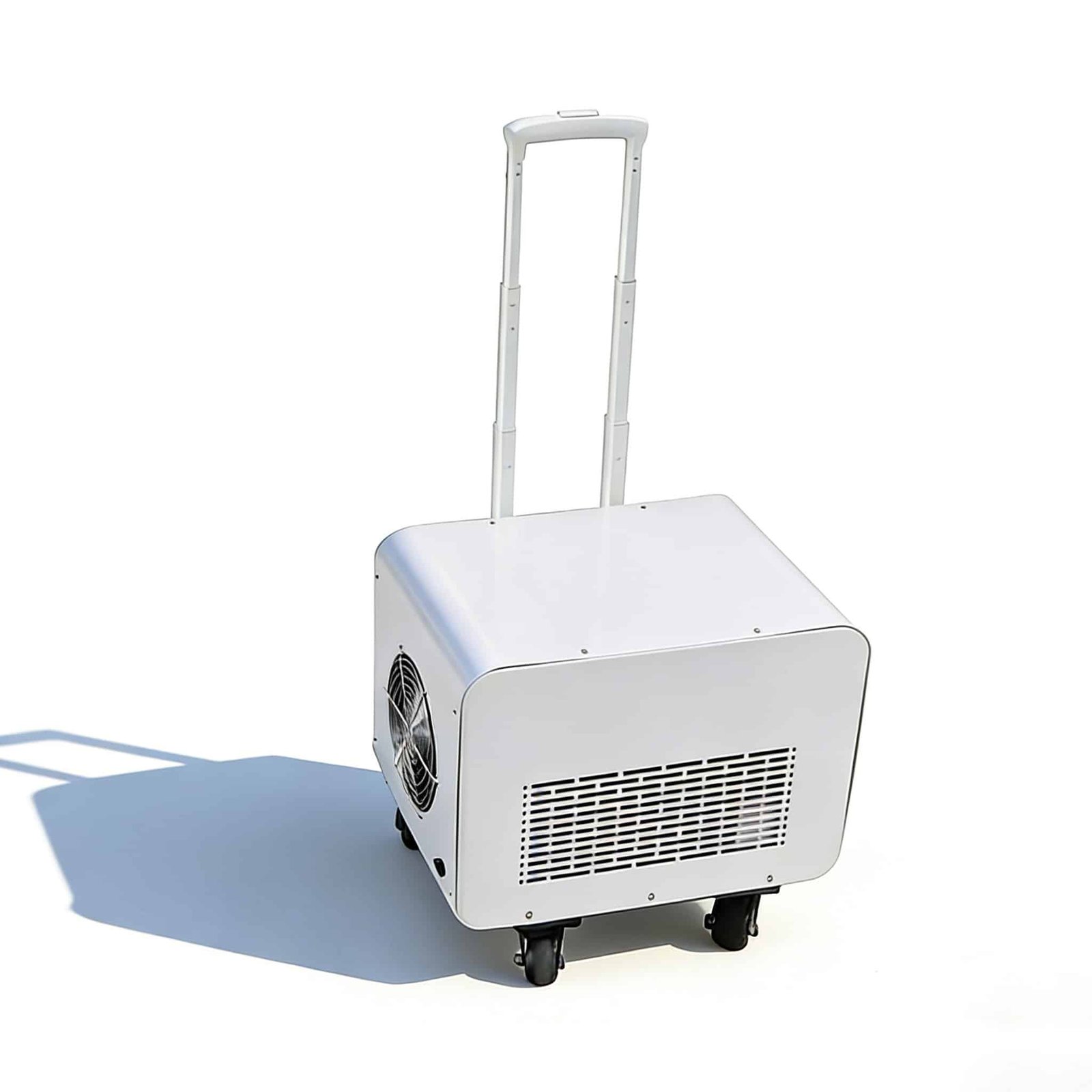
A portable machine still depends on fixed site interfaces
A portable water chiller for cold plunge operation shifts work from permanent installation to repeated connection management. Each destination needs compatible power, a controlled water route, drainage, adequate heat rejection and a person responsible for the setup. If those interfaces are improvised at every move, the equipment may be movable while the operating system remains unreliable.
For electrical planning, record the exact rating and destination supply. In the United States, the U.S. Consumer Product Safety Commission explains the protective role of ground-fault circuit interrupters where electrical products may contact water. The CPSC electrical-safety guidance also emphasizes correct cords, plugs and protective devices. These sources are general U.S. safety guidance, not an installation approval for a specific chiller. Use the exact manufacturer instructions, applicable local rules and a qualified electrical decision for each destination.
Do not daisy-chain adapters or choose an extension arrangement from a generic article. If temporary power is part of the operating plan, define the approved equipment, routing, protection from water and inspection responsibility through the qualified site process. A different country, venue or electrical variant can change the connection entirely.
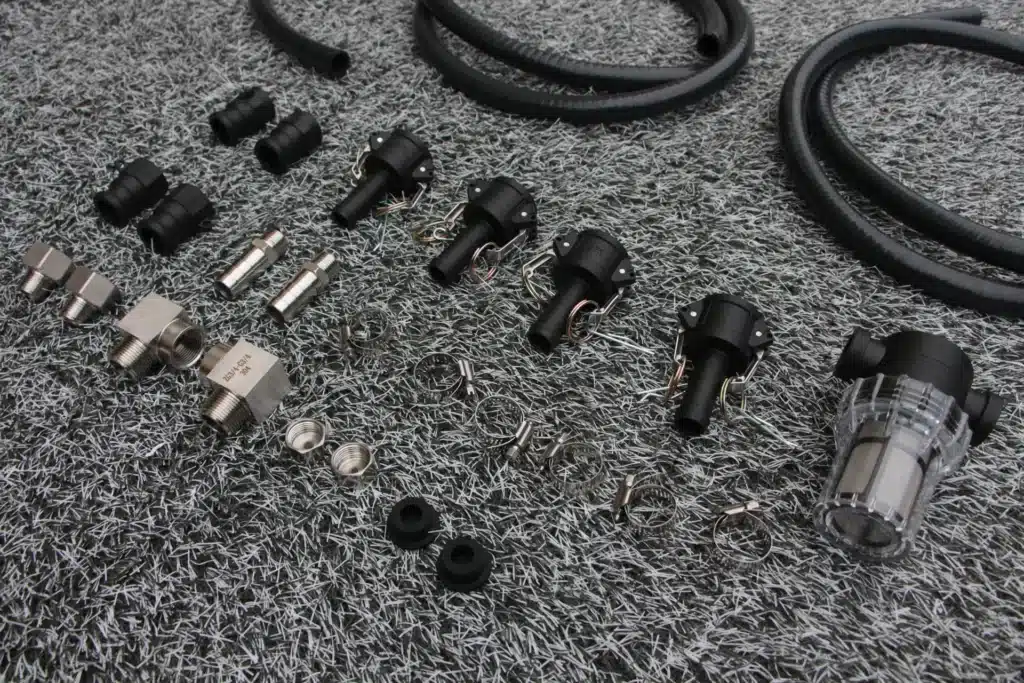
Water connections need the same discipline. Label inlet and outlet. Use the specified hose or pipe size, material and connector. Cap open ports during transport. Record where residual water goes and how cross-contamination is prevented between sites. A quick connector makes disconnection faster; it does not prove material compatibility, pressure suitability or hygienic condition.
Air is another site interface. A wheeled air-cooled chiller still rejects heat where it operates. Keep the required intake, discharge and service space at every destination. The chiller heat-rejection worksheet helps the site team separate equipment discharge from the whole-room decision.
Treat every move as a controlled recommissioning event
Write the portable water chiller for cold plunge move-cycle time as a sum of real tasks rather than promising an unsupported setup time:
Total move cycle = drain and isolate + disconnect and protect + move and secure + reconnect + prime and leak-check + operating verification.
No duration is supplied here because hose length, retained water, route, equipment design and site readiness differ. Measure the cycle during a representative trial if setup time matters commercially. Record delays separately so the buyer can distinguish the machine-handling time from missing power, unsuitable drains or lost accessories.
After relocation, inspect the cabinet, casters, handle, cable, ports, hoses and retained accessories. Confirm the unit has been in any required post-transport orientation or rest state stated by the manufacturer before starting. Do not invent a universal waiting period. Use the exact product instruction.
Reconnect to the approved diagram. Prime the water circuit as required and check for air, leaks and hose interference. Verify actual operating flow through the relevant method rather than judging from outlet feel; the cold plunge chiller flow-rate record provides a measurement boundary. Then check controller state, alarms and the agreed operating observation before releasing the system.
| Finding after a move | Decision |
|---|---|
| Route, connections, electrical supply, airflow and restart checks match the approved record | Release the system for the stated destination and operating scope |
| The unit powers on, but flow, leak, drain or site condition is unresolved | Keep operational handover open; identify the missing evidence and responsible person |
| Transport damage, severe vibration, electrical concern, refrigerant-system concern or repeated protection occurs | Stop and use the qualified service path; do not continue an improvised restart |
| A new adapter, hose, enclosure or power arrangement is proposed | Review the changed interface before relying on the previous acceptance |

Run one portable water chiller for cold plunge move trial
Illustrative method, not a published OMNI test: choose the hardest expected route and run the complete move with the exact equipment, accessories and responsible staff. Begin from the normal storage or operating state. End only when the connected system has passed the agreed leak, flow, controller and operating checks at the destination. The trial should reveal work that a product photograph cannot show.
Time each segment separately: shutdown and drain, connection protection, equipment handling, route movement, positioning, reconnection, priming, leak inspection and operating verification. A portable water chiller for cold plunge project may have a short rolling segment but a long drain or prime segment. Separate timing helps the buyer improve the real bottleneck without claiming that the chiller itself moves slowly.
Record every person, tool and accessory used. If one threshold requires a temporary ramp, that ramp belongs in the operating kit. If a hose cap, spare seal or adapter is needed after every move, list and store it with the equipment. If staff must tilt the machine beyond the documented transport orientation, the route fails until the handling method or route changes. Do not redefine the equipment limit to preserve a preferred venue.
Build a controlled mobility kit for the accepted configuration. It may include labelled hoses, connection caps, specified seals, spill-control materials, cable protection, the approved handling aid, the route sheet and the restart checklist. The contents must come from the real equipment and site plan, not from a generic portable-chiller list. Inventory the kit before departure and after return so a missing cap or adapter is found before the next venue.
Define the storage state as carefully as the operating state. Record whether the portable water chiller for cold plunge system is stored drained, protected from weather, disconnected from the tub and kept within stated environmental conditions. Mark which components require cleaning or drying and who signs the return-to-storage check. Repeated movement can fail operationally because accessories, residual water or damage are unmanaged even when the cabinet rolls correctly.
Repeat the trial when a material interface changes. A longer hose, different connector, new power location, altered enclosure, steeper route or different transport vehicle can change the accepted setup. The portable water chiller for cold plunge record should identify the tested revision and destination class so staff do not apply one successful move to every future site.
Use the result to write a clear operating boundary: who may move the equipment, in what state, with which kit, over which route types and through which restart checks. A portable water chiller for cold plunge system becomes operationally portable when another trained person can follow that record and reach the same accepted state. Wheels remain helpful hardware, but the repeatable process is what supports the buyer’s deployment decision.
Copyable portable-chiller mobility record
- Mobility purpose: local room change, mobile event, vehicle transport, storage or service exchange.
- Equipment identity: model, serial/sample ID, electrical variant, controller revision and supplied accessories.
- Transport state: drained points, residual-water control, caps, removable accessories, permitted orientation and protection.
- Handling: verified weight, dimensions, center-of-mass concern, approved grips/lift points, people and equipment.
- Route: doors, turns, lifts, thresholds, slopes, vehicle restraint and destination floor.
- Water interface: inlet/outlet, hoses, connectors, isolation, drain destination, prime method and spare seals.
- Electrical interface: voltage/frequency, connection, circuit and protective requirements, qualified approval and cable route.
- Air/environment: intake and discharge, clearances, ambient/weather boundary, enclosure and service access.
- Restart: inspection, orientation/rest instruction, reconnection, prime, leak, flow, controller, alarm and operating check.
- Handover: destination, operator, date, accepted scope, open items, damage/deviation record and next move.
For portable water chiller for cold plunge selection, start with the OMNI cold plunge systems page and use the OEM chiller RFQ template to request the exact handling and interface data. To evaluate a particular project, send OMNI the route, destination utilities, tub volume and move frequency. The useful question is not simply whether the cabinet has wheels; it is whether the complete system can be moved and returned to an accepted operating state.
Questions buyers ask about portable water chillers
Do wheels make a cold plunge chiller portable?
Wheels support local movement, but portability also depends on weight, route, drain-down, connections, electrical supply, airflow, transport orientation and restart verification.
Can a portable chiller operate while being moved?
Do not assume so. Follow the exact model instructions and approved operating arrangement. A normal move should use the defined shutdown, drain, disconnection, transport and recommissioning process.
Is a portable water chiller automatically plug and play?
No. A plug does not confirm circuit suitability, wet-area protection, water-loop compatibility, drainage, airflow or priming. Each destination still needs approved interfaces.
How long should relocation and setup take?
Measure the complete move cycle for the actual route and equipment. It includes drain, disconnect, transport, reconnect, prime, leak-check and operating verification. This article does not invent a universal duration.
What should a portable water chiller for cold plunge quotation include?
A portable water chiller for cold plunge quotation should identify the exact model and variant, verified weight and dimensions, handling method, permitted transport state and orientation, water and electrical interfaces, environmental limits, restart procedure, accessories and service boundary.