A smart cold plunge with chiller is only “smart” when its control functions are defined for the exact hardware, controller, firmware or app version. Buyers should separate local temperature control from scheduling, alerts, Wi-Fi, cloud accounts, remote commands, data history and software support instead of assuming that every connected feature is included.
This guide helps home users, gyms, studios, hotels, distributors and OEM brands evaluate control claims without turning connectivity into a performance promise. A smart feature does not replace correct cooling capacity, water flow, filtration, electrical installation, water care or maintenance. It also does not prove that a chiller can reach a stated temperature under every operating condition.
Table of Contents
Smart cold plunge with chiller control checklist
What is a smart cold plunge with chiller?
A smart cold plunge with chiller combines the physical cooling and circulation system with one or more digital control capabilities. At the simplest level, that can mean an electronic controller with a setpoint and status display. A more connected configuration may add schedules, alarms, an app, user accounts, remote commands, data history or integration with another system.
Those smart cold plunge with chiller capabilities should be listed individually. “App control” does not tell the buyer whether the app works over local Bluetooth, the site Wi-Fi or a remote cloud service. It does not identify supported phones, account ownership, user roles, update policy, data retention, regional availability or what happens if the vendor stops supporting the service.
- Physical layer: refrigeration circuit, heat exchanger, pump, filter, tub, hoses or pipes and electrical supply.
- Control layer: sensors, setpoint logic, protective limits, local display and controller outputs.
- Connectivity layer: Bluetooth, Wi-Fi, gateway, internet or another interface, where included.
- Service layer: app, cloud account, alerts, history, updates, support and data policies.

Nine critical smart cold plunge with chiller checks
| Check | Buyer question | Acceptance evidence |
|---|---|---|
| 1. Exact capability | Which functions are included on the quoted model and revision? | Feature matrix tied to controller, firmware and app versions |
| 2. Local control | What can be set, viewed and stopped without a phone or internet? | Local operating demonstration and manual |
| 3. Connectivity | Which radio, network, account and regional services are required? | Connection workflow, supported platforms and dependency list |
| 4. User access | Who owns the account and what roles or credentials exist? | Account setup, credential-reset and user-removal test |
| 5. Data | What is collected, stored, transmitted or shared, and for how long? | Current privacy/data documentation and configurable settings |
| 6. Software updates | How are controller, firmware or app updates delivered and supported? | Update method, version visibility, support term and failure recovery |
| 7. Offline behaviour | How does the system operate when the phone, router, internet or cloud is unavailable? | Documented fallback and witnessed offline test |
| 8. Protective logic | Which limits stop or protect the pump, flow, temperature or compressor? | Model-specific alarm list and approved functional checks |
| 9. Change control | How are app, controller, sensor or configuration changes recorded? | Version baseline, permissions and commissioning/change log |
Ask every supplier to complete the same table. A smart cold plunge with chiller decision should favor stable local control and clear support over a longer feature list with undefined cloud dependencies.
Map local control, app control and physical safety
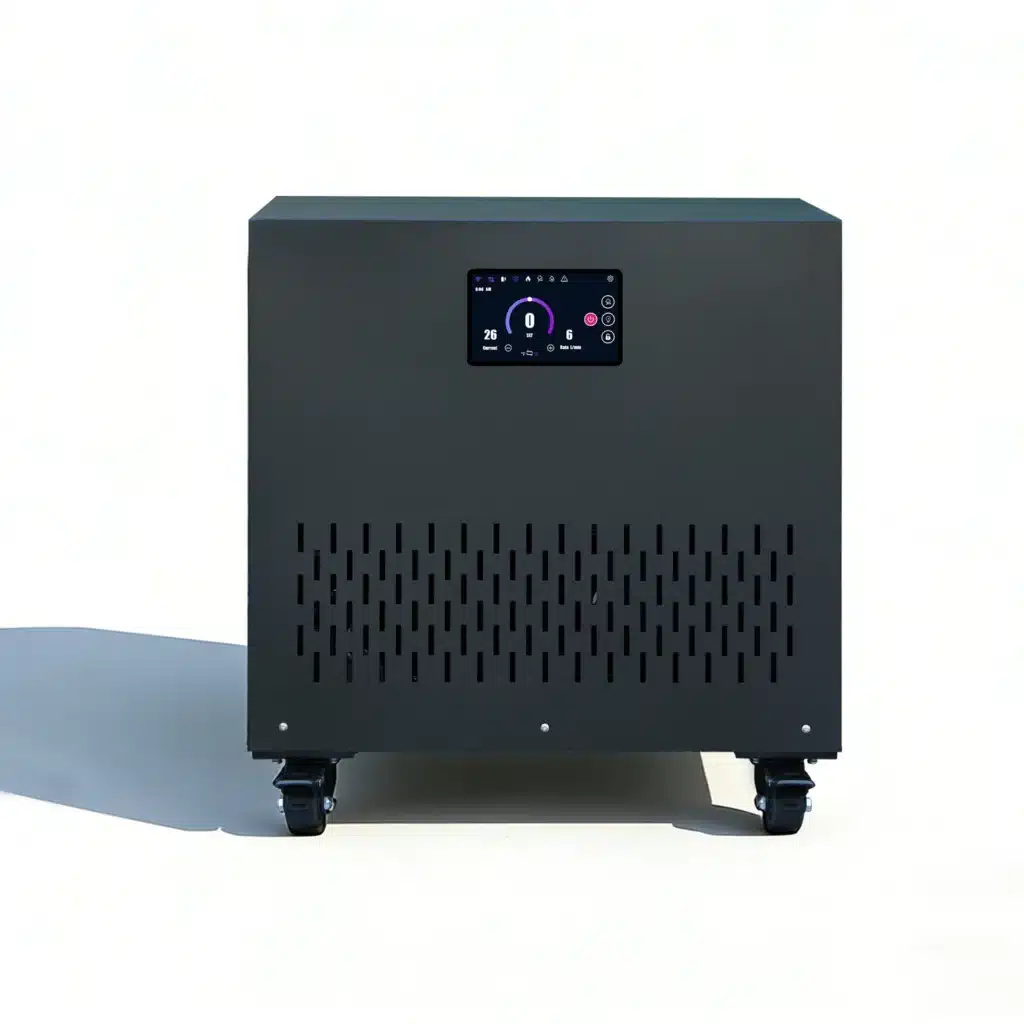
For each smart cold plunge with chiller, start with the local control path. Record what the display shows, which setpoints are adjustable, how schedules work, how alarms appear, how settings are locked and how normal shutdown differs from emergency isolation. If a venue has staff, state which functions are available to guests, operators, maintenance personnel and administrators.
Then map every smart cold plunge with chiller dependency outside the cabinet. Does the phone connect directly, or must both devices reach a cloud platform? Can more than one user manage the system? Can a former employee be removed? Is there a documented password-reset route? Does the app show the measured sensor value, a requested setpoint, or both? Can a remote command restart equipment after an unsafe condition, and if so, what interlocks remain active?
Do not use smart cold plunge with chiller software as a substitute for a site disconnect, protective device or qualified installation. The cold plunge chiller electrical guide explains the model and supply details that remain necessary regardless of app control. The exact installation must follow the product documentation and destination requirements.
Review cybersecurity, data and support before connecting the device
The U.S. National Institute of Standards and Technology says its NISTIR 8259 series is intended to help manufacturers and supporting parties consider IoT devices through design, development, testing, sale and support. NIST also describes NISTIR 8259A as a starting point for identifying core device cybersecurity capabilities. These resources are not a certification for any cold-plunge product; they provide useful questions for a connected-equipment procurement review.
- Can the device and software version be uniquely identified?
- Can authorized users change configuration while unauthorized access is restricted?
- Is data protected according to the buyer’s risk and privacy requirements?
- Can access to logical interfaces be controlled?
- Is there a defined software-update capability and support route?
- Can the operator understand the device’s cybersecurity state?
A home buyer may accept a different risk profile from a hotel, gym chain or healthcare-related facility. A smart cold plunge with chiller procurement brief for a commercial site should involve the organization’s IT or security owner before connection to a business network. Network segmentation, account lifecycle, incident response, vendor access and data location may need internal approval.
Ask what happens to the smart cold plunge with chiller at end of support. If the app is removed, a cloud service closes or a phone operating system changes, can the chiller still be operated locally? Is there a documented route to transfer ownership when equipment is sold or a facility changes operators? Avoid a purchasing decision that depends on an unspecified promise of “lifetime app access.”
A smart cold plunge still depends on water flow and cooling duty
A smart cold plunge with chiller cannot correct an undersized cooling system, restricted filter, air-locked pump, collapsed hose, poor ventilation or an incompatible tub. Define water volume, starting and target temperatures, ambient conditions, insulation, cover practice, pipe route, required flow and user pattern before selecting the control package.
Use the ice bath water-chiller sizing guide for the thermal inputs. Use the cold plunge chiller filter guide for restriction and service questions. For a multi-user site, the commercial cold plunge chiller guide connects those components to operating hours, user load and staff responsibilities.
Displayed temperature is also not a complete performance record. State the measurement location and compare the controller reading with a defined bulk-water method when acceptance matters. A near-freezing claim requires additional flow, sensor and ice-condition evidence; the zero degree cold plunge chiller test guide explains that boundary.

Smart ice bath chiller system handover for commercial facilities
A commercial smart ice bath chiller system needs a control handover, not only an app demonstration. Record which actions remain available at the local controller, which require a phone or site network, which require a vendor cloud service, and what the equipment does when each dependency is unavailable.
| Control layer | Acceptance question | Evidence to retain |
|---|---|---|
| Local controller | Can an authorized operator view status, change permitted settings and stop the unit without a phone or internet? | Local demonstration, manual and access limits |
| Phone or tablet | Which operating systems, app version, permissions and pairing method are supported? | Tested device list and setup record |
| Site network | Which Wi-Fi band, ports, credentials or gateway are required, and who supports connection failures? | Network dependency list and facility owner |
| Cloud service | Which functions stop if the internet or vendor service is unavailable? | Offline behavior test and current service terms |
| Accounts and data | Who owns the account, removes users, resets credentials and reviews stored or transmitted data? | Role matrix, reset test and current privacy documentation |
| Updates and support | How are firmware and app updates identified, recovered and supported? | Version record, update method, rollback/recovery route and support term |
Run a dependency-loss acceptance sequence
- Record the controller, firmware and app versions and the exact quoted functions.
- Demonstrate normal local operation and the approved user roles.
- Disconnect the phone while keeping the local controller available; record what changes.
- Remove site-network or internet access using an approved test method; record alarms, schedules, local control and recovery.
- Restore connectivity and confirm that settings, time, logs and account access recover as documented.
- Record the support contact and the procedure if an app, account or cloud service is retired.
This sequence verifies control continuity; it does not prove cooling capacity, sanitation, energy savings or user capacity. Size the physical system separately with the cooling-duty inputs and the commercial facility brief.
Commercial smart-control handover record
- Controller model, firmware, app version, region and test date.
- Local, Bluetooth, Wi-Fi and cloud functions listed separately.
- Account owner, user roles, credential reset and staff-removal procedure.
- Data collected, storage/transmission location, retention and configurable settings.
- Offline behavior, restart behavior, update method and failure recovery.
- Acceptance result linked to the exact unit or order.
Add these fields to the OEM RFQ, then bind the approved functions to the factory acceptance test and inspection record.
Run a control and failure-mode acceptance test
Include smart functions in the purchase specification before factory testing. A smart cold plunge with chiller acceptance plan should name every required function and failure condition. The cold plunge chiller factory acceptance test can be extended with the following control checks:
- Record chiller, controller, firmware and app versions.
- Verify local start, stop, setpoint, schedule, lock and alarm functions.
- Create the owner account and any operator roles using the approved method.
- Test pairing or network setup on a controlled connection.
- Compare local and remote status and confirm what each value represents.
- Disconnect the phone, local network and internet separately; document system behaviour.
- Simulate only the protective conditions approved by the test method.
- Confirm event, alarm or history records where those functions are included.
- Demonstrate credential reset, user removal and ownership transfer.
- Record update availability, support contact and rollback or recovery route.
After testing, the pre-shipment inspection checklist should confirm that the tested smart cold plunge with chiller controller and documents are packed with the correct outgoing unit. A demonstration on a sample does not prove that every production unit has the same controller or software revision.
Copyable smart cold plunge with chiller RFQ
PROJECT / DESTINATION: [site, country, use]
TUB AND WATER VOLUME: [model, usable volume]
COOLING DUTY: [start, target, ambient, pull-down time, user pattern]
LOCAL CONTROL: [display, setpoint, schedule, lock, alarms]
CONNECTIVITY: [none / Bluetooth / Wi-Fi / gateway / cloud]
REMOTE FUNCTIONS: [view, alerts, schedule, commands, history]
PLATFORMS: [supported phone/OS/app version and region]
ACCOUNTS AND ROLES: [owner, operator, service, reset, transfer]
DATA: [collected, stored, transmitted, location, retention]
SOFTWARE SUPPORT: [update method, term, end-of-support route]
OFFLINE BEHAVIOUR: [phone, router, internet and cloud failures]
PROTECTIVE LOGIC: [flow, temperature, compressor and alarm limits]
ELECTRICAL / WATER LOOP: [exact variant, pump, filter, connections]
ACCEPTANCE TEST: [functions, failures, versions, records]
DOCUMENTS: [manual, privacy/data, app, update and service information]
When the smart cold plunge with chiller will carry a buyer’s brand, send the completed fields through the OEM cold plunge chiller solutions route. Branding the cabinet or app does not remove the need to identify the underlying controller, platform owner, update responsibility and support term.
Smart cold plunge with chiller FAQ
Does every smart cold plunge include Wi-Fi?
No. A smart cold plunge with chiller does not have a standardized feature bundle. Ask whether the quoted configuration uses local electronic control, Bluetooth, Wi-Fi, a gateway or a cloud service and request the exact feature matrix.
Can a smart controller make an undersized chiller cool faster?
No. Controls can manage operation within the equipment’s design, but they do not replace adequate cooling capacity, water flow, heat transfer, ventilation, insulation or realistic operating conditions.
Will the chiller work if the internet is down?
That depends on the controller and service architecture. Require a documented answer and test local operation after the phone, router, internet and cloud connection are removed separately.
What cybersecurity questions should a commercial buyer ask?
Ask about device and version identification, user access, configuration permissions, data handling, logical interfaces, software updates, security-state visibility, support term and ownership transfer. Let the organization’s IT or security owner define the final requirements.
What should be recorded at commissioning?
Record equipment and controller identity, firmware and app versions, account owner, enabled functions, setpoints, schedules, alarms, network dependencies, offline behaviour, protective checks, water-loop baseline and the approved support contacts.