A cold plunge for wellness studio use should be planned as an operated water system with a defined customer journey, not as a feature added from a product photo. The owner needs to connect demand, room layout, user screening, water management, cleaning, cooling duty, staff roles, maintenance, claims control and financial assumptions before selecting equipment.
This guide is for independent studios, recovery centers, multi-location operators and project teams evaluating a cold plunge for wellness studio facilities. It provides a planning and evidence framework. It does not promise member retention, session revenue, medical benefits or payback; each studio must validate those outcomes with its own data and qualified advisors.
Table of Contents
Wellness studio planning checklist
Cold plunge for wellness studio: quick answer
The right cold plunge for wellness studio use is the complete operating configuration that fits the expected appointment pattern, usable water volume, target operating range, room conditions, local requirements and staff capacity. Select the tub, chiller, pump, filter, water-care components, drainage, controller and service plan together.
Start with a four-week demand test or existing booking evidence when possible. Estimate typical and peak sessions, how long each customer occupies the room, turnover time between sessions, cleaning windows and likely cancellations. These inputs determine layout and staffing before they influence equipment selection.
Build a studio-specific business case
A credible cold plunge for wellness studio business case uses local evidence. Separate capacity from demand. A room may technically support many sessions, but the booking mix, staffing, cleaning interval and opening hours determine the number actually available for sale or included in membership.
| Input | Studio evidence | Why it matters |
|---|---|---|
| Demand | Waitlist, survey, trial bookings or comparable service data | Avoids assuming that online interest equals paid use |
| Session model | Standalone, add-on, class recovery or membership inclusion | Changes scheduling, staffing and revenue attribution |
| Usable capacity | Open hours minus cleaning, service and recovery windows | Defines realistic appointment supply |
| Variable cost | Water, energy, treatment, laundry, consumables and payment fees | Shows contribution by session without using a generic industry figure |
| Fixed cost | Equipment, build-out, drainage, electrical, ventilation, approvals and training | Captures the installed project rather than the tub price alone |
| Downtime | Maintenance plan, spare route and closure assumption | Tests whether the service remains viable when equipment is unavailable |
| Decision threshold | Owner-defined utilization and contribution requirement | Creates a written go, revise or stop gate |
Run low, base and high scenarios with your own numbers. Do not put an expected retention rate, revenue lift or payback period into the purchase decision unless the studio can show the source and sensitivity. The small-business cold plunge guide covers broader startup planning; this page owns the workflow for an operating wellness studio.
12 cold plunge for wellness studio planning checks
| Check | Required decision | Evidence or owner |
|---|---|---|
| 1. Service definition | What is offered and what is not | Approved customer-facing service description |
| 2. User journey | Booking, arrival, screening, changing, use and exit | Room flow and staff procedure |
| 3. Demand pattern | Typical and peak sessions | Trial or booking evidence |
| 4. Water volume | Usable fill and displacement | Model drawing and measured setup |
| 5. Temperature duty | Starting range, operating range and recovery time | Supplier calculation or test with conditions |
| 6. Water system | Pump, filter, treatment, testing and replacement | Flow diagram and named operator |
| 7. Site utilities | Electrical, drainage, ventilation and water supply | Qualified site design and verified inputs |
| 8. Access | Entry, exit, handholds, wet surfaces and accessibility | Designer and local review |
| 9. Cleaning | Between-session and periodic tasks | Written schedule, products and records |
| 10. Claims | Permitted service and marketing language | Evidence and legal/clinical review as needed |
| 11. Maintenance | Consumables, spares, service and shutdown | Lifecycle plan and escalation route |
| 12. Acceptance | Factory, site and staff handover gates | Signed records and unresolved deviations |
Design customer flow and room layout
Plan a cold plunge for wellness studio room from both the customer and operator viewpoints. The customer route should address privacy, changing, slip-resistant wet areas, entry support, towels, personal-item storage and a clear exit. The staff route should reach the drain, filter, valves, controller and service panels without crossing an occupied session.
A cold plunge for wellness studio layout also needs a defined holding point when the room is being cleaned, inspected or taken out of service.
Keep chiller exhaust and service noise away from the experience area. Confirm model-specific clearances before placing equipment in cabinetry. An enclosure that looks finished may recirculate warm air, increase service time or block removal of a panel. Drainage also needs a planned destination and backflow considerations determined by the site team. Before equipment release, use the indoor cold plunge installation room-planning checklist to close the room’s load, water, moisture, heat, electrical and removal-access interfaces.
Accessibility is a project input. In the United States, the U.S. Access Board publishes a guide to pool and spa accessibility standards for covered facilities. The studio should confirm whether and how those or other local provisions apply to the exact installation.
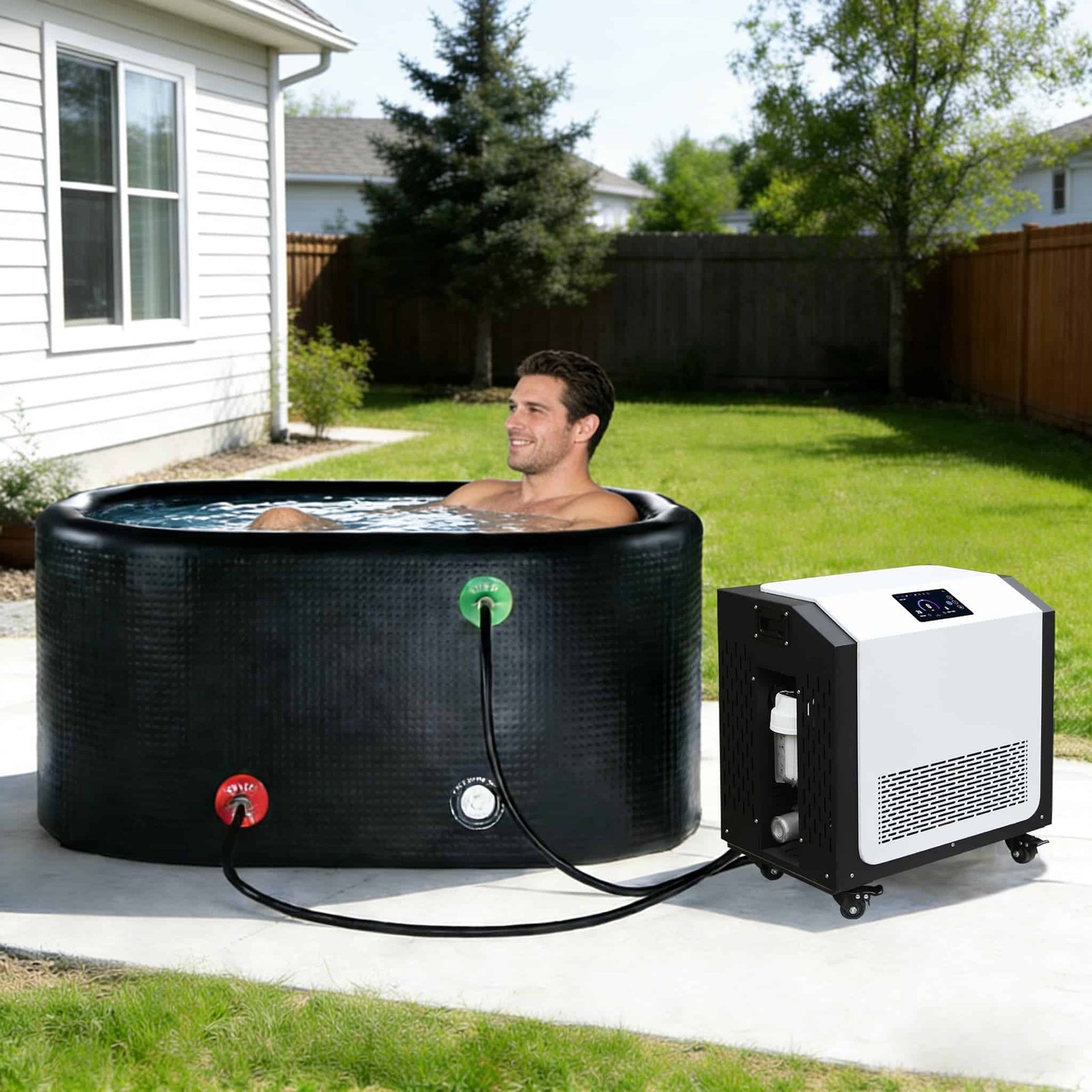
Cold plunge for wellness studio equipment and duty
Do not size a cold plunge for wellness studio use from horsepower, room area or daily customers alone. Provide usable water volume, typical and peak session sequence, starting and desired operating range, ambient range, cover state and allowed recovery time. Ask the supplier to state which assumptions its recommendation uses.
The cold plunge for wellness studio equipment schedule should list every supplied and site-installed component under one revision.
Separate initial pull-down from ongoing maintenance. A unit may cool an empty covered tub overnight yet recover differently during consecutive sessions. Ask for a representative test or calculation that identifies the exact chiller, pump, flow condition, water volume, temperature points, ambient condition and elapsed time. Use the commercial chiller selection guide for the full load worksheet.
Review the complete supplied scope: tub, chiller, pump, filter, water-care components, controller, hoses or pipes, fittings, cover, drain arrangement and included accessories. If the studio buys parts from different vendors, nominate one party to approve interface compatibility.
Cold plunge for wellness studio water management
A cold plunge for wellness studio service involves shared water and repeat use, so “includes filter” is not an operating plan. Define circulation, filtration, treatment, testing, cleaning, water replacement, record frequency, corrective actions and who can stop use. Follow equipment instructions and the requirements set by the applicable authority.
The CDC explains that its current Model Aquatic Health Code provides guidance for public aquatic venues and addresses design, operation and maintenance topics. It is not federal law and is not automatic approval for every studio. Use it as a reference while confirming local rules and the venue classification.
Commission the water loop with a clean-filter baseline, representative flow indication, controller settings, normal operating readings and a documented response to leaks, alarms or unacceptable water conditions. The cold plunge filter-system guide separates the roles of circulation, mechanical filtration and water care.
Control health claims and user protocols
Equipment capability does not establish a medical protocol. A cold plunge for wellness studio operation should separate supplier specifications, staff operating instructions, user-facing safety information and any health-related program developed by qualified professionals. Do not copy a social-media temperature or duration into a universal customer instruction.
The U.S. Federal Trade Commission’s health-products compliance guidance states that objective health and safety claims should be truthful, not misleading and adequately substantiated. Review express and implied claims across the website, ads, signage, booking flow, influencer content and staff scripts.
If the studio operates alongside medical or aesthetic services, use the med-spa cold plunge guide for the stricter boundary between general wellness equipment, professional oversight and treatment claims.

Cold plunge for wellness studio operations and records
| Record | Purpose |
|---|---|
| Opening check | Confirm room, access, water condition, flow, leaks, controller and required readings |
| Session turnover | Show cleaning and reset tasks were completed |
| Maintenance log | Track filters, consumables, cleaning, inspections and replaced parts |
| Exception log | Capture slow recovery, alarms, repeated trips, leaks, water concerns and shutdowns |
| Change record | Control replacement components, settings, protocols and approved customer language |
Assign a named owner and backup for each task. Staff should know the normal operating baseline, the conditions that require closure and the escalation route. Verify the complete installed system and training through a documented factory and site acceptance process.
That record turns a cold plunge for wellness studio project into a repeatable service rather than an undocumented amenity.
Standardize multi-location studio projects
For multiple locations, create a controlled cold plunge for wellness studio baseline: approved model and variant, room-interface requirements, water-management minimums, customer information, maintenance tasks, consumables, spare list, commissioning form and change-control owner. Then maintain a site-specific deviation list for voltage, climate, drainage, local approvals and layout.
Do not assume that a successful first site can be copied unchanged. Capture actual session patterns, service events, recovery observations and staff feedback, then decide whether the design baseline should change. Every approved revision should identify which future locations it covers.
Copyable cold plunge for wellness studio RFQ
STUDIO / DESTINATION / NUMBER OF SITES: [ ]
SERVICE MODEL AND SUPERVISION: [ ]
TYPICAL / PEAK SESSIONS PER HOUR: [ ]
OPERATING HOURS / CLEANING WINDOWS: [ ]
USABLE WATER VOLUME: [ ]
STARTING / OPERATING TEMPERATURE RANGE: [ ]
INDOOR / OUTDOOR / AMBIENT RANGE: [ ]
TUB / ENTRY / FINISH REQUIREMENTS: [ ]
PUMP / FILTER / WATER-CARE RESPONSIBILITIES: [ ]
VERIFIED VOLTAGE / FREQUENCY: [ ]
DRAINAGE / VENTILATION / NOISE / SERVICE LIMITS: [ ]
ACCESSIBILITY AND LOCAL REVIEW OWNER: [ ]
DOCUMENTS / TESTS / STAFF HANDOVER: [ ]
MAINTENANCE / SPARES / DOWNTIME REQUIREMENTS: [ ]
QUANTITY / PACKING / DELIVERY BASIS: [ ]
Send the completed cold plunge for wellness studio brief through the OEM cold plunge solutions page. Request an exact configuration, stated assumptions and document list rather than a generic studio package.
Cold plunge for wellness studio FAQ
How many sessions can one studio cold plunge support?
There is no universal number. Usable capacity depends on the booking model, session and turnover time, water volume, user sequence, cooling recovery, cleaning procedure, water management and staff availability.
What chiller size does a wellness studio need?
Size from usable water volume, starting and target ranges, ambient condition, peak sequence, cover state and allowed recovery time. Horsepower alone does not provide a comparable answer.
Does a filter make shared studio water safe?
No single component proves safe operation. The studio needs a complete water-management plan aligned with equipment instructions, intended use and applicable local requirements.
What is the ROI of a cold plunge for wellness studio use?
It must be calculated from the studio’s own demand, pricing, usable capacity, variable cost, installed cost, staffing, maintenance and downtime assumptions. A generic percentage is not reliable evidence.
What should pass before the first paid session?
Complete site acceptance, local reviews, representative operating checks, water-management procedure, access and customer-safety arrangements, claims review, staff training, maintenance plan and shutdown process.