If you’re thinking about putting an infrared sauna in your bedroom, the short answer is yes—it works, and plenty of people do it. But you almost certainly cannot just carry the panels upstairs, plug the cord into the wall behind your nightstand, and start sweating.
First, rule out traditional saunas entirely. You cannot put a rock-and-stove sauna in a bedroom unless you want to rip the room down to the studs and waterproof it like a commercial shower. The moment you splash water on hot rocks, that steam goes straight into your standard bedroom drywall, gets behind your baseboards, and turns into mold within a month. A dry far-infrared sauna cabin is the only type of sauna that makes sense in a finished living space, because it heats your body directly with radiant light instead of boiling the room air.
Even with infrared, though, there are a few practical issues that surprise people once the delivery crates arrive on their driveway. Here is what actually happens when you put a cabin in a bedroom, and how to set it up so you don’t end up tripping breakers, damaging your stairs, or ruining your flooring.
Why your bedroom breaker will trip (the 15-amp problem)
Most bedrooms in North America run on a standard 15-amp, 120-volt circuit. The catch is that this single breaker doesn’t just feed the outlet you’re looking at—it usually powers every outlet in the room, the ceiling light, and often the bedroom or hallway next door.
Under US electrical code, an electric heater running continuously shouldn’t pull more than 80% of a circuit’s capacity. On a 15-amp line, that safe limit is 1,440 watts.
Now look at what real sauna cabins actually draw:
| Cabin Size | Dimensions | Heater Power | Current Draw | What you actually need |
|---|---|---|---|---|
| 1-Person Compact (Aura-1) | 35.4″ × 35.4″ × 76.8″ (900 × 900 × 1950 mm) | 1,600W | 13.3A @ 120V | Dedicated 20A line (NEMA 5-20R outlet) |
| 1–2 Person Corner (Aura-C1) | 40.1″ × 40.1″ × 76.8″ (1020 × 1020 × 1950 mm) | 1,900W | 15.8A @ 120V | Dedicated 20A line (NEMA 5-20R outlet) |
| 2-Person Bench (Aura-S3) | 53.1″ × 41.3″ × 76.8″ (1350 × 1050 × 1950 mm) | 2,400W | 20A @ 120V or 10A @ 240V | Dedicated 240V / 15A or 120V / 25A line |
Even our smallest single-person Aura-1 pulls 1,600 watts. If you plug that into a shared 15-amp bedroom outlet while your TV is on or your phone is charging, the breaker will trip in about 15 minutes every single time. It’s not a defect in the sauna; the breaker is just doing its job so the wiring inside your wall doesn’t overheat.
Before you buy anything, look at your breaker box. For a 1-person or corner unit, you’ll need an electrician to run a dedicated 12-gauge wire from your panel to a 20-amp outlet in the corner where the sauna will sit. If you’re going for a larger 2-person cabin, plan on running a 240-volt line.
A critical warning about extension cords: Factory sauna power cords are usually 6 to 8 feet long, coming out from the rear corner or the roof junction box. If your newly installed 20-amp receptacle is on the opposite wall, never grab an orange household extension cord from your garage. Running a continuous 1,600W to 2,400W heating element through an undersized 16-gauge or 14-gauge extension cord will melt the rubber jacket and create a severe fire hazard against your bedroom baseboards. If the cord can’t reach, have your electrician place the outlet within 4 feet of the cabin’s rear corner.
Getting the panels up the stairs (the delivery surprise)
When residential freight carriers drop off a sauna, they deliver it curbside on a wooden pallet. They will not carry panels up to your second-floor master suite. That part is on you, and it catches a lot of people off guard.
While the modular tongue-and-groove side panels are light enough for two people to carry comfortably, the front glass wall is heavy. On quality cabins, that front panel is pre-glazed with 8mm thick tempered safety glass. That single piece can weigh anywhere from 100 to 140 pounds.
Before you commit to a bedroom location, walk your stairs with a tape measure:
- Tight 90-degree landings: If your staircase has a turn with a low ceiling bulkhead, maneuvering a 77-inch tall, rigid glass panel around that corner requires at least two people and careful pivoting. Measure the diagonal clearance of your stair turn before uncrating.
- Door jamb width: Your bedroom door needs to open clear to at least 30 inches. If it’s a tight 28-inch door in an older home, you might have to temporarily pop the bedroom door off its hinge pins to walk the front frame through.
What happens when you put a 400-lb sauna on bedroom carpet
A typical modular wooden sauna weighs around 400 to 500 pounds empty, and close to 700 pounds with someone sitting inside. If you put that directly on bedroom carpet, two things happen that most people don’t think about:
The door stops closing properly. Carpet sits on soft foam padding. Under the heavy weight of the exterior wood walls, that padding compresses unevenly over the first two or three weeks. When the base settles by even an eighth of an inch, the rectangular frame twists slightly. Because the glass door is tempered and has no flex, it starts rubbing on the wood frame, or the magnetic latch stops catching and lets heat leak out constantly.
Sweat gets trapped in the carpet pad. In a good 30-minute session, you will sweat out anywhere from half a liter to nearly a full liter of fluid. Even though you sit on towels and the Canadian hemlock benches absorb moisture, sweat drops through the floorboards. Once salt and sweat soak into synthetic carpet fibers and the foam pad underneath, bacteria grow, and your bedroom will develop a sour gym smell that you cannot vacuum out.
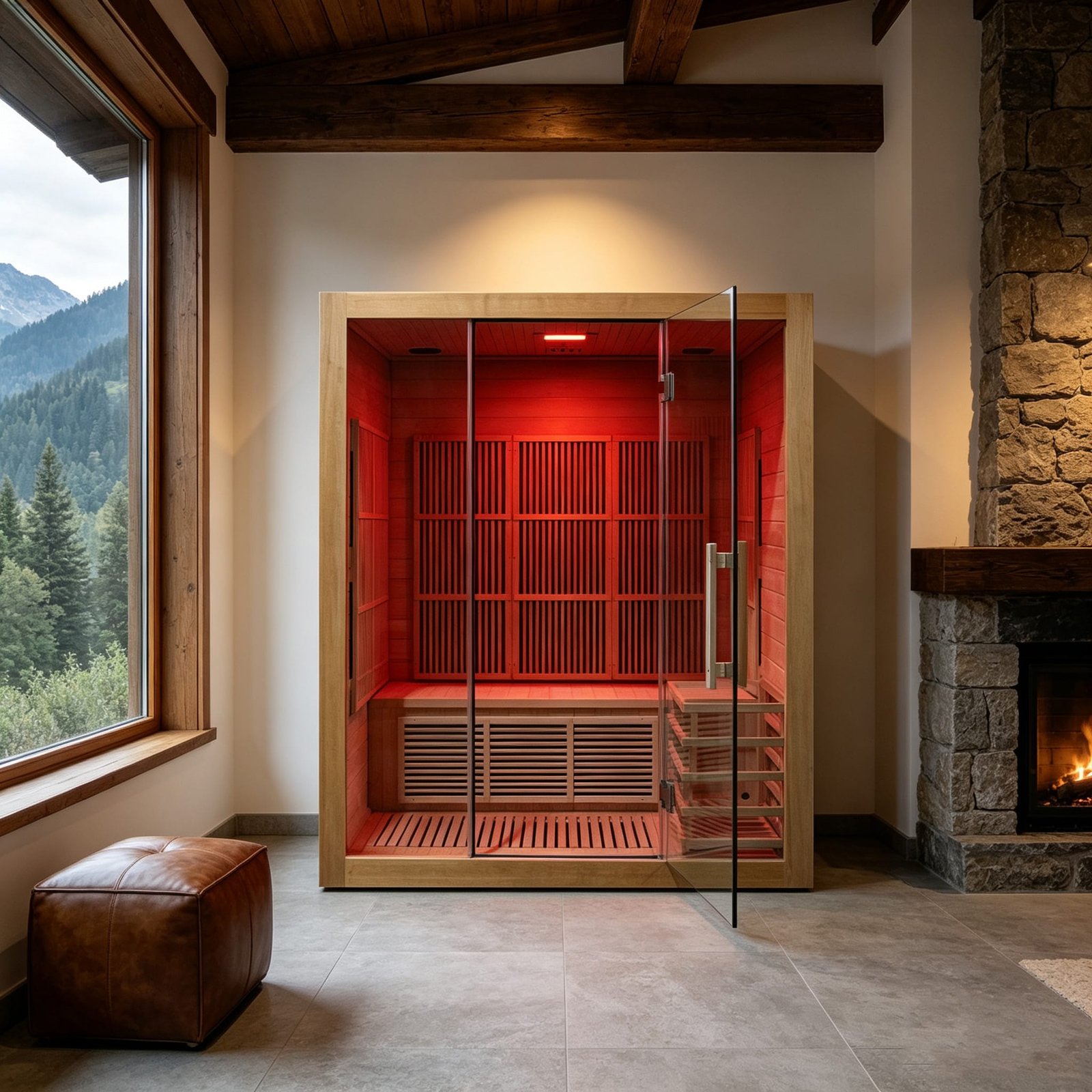
The simple fix: If you have hardwood or tile, you’re fine—just keep a washable towel or cotton rug on the cabin floor. If you have carpet, go to a home improvement store and get a 1/4-inch hard rubber gym mat or cut a piece of 1/2-inch birch plywood to match the cabin’s footprint. Put that down first, then build the sauna on top of it. It levels the weight so the door never sticks, and keeps sweat completely away from your carpet.
The ceiling latch problem (measure height before ordering)
Almost everyone measures their bedroom floor to make sure the cabin fits between the closet and the bed. Almost nobody measures their ceiling clearance properly.
Our Aura cabins stand about 6 foot 4 inches tall (1950 mm). If your bedroom has standard 8-foot ceilings, you have plenty of room. But if you’re putting this in a converted attic, an older home, or a basement bedroom with drop ceilings, check your vertical space carefully.
These saunas are modular. You put up the back wall, connect the side walls, and then the heavy roof panel has to be lifted up and dropped into place from above. On top of that, the power supply cables and metal buckle latches are on the outside of the roof. You need at least 4 to 6 inches of open space between the top of the sauna and your ceiling just to get your hands up there, hook the latches, and plug in the roof harness. If your ceiling is 78 inches high and the cabin is 77 inches, you will literally not be able to put the roof on.
If you’re working with an apartment or tight townhouse layout, check our apartment sauna layout guide for exact doorway and turn radius clearance tips.
The heat dump: what happens when you open the door
An infrared sauna runs between 125°F and 145°F. The insulated hemlock walls stay cool to the touch on the outside, but the inside of the cabin holds a ton of heat.
When your session is over and you push open the glass door to step out, all that hot air rushes out into your bedroom. If you have an average-sized bedroom (around 120 to 150 square feet), that blast of heat will raise the temperature of your bedroom by 4 to 6 degrees in less than five minutes.
If you like sleeping in a cool room, going to bed in a room that just jumped from 68°F to 74°F is miserable. Three practical habits solve this:
- Window ventilation: Put the sauna within a few feet of an exterior window if you can. Crack the window for three minutes right after you get out, and the room temperature normalizes almost immediately.
- Ceiling fan in reverse: Turn on your bedroom ceiling fan in reverse (pulling air up toward the ceiling) so the warm air mixes across the ceiling instead of settling in a hot pocket right over your bed.
- Smoke detector placement: Keep the sauna door at least five or six feet away from your ceiling smoke detector. Infrared doesn’t make smoke, but a sudden rush of 135-degree air directly into an optical sensor can occasionally trigger a false alarm.
Why bedrooms are actually better than master bathrooms
A lot of homeowners initially try to squeeze an infrared sauna into a master bathroom next to the walk-in shower. In practice, that is often a worse choice than an open bedroom corner.
Bathrooms are inherently damp. When someone takes a hot shower, relative humidity spikes to 90% or higher. Untreated sauna wood like Canadian hemlock and cedar is hygroscopic—it absorbs surrounding airborne moisture. Over time, high ambient bathroom humidity causes the modular wall panels to swell, making latches tighten and doors bind.
In contrast, a master bedroom is climate-controlled with dry, conditioned air (usually 35% to 50% relative humidity). That stable environment keeps the wood stable, prevents panel warpage, and ensures your sauna lasts decades without swelling or mildew.
Relay noise and wood choice: things that matter when you sleep
If you put a sauna in a garage or a basement gym, you don’t care how it sounds or smells. In a master bedroom where someone might be sleeping while you do an early morning session, the mechanical parts matter.
Cheap saunas use mechanical relays to turn the heaters on and off. Every time the cabin hits 135°F and cuts power, and every time it drops a degree and kicks back on, you hear a loud, metallic clack-clack from the roof control box. In a quiet bedroom, that clicking will wake up anyone sleeping nearby. Better units use solid-state relays (SSRs) that cycle power completely silently.
The other detail is wood aroma. Western Red Cedar smells great in an outdoor barrel, but in a closed bedroom, that cedar scent is intense and never really goes away. For a bedroom, untreated Canadian Hemlock is almost always the better pick—it’s hypoallergenic, has virtually zero smell when heated, and won’t make your sheets and clothes smell like a lumber yard.
The bottom line
A bedroom sauna is one of the most convenient setups you can have, because you walk right out of bed, do twenty minutes of heat therapy, shower, and start your day. But you have to treat it like a serious piece of equipment:
- Get an electrician to pull a dedicated 20-amp line to the corner where it will live.
- Put down a hard rubber mat or plywood sheet if you have carpet.
- Make sure you have at least 5 inches of clearance above the roof to fasten the latches.
- Measure stair turns and door jambs so you know the glass front panel will make it inside.
- Keep a window nearby to vent the warm air after you finish.
If your room checks those boxes, take a look at our OMNI sauna manufacturing catalogue to see exterior dimensions and power ratings for the Aura series, and find the footprint that fits your space.