If you’ve been researching cold plunge tubs for more than a week, you’ve probably noticed that most buying guides are either product pages in disguise or generic comparisons that tell you nothing useful. This one’s different — because we manufacture these tubs and we see what actually fails, what customers regret, and what questions everyone asks after they’ve already bought.
The stainless steel cold plunge tub is the right choice for most commercial buyers and a lot of serious home users. But the category is more complicated than it looks. The grade of steel matters. The depth matters more than the volume. And the chiller pairing can make or break the whole setup regardless of how good the tub is.
Here’s what you actually need to know.
The Grade of Stainless Steel in Your Cold Plunge Tub Is Not a Marketing Detail
Most listings mention “stainless steel” without specifying the grade. That’s either laziness or a reason to be suspicious.
304 and 316L are both stainless steel, but they behave very differently in a cold plunge environment. 304 is what most kitchen appliances and entry-level tubs are made from — it’s fine for cold water, handles normal conditions well, and costs less. 316L adds molybdenum, which changes how the steel responds to chlorides. In a cold plunge tub, chlorides come from the water treatment you use. Ozone is fine for 304. Chlorine-based sanitisers — even diluted — attack 304 over time, creating small pitting and surface corrosion that gets worse with every cycle.
We’ve seen 304 tubs from other manufacturers that looked fine at purchase and showed significant pitting within two years of commercial use with standard chemical sanitation. That’s not a manufacturing defect — it’s the wrong material specification for the application.
For home use with ozone sanitation only, 304 holds up fine for years. For any commercial installation where you’re running chemical treatments, or if you’re not sure what sanitation system you’ll end up using, 316L is the only sensible choice. ASM International’s corrosion data consistently shows 316L maintaining structural integrity in chloride environments where 304 begins to fail — this isn’t a sales claim, it’s materials science.
Our stainless steel cold plunge tubs use 316L throughout. See the full range at OMNI Ice: Stainless Steel Cold Plunge Tubs.
Stainless Steel vs Acrylic vs Wood — An Honest Comparison
The material debate comes up constantly and most comparisons either push whatever the seller has in stock or hedge everything into uselessness. Here’s the straightforward version.
Stainless steel cold plunge tubs cool faster because steel conducts temperature changes quickly. The water responds immediately when the chiller runs, which matters when you’re managing back-to-back sessions in a commercial setting. The surface is completely non-porous — bacteria have nowhere to hide, and a proper clean actually cleans the tub. At 316L construction, it’ll outlast almost anything else in the room. The tradeoffs: it’s heavier, costs more upfront, and looks industrial. In a home gym or wellness space where appearance matters, some people find it cold-looking in both senses.
Acrylic tubs are lighter, easier to install without help, and warmer aesthetically. Acrylic is slightly more insulating than steel by nature, so the chiller works marginally less hard to hold temperature. The issue is durability under real commercial conditions. Acrylic scratches, develops micro-cracks from repeated temperature cycling over years, and degrades faster with chlorine exposure. For one or two home users doing daily sessions, acrylic lasts well. For a gym running 40 sessions a week, stainless steel is the better investment every time.
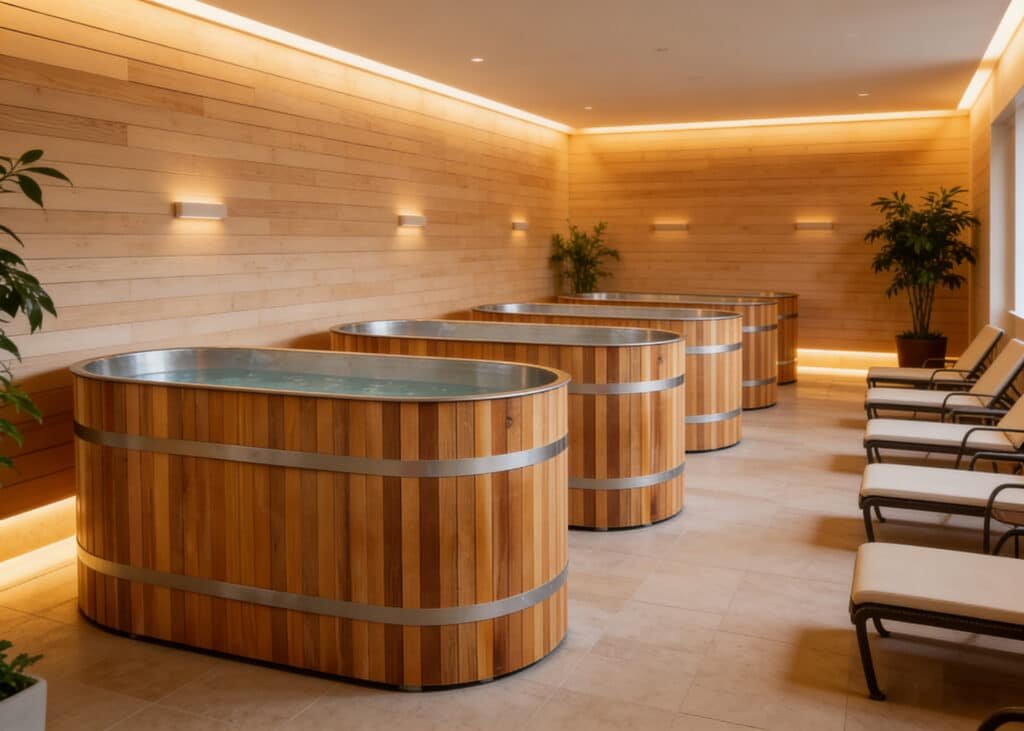
Wood-wrapped tubs — cedar or WPC exterior with a stainless steel inner liner — are the middle path. You get the hygiene of stainless inside and the aesthetic warmth of wood outside. WPC is fully weatherproof and better than natural cedar for permanent outdoor installations. These work well for home wellness rooms and outdoor spa setups where the tub is meant to look like part of the environment. The complication is that you’re now maintaining two different materials.
For anything commercial, a stainless steel cold plunge tub is the practical default. Browse the full tub range here: Cold Plunge Tub Collection.
Depth Is More Important Than Volume — And Most Buyers Get This Wrong
Tub volume is the first number everyone looks at. It shouldn’t be.
Depth determines whether cold immersion therapy actually works. The research on cold water immersion — the studies on inflammation reduction, hormonal response, and recovery acceleration — is based on full-body submersion with water at or near shoulder level. That requires upright seated or standing immersion at a minimum of 80cm water depth, ideally 90 to 95cm.
A 400-litre stainless steel cold plunge tub that’s wide and shallow gives you partial immersion when you sit in it. Your lower body is cold, your upper body isn’t. That’s a different physiological experience from true full-body immersion, and not what the protocols are based on.
This is worth checking explicitly when comparing tubs. Ask for the internal depth, not the external dimension. Tubs designed for lying flat are different products from tubs designed for upright immersion. For cold therapy, upright immersion at 90cm depth in a 300-litre stainless steel tub is more effective than lying flat in a shallower 500-litre one.
Sizing Your Stainless Steel Cold Plunge Tub for the Right Use Case
Volume matters once depth is confirmed. Here’s how to think about it:
Home users doing solo daily sessions don’t need a large tub. A 250 to 300-litre stainless steel cold plunge tub paired with a 1HP chiller handles this cleanly — easier to maintain, faster to cool, lower running costs.
Gyms and studios need to think about peak usage, not average usage. A single 350-litre tub running six sequential sessions daily has different water temperature recovery requirements than a home tub sitting idle between two sessions. Give yourself headroom: if you expect six daily sessions at peak, size for eight. Running a tub at 80% of capacity consistently is better than running it at maximum and watching temperature creep up between sessions.
For simultaneous dual-user use — partners, coach-alongside-athlete rehabilitation — volume needs to be 450 litres or above, and the tub’s internal dimensions need to accommodate two adults comfortably. A narrow 450-litre tub that’s deep but not wide enough for two people side by side doesn’t solve the problem.
| Use Case | Volume | Minimum Chiller HP |
|---|---|---|
| Home, solo daily use | 250–300L | 0.8–1HP |
| Home, two users | 300–400L | 1HP |
| Small gym, sequential use | 350–450L | 1–1.5HP |
| Commercial, dual simultaneous | 450–600L | 1.5HP |
| High-traffic commercial | 600L+ | 2HP+ |
Matching a Chiller to a Stainless Steel Cold Plunge Tub
Stainless steel conducts temperature more readily than acrylic or insulated wood-wrapped tubs. In practice this means two things: it cools faster when the chiller is running, and it loses temperature faster when it’s idle. A well-fitted insulating lid changes this equation significantly — it’s not an optional accessory, it’s part of the system.
For a 300-litre stainless steel cold plunge tub in a standard indoor environment, a 1HP chiller manages solo sequential sessions without struggling. Outdoor installations or warmer climates need 1.5HP to hold temperature consistently through a full day of use.
Undersizing the chiller for a stainless steel tub is the most common setup mistake we see. The tub cools quickly when the chiller first runs, which gives a false impression of adequate capacity — the problem shows up during back-to-back sessions when the chiller can’t recover the temperature fast enough between users.
For specific chiller recommendations by volume, environment, and usage frequency, see our cold plunge chiller range and HP selection guide.
Maintaining a Stainless Steel Cold Plunge Tub — What the Routine Actually Looks Like
Stainless steel is the easiest cold plunge tub material to maintain, but “easy” doesn’t mean nothing. Here’s the realistic routine.
With an inline filter and ozone sanitation, a single home user needs a full water change every 30 to 60 days. A commercial gym tub with 8 to 10 daily users needs a change every 14 to 21 days, more if you notice clarity or odour changing before that.
Interior cleaning after each water change: wipe down with a clean cloth. Hard water deposits on 316L respond well to diluted food-grade citric acid — leave it for 15 minutes, wipe off, rinse. Don’t use abrasive scrubbers. The surface scratches created by abrasion are small enough to be invisible but large enough to harbour bacteria, which defeats the purpose of having a non-porous material.
The one thing that damages 316L stainless faster than anything else is chemical combinations. Chlorine alone is manageable. Bromine is aggressive on stainless and should be avoided. If you’re using a multi-chemical treatment approach, check compatibility before you introduce anything new into the system.
Where Stainless Steel Cold Plunge Tubs Make the Most Sense
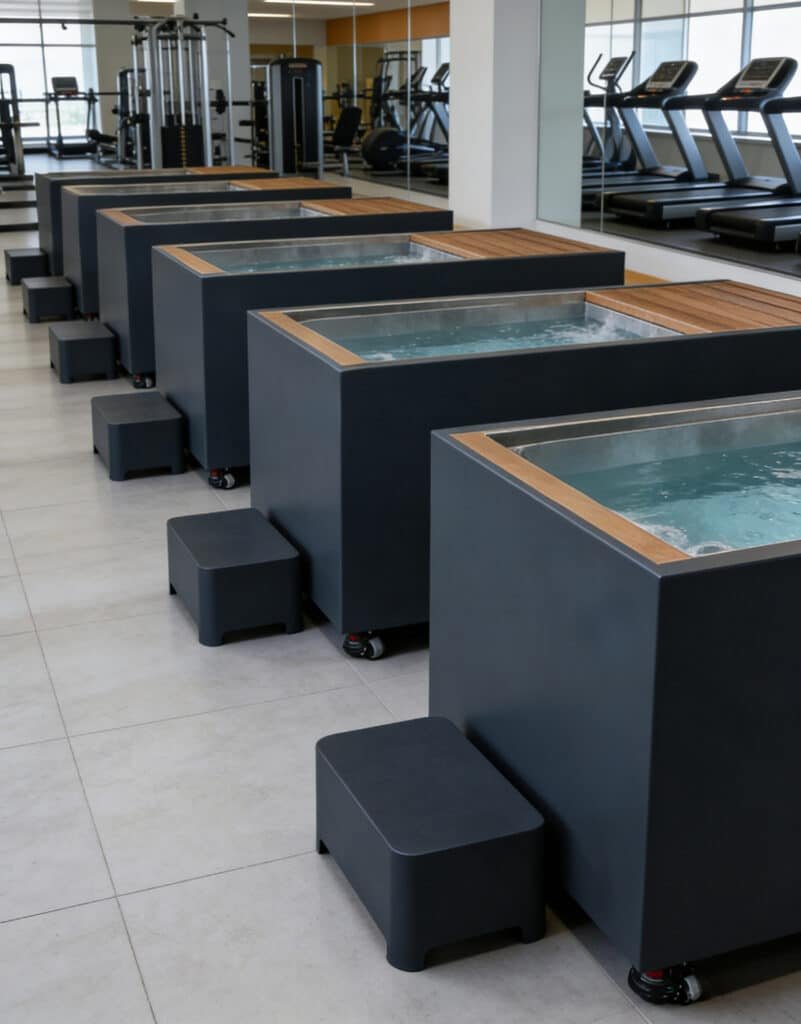
Gyms and fitness studios are the primary commercial application. The durability under daily high-frequency use, hygiene standards, and professional appearance are exactly what a facility needs. Most gyms that buy acrylic to save money upfront end up replacing it within four to five years. Stainless steel cold plunge tubs run 10 to 15 years under the same conditions. See our commercial gym cold plunge setups.
Hotels and luxury spas require guest-facing hygiene that stainless steel delivers more reliably than any alternative. 316L’s compatibility with medical-grade sanitation protocols and its non-porous surface meet the hygiene standards that hospitality environments need. See our hotel and spa cold plunge solutions.
Sports recovery facilities and physiotherapy clinics run clinical-level hygiene across multiple patient sessions daily. Stainless steel cold plunge tubs are the industry standard in professional sports recovery rooms. For sports-specific setups, see our professional sports recovery page.
Home users with a long-term view — if you’re building a permanent wellness setup and plan to use it daily for years, stainless outlasts acrylic at the same usage intensity and requires less intervention over time. The higher upfront cost pays back in not having to replace the tub in five years.
For clinical physical therapy applications, see: Cold Plunge Physical Therapy: Clinical Setup Guide
Stainless Steel Cold Plunge Tub — Questions We Get Asked Most Often
304 or 316L — does it actually matter for home use?
If you’re using ozone sanitation and no chlorine, 304 holds up well for years at home. If there’s any chance you’ll use chemical treatment — or if you’re buying for a space that might be used commercially later — go 316L from the start. Retrofitting is not an option.
How long will a stainless steel cold plunge tub last?
A 316L tub with proper maintenance runs 10 to 15 years in commercial use. The things that shorten lifespan are incompatible chemical treatments and abrasive cleaning — both avoidable. We have commercial clients still running tubs from their first order eight years ago.
Do I need a special chiller for stainless?
No — any properly sized cold plunge chiller works with stainless steel. The main consideration is accounting for the tub’s faster heat loss compared to insulated alternatives. A lid and correct HP selection handle this.
Can it go outdoors year-round?
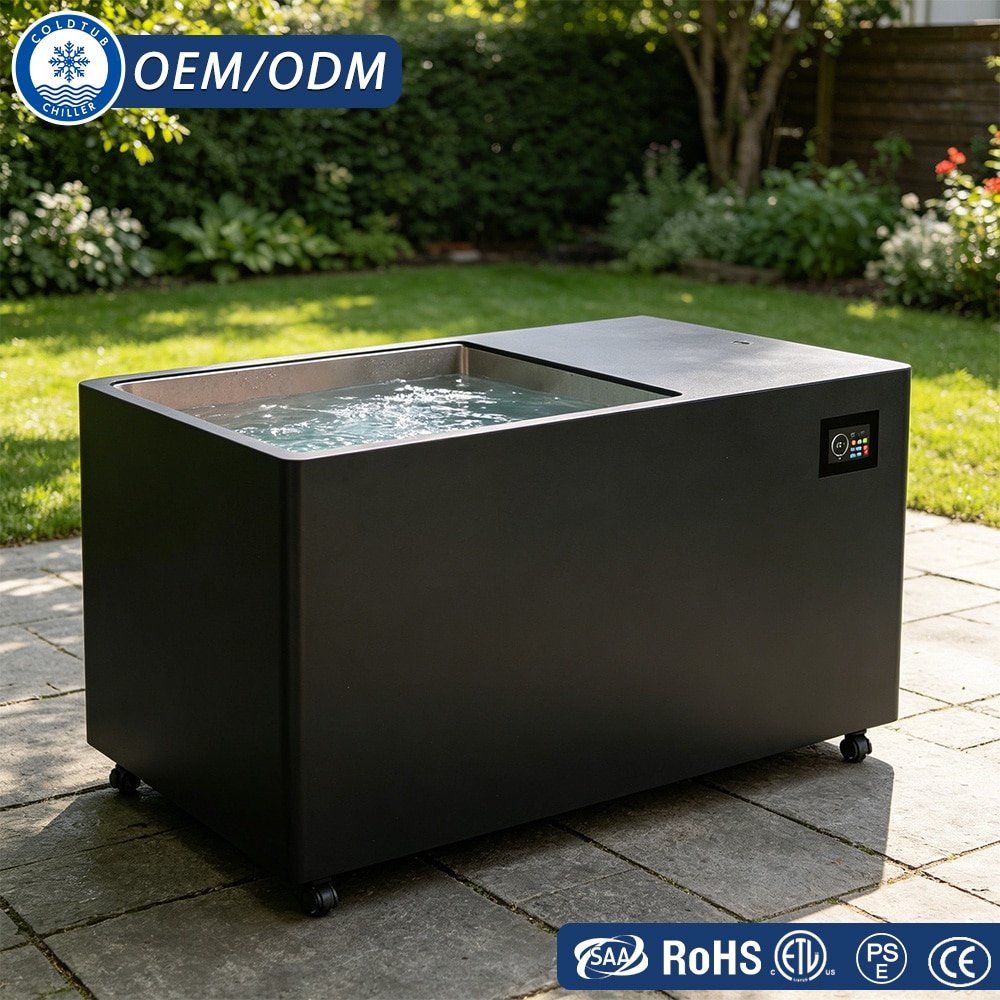
Yes. 316L handles outdoor conditions, UV exposure, and temperature cycling without degradation. A wood-wrapped exterior option adds weather protection and better visual integration for outdoor spa settings. A cover or foam lid is worth having regardless of material for any outdoor installation.
What’s the minimum depth that actually works?
80cm internal depth is the minimum for upright shoulder-level immersion. Most quality stainless steel cold plunge tubs for therapy use are 90 to 95cm. Below 80cm, you’re doing partial immersion — which delivers some benefit but isn’t what the cold therapy research protocols are based on.
OMNI Ice manufactures 316L medical-grade stainless steel cold plunge tubs factory-direct, supplied to gyms, spas, clinics, and home recovery setups across more than 80 countries. OEM customisation available for brands and distributors.
Browse the full range at OMNI Ice: Stainless Steel Cold Plunge Tubs
For chiller pairing recommendations matched to your volume and environment: Cold Plunge Chiller Range