An R32 vs R290 cold plunge chiller decision should not be made from GWP alone. R290 has a far lower published global-warming-potential value, while R32 and R290 also carry different ASHRAE safety classifications. For an importer, the correct choice is the version that matches the destination market, equipment design, refrigerant charge, installation conditions, service network and document package.
The unreliable shortcut is to ask for “the greener refrigerant” and approve the quote. Refrigerant affects components, labels, service procedures, transport questions and market acceptance. A brochure can help build a shortlist, but the final order needs a current nameplate, datasheet and configuration record. This guide explains what to compare and where OMNI’s current brochure evidence stops.
The short answer for importers
R32 and R290 can both appear in compact cooling equipment, but they are not drop-in commercial labels. The 2026 ASHRAE Handbook refrigerant table lists R32 with safety group A2L and a 100-year GWP of 675. It lists R290 with safety group A3 and a GWP of 3. Those values explain why buyers discuss climate impact and flammability together; they do not prove that either refrigerant is approved for every cold-plunge product or country.
The classification source is the ASHRAE refrigerant table. Read it as a technical property reference. Product approval still depends on the applicable equipment standard, charge, construction, installation and jurisdiction. “Lower GWP” is one input. It is not a substitute for a conformity file or a local installer decision.
For an R32 vs R290 cold plunge chiller, a buyer should compare two complete configurations, not two gas names. Ask what changes in the compressor, heat exchangers, controls, enclosure, airflow, labels and service instructions. If the supplier cannot tie those answers to the exact model and sample, the refrigerant choice is not ready for approval.
Compare R32 vs R290 cold plunge chiller options as a product decision
For an R32 vs R290 cold plunge chiller review, the table below turns refrigerant properties into buyer questions. It deliberately avoids naming a universal winner. The useful output is a controlled shortlist with open items assigned to the supplier, buyer and local professional.
| Decision field | R32 route | R290 route | Importer evidence |
|---|---|---|---|
| Published climate metric | ASHRAE table GWP 675 | ASHRAE table GWP 3 | Record the data source and do not convert GWP into an efficiency claim |
| Safety group | A2L | A3 | Request the product’s applicable safety evidence, charge and installation instructions |
| Market fit | Check equipment category, date and local restrictions | Check hydrocarbon acceptance, charge and site conditions | Destination-country review for the exact product category |
| Service path | Confirm trained technicians, tools, recovery and parts | Confirm trained technicians, work-area controls and parts | Written after-sales responsibility and escalation route |
| Production control | Variant code, nameplate, BOM and test record | Variant code, nameplate, BOM and test record | Approved sample and change-control rule |
Two details often get lost in an R32 vs R290 cold plunge chiller comparison. First, GWP does not tell you electrical consumption or cooling speed. Those results depend on the complete refrigeration system and test conditions. For that separate task, use the chiller efficiency test inputs. Second, a safety-group label does not tell you whether the final product can be installed in a particular room. That answer belongs to the exact equipment documentation and local project review.
Read OMNI model tables without mixing variants
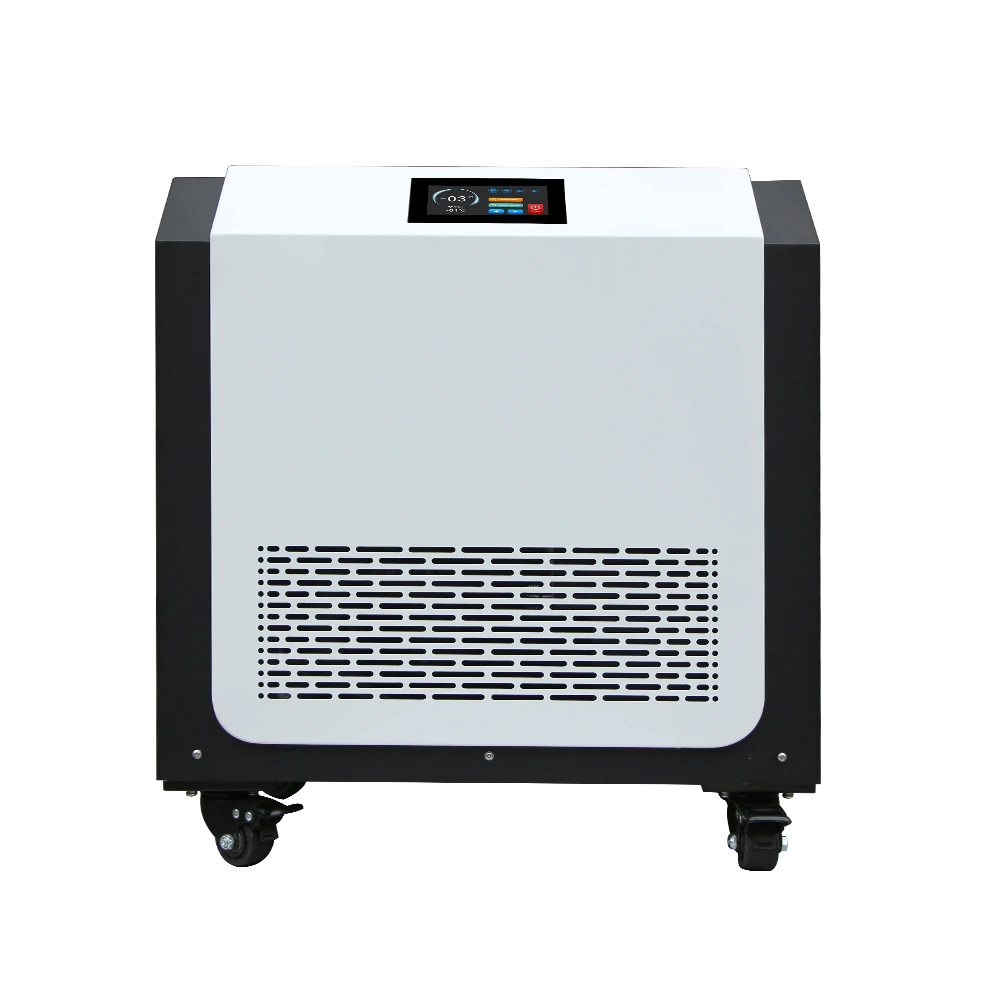
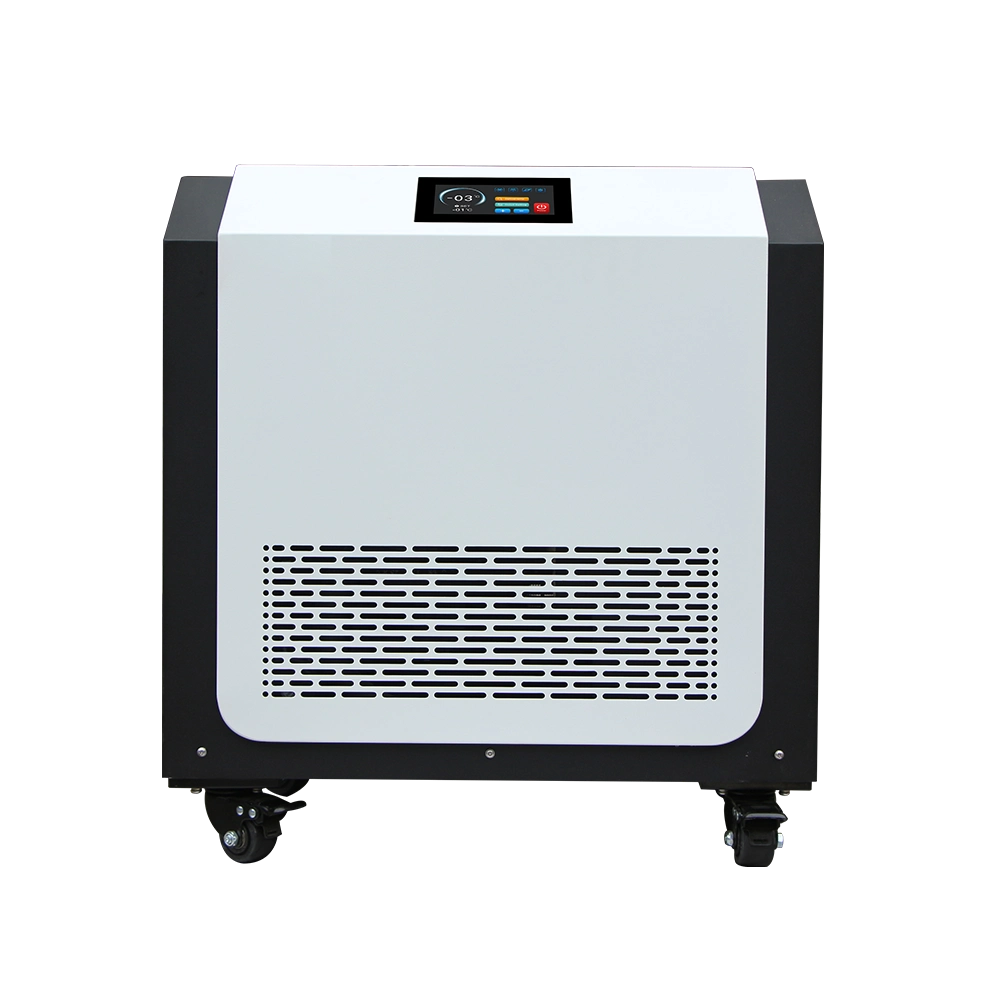
OMNI’s image-only Chiller Brochure gives useful model-level evidence. On PDF page 6, CHU-15-RW is printed as a 220–240 V, 50 Hz model using R290 with a listed charge of 300–320 g. The same page lists CHU-15-RV as 110–120 V, 60 Hz and prints “R32/R410a” without explaining whether that means alternative builds or a table error. That ambiguity must stay visible; it cannot be resolved by guessing.
The brochure also lists CHM-10-RW and CHM-10-RV with R32 on PDF page 13. CH-08-RW and CH-08-RV are printed with R32 on page 16. These are brochure facts for named variants. They do not prove that every current production unit, every destination-market version or every future order uses the same refrigerant.
For an R32 vs R290 cold plunge chiller procurement file, this model map creates a practical rule: never turn the RV/RW pattern into a universal refrigerant code. In the brochure, those suffixes consistently pair with voltage and frequency, but the document does not define them. An importer should quote the full model, voltage, frequency, refrigerant and charge as separate controlled fields.
That boundary is especially important when comparing an R32 vs R290 cold plunge chiller. A buyer may see similar cabinets and assume only the gas changes. In reality, the supplier must confirm which refrigerant-specific components, labels and instructions belong to each build. Similar appearance is not interchangeability.

Build the refrigerant evidence block before sample approval
Put one R32 vs R290 cold plunge chiller evidence block in the RFQ, sample approval sheet and receiving record. The fields should remain identical unless a controlled change is approved. This makes a later substitution visible before it reaches product listings, labels or customer manuals.
| Field | What the supplier provides | What the buyer verifies |
|---|---|---|
| Configuration identity | Model, variant code and drawing revision | Matches quote, sample and purchase order |
| Refrigerant identity | Exact refrigerant and charge mass | Matches nameplate and current datasheet |
| Electrical version | Voltage, frequency, input and plug/cable configuration | Matches destination site and approved sample |
| Safety and market file | Applicable declarations, reports and installation instructions | Scope covers the exact model, market and configuration |
| Service package | Service instructions, parts list and escalation contact | Local service path is realistic before launch |
| Change control | Written notification before refrigerant or component change | Reapproval trigger is written into the order |
Copy these R32 vs R290 cold plunge chiller fields into the OEM chiller RFQ. Do not accept “R32 available” or “R290 optional” as a complete response. The answer should identify the model, charge, market, documents and the sample that proves the selected build.
The same block helps after delivery. Receiving staff can photograph the nameplate, compare the model and refrigerant against the packing list, and quarantine a mismatch before installation. The task is not to open the sealed refrigeration circuit; it is to verify the external evidence and escalate discrepancies to qualified service personnel.
Check market, installation and service responsibility
An R32 vs R290 cold plunge chiller cannot be approved without checking the jurisdiction, equipment category and applicable date. The EU’s current Regulation (EU) 2024/573 is one example: restrictions are written around defined equipment categories, fluorinated-gas thresholds and timelines. It should not be reduced to “R32 is banned” or used as proof that a specific cold-plunge chiller is compliant. The importer must determine the actual product category and applicable date with competent local advice.
Installation responsibility also changes the R32 vs R290 cold plunge chiller answer. Ask where the unit will operate, how ventilation and service access are handled, whether local technicians support the selected system, and what the manual requires. Do not publish generic room-clearance or refrigerant-handling instructions by copying another manufacturer’s product. Those are model-specific safety items.
Serviceability deserves equal weight. A lower-GWP option that no qualified local team can install or support may create a poor launch. Conversely, an established service route does not excuse a buyer from checking current market requirements. The decision needs both: lawful market placement and a workable after-sales path.
For electrical pairing, keep the refrigerant decision separate from the 110V versus 220V chiller decision. OMNI’s brochure shows refrigerant and voltage variants in the same tables, but one field must not be used to infer the other. Confirm both on the ordered configuration.
Make the shortlist and send the RFQ
Shortlist an R32 configuration when the exact unit has a clear destination-market route, the buyer has suitable service support, and the supplier can provide the matching nameplate, charge, documents and sample record. Shortlist an R290 configuration when the product design, charge, installation conditions, market route and trained service plan are all documented. Reject either route when the supplier answers only with a refrigerant name.
A useful R32 vs R290 cold plunge chiller decision record ends with four lines: selected configuration, open compliance items, responsible person and reapproval trigger. That is enough for purchasing, engineering and sales to work from one version. It also stops a later component or refrigerant change from quietly entering a repeat order.
Start with OMNI’s cold plunge chiller configurations, then send the destination country, application, water volume, target temperature, ambient conditions, voltage, installation type and required documents. An R32 vs R290 cold plunge chiller quote should be tied to the exact variant rather than a generic refrigerant promise. If the project needs a controlled OEM review, use the OMNI contact page.
Questions buyers ask
Is R290 always better than R32 for a cold plunge chiller?
No. R290 has a much lower published GWP, but it is classified A3 while R32 is classified A2L. The right choice depends on the product design, refrigerant charge, destination-market rules, installation conditions, service capability and the supplier evidence for the exact unit.
Can an importer approve the refrigerant from a brochure alone?
No. A brochure can support shortlisting, but order approval should use the current model datasheet, nameplate photo, refrigerant charge, electrical version, component list, applicable market documents and an approved sample or production record.
Should R32 and R290 versions share one model code?
Only if the manufacturer has a controlled variant system that keeps the refrigerant, charge, electrical version, labels, components and documents traceable. A buyer should not assume two refrigerants are interchangeable because the cabinet looks the same.