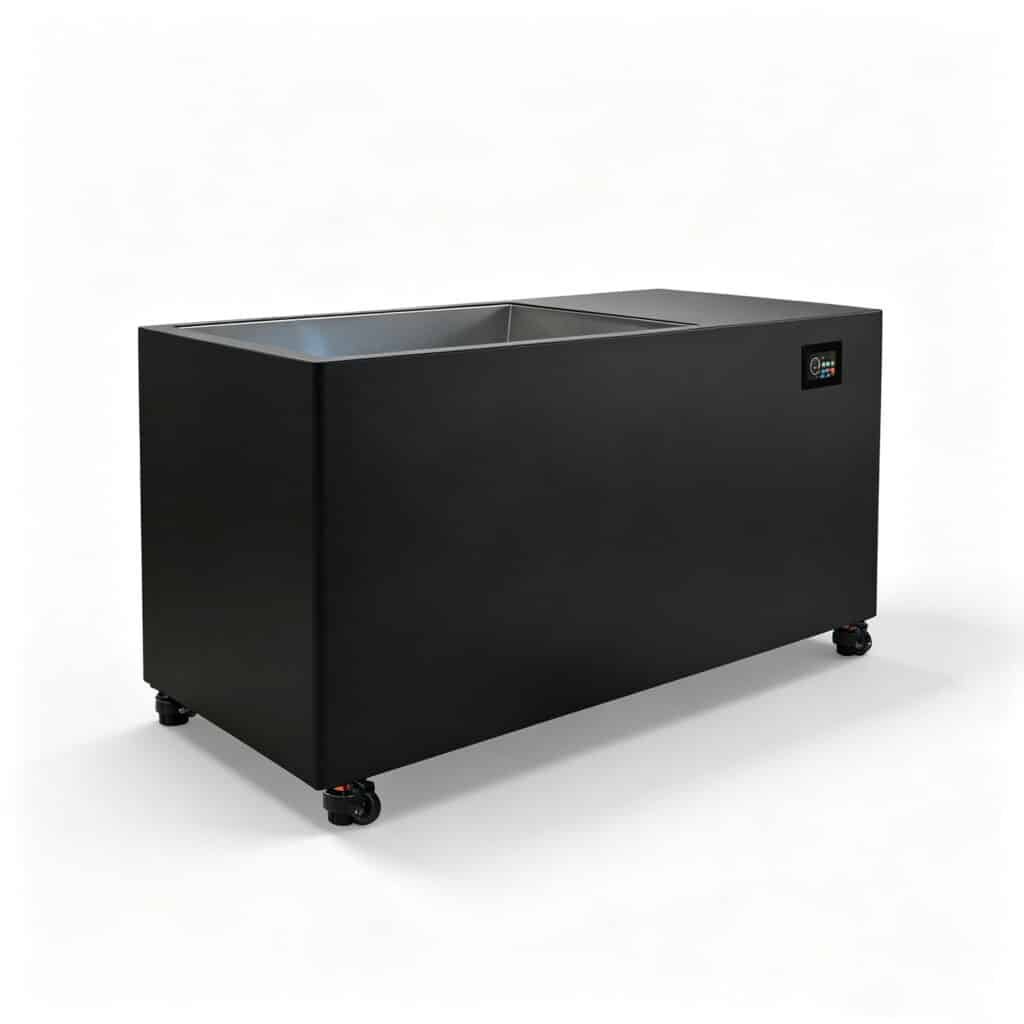
A cold plunge chiller with ozone adds a supplemental water-treatment function; it does not replace physical filtration, circulation, cleaning or a complete water-care plan. Buyers should approve ozone only when the exact model, generator, controls, operating restrictions and maintenance documents are identified.
This guide answers the searcher’s real question: what does a cold plunge chiller with ozone actually include, and what claims should remain open? It uses OMNI catalogue facts by model and the safety boundaries in an unmapped operation manual. It does not promise a kill rate, maintenance-free water or universal occupied-space safety.
A cold plunge chiller with ozone still needs a filter
In a cold plunge chiller with ozone, ozone and filtration perform different jobs. A filter captures hair, sediment and other physical debris in the water path. Ozone introduces an oxidizing treatment step when the system and operating procedure support it. Neither function proves that the other is present, correctly sized or maintained.
| System function | What it addresses | What it does not replace |
|---|---|---|
| Circulation | Moves water through the connected loop | Filtration, treatment or cleaning |
| Physical filter | Captures debris according to the installed medium and housing | Disinfection or complete water chemistry control |
| Ozone function | Supplemental oxidation/treatment under documented conditions | Filter service, debris removal, water testing or surface cleaning |
| Cleaning and water care | Manages accessible surfaces, water condition and operating records | Correct flow, filtration or model-specific safety controls |
A cold plunge chiller with ozone should therefore be described as a configured system, not as “self-cleaning.” The chiller filter guide owns physical filtration. This page owns the ozone feature boundary and buyer verification task.
Read the model table before accepting an ozone claim
OMNI’s Chiller Brochure gives named examples. On PDF page 6, CHU-15-RW, CHU-15-RV and CHU-10-RV list an ozone generator, 88 W DC circulation motor and externally installed filter. On page 9, CHU-05-RV also lists ozone and an external filter. On page 13, CHM-10-RW and CHM-10-RV list ozone with a built-in self-priming circulation system and internally installed filter.
Those facts support a model-specific cold plunge chiller with ozone comparison. They do not prove that every cabinet in the range includes ozone or that brochure options remain unchanged for every order. The CH-08 table has no ozone row; omission is not enough to invent either presence or absence for unlisted configurations.
| Model family | Catalogue ozone evidence | Filter evidence | Buyer action |
|---|---|---|---|
| CHU-15 / CHU-10 | Ozone generator listed | External filter listed | Confirm exact suffix, BOM and control method |
| CHU-05-RV | Ozone generator listed | External filter listed | Confirm included filter/housing and cycle procedure |
| CHM-10-RW/RV | Ozone generator listed | Internal filter listed | Confirm service access, control logic and documentation |
| CH-08-RW/RV | No model-table ozone row | External filter appears at series/accessory level | Do not infer ozone; require current datasheet |
Use the exact ozone operating and safety boundary
OMNI’s generic Ice Bath Chiller Operation Instruction shows an ozone switch, but it does not identify the model or manual revision. It says people must leave the site during ozone disinfection, ozone must not operate during bath use and the operator should use protective equipment to avoid prolonged exposure. It gives no ozone output, concentration, cycle duration, room-volume requirement, re-entry threshold, destruct mechanism or sensor requirement.
That evidence changes how a cold plunge chiller with ozone should be sold and approved. Do not invent a universal run time, safe re-entry delay or occupied-use mode. Confirm the exact model manual and site procedure before operating the function.
The U.S. EPA explains that ozone exposure can irritate and damage the respiratory system. Its ozone-generator guidance concerns indoor air cleaners, not cold-plunge equipment, but it supports the general inhalation-risk boundary. It does not prove how an ozone-water system performs or establish a safe cycle for an OMNI unit.
Put the ozone evidence block in the RFQ
A buyer requesting a cold plunge chiller with ozone should require more than a feature icon. The cold plunge chiller with ozone evidence block should remain consistent across quotation, sample approval, production and receiving inspection.
| Field | Supplier evidence | Buyer decision |
|---|---|---|
| Configuration identity | Model, suffix, controller and BOM revision | Matches quote, sample and product listing |
| Ozone hardware | Generator model/specification, connection and replaceable parts | Feature is physically and documentably included |
| Control logic | Manual command, timer, interlock, fault and power-loss behavior | Operation cannot bypass approved restrictions |
| Cycle conditions | Water volume, circulation state, output, duration and method | Claims are tied to defined conditions |
| Occupied-space boundary | Presence restriction, ventilation and re-entry instructions | Site procedure and responsibility are assigned |
| Water-care boundary | Filter, cleaning, testing and full-water-change requirements | Ozone is not presented as a complete water plan |
The chiller configuration page helps identify the product family. Buyers who want a concrete example can review the 1HP ozone chiller product, then confirm the current ordered specification instead of copying page text into a contract.
Decide whether the feature fits the operator
A cold plunge chiller with ozone may suit a buyer who wants a documented supplemental water-treatment function and can operate it within the approved restrictions. It is a weaker fit when staff cannot control access, maintain records, service the filter or confirm the procedure for the exact model.
Commercial sites should name who may start the cycle, how bath use is blocked, how the area is controlled, what evidence closes the cycle and who authorizes re-entry. Home buyers still need the model manual and safe procedure; “automatic” does not mean unattended or unrestricted.
For connected controls, the smart chiller systems page shows current product routes. Wi-Fi, timers or a touchscreen do not prove that ozone interlocks, cycle duration or re-entry instructions are identical across models.

Use four ozone approval gates
A cold plunge chiller with ozone should pass four separate gates instead of one feature checkbox. The configuration gate proves that the ordered model actually includes the ozone hardware. The control gate proves how the cycle starts, stops and responds to faults or power loss. The site-safety gate defines occupied-space restrictions, ventilation and re-entry authority. The water-care gate shows how ozone works alongside filtration, circulation, cleaning and testing.
| Approval gate | Evidence to retain | Hold when |
|---|---|---|
| Configuration | Model, BOM revision, generator identity, tubing/injection point and controller | The quote uses only an icon or generic feature name |
| Controls | Cycle command, timer, interlocks, fault state and power-loss behavior | The cycle can run without the approved conditions |
| Site safety | Presence restriction, ventilation, signage, PPE and re-entry instruction | The project has no documented operator or boundary |
| Water care | Filter, circulation, testing, cleaning, cartridge service and water-change triggers | Ozone is presented as the entire maintenance plan |
These gates make a cold plunge chiller with ozone easier to audit across quotation, sample approval, production and handover. They also prevent a product-page feature from silently becoming an operating claim that the model documents do not support.
Separate hardware presence from treatment performance
Seeing an ozone switch or generator in a BOM proves presence, not performance. A treatment claim depends on output, contact method, water volume, circulation, organic load, temperature, cycle time and measurement method. Unless those conditions and results are documented, do not publish a percentage reduction, “sterilized water” promise or fixed cycle recommendation.
For a cold plunge chiller with ozone, the buyer should ask what the sample test actually demonstrates. Does it confirm that the generator energizes? Does it confirm controller timing? Does it measure ozone in water or air? Does it show a verified treatment result under a named method? Those are different evidence levels and should not be merged into one pass/fail field.
Example: a hypothetical shared recovery studio
Consider a hypothetical studio evaluating a CHM-10-style cold plunge chiller with ozone. The catalogue indicates ozone, internal filtration and a self-priming circulation system for that model family. The studio still needs the current model datasheet and operating manual. It assigns one staff role to control the ozone cycle, prevents bath use during the approved process, records the filter condition and retains the manufacturer instructions at the equipment location.
If the studio later changes to a CH-08-style cooling-only unit, the ozone approval does not transfer. The CH-08 table does not list ozone. Similar size, colour or touchscreen controls cannot bridge that evidence gap. The new configuration must be reviewed from its own BOM and manual.
Keep maintenance and incident records separate
The routine cold plunge chiller with ozone log should record cycle date/time, operator, water state, filter condition, cycle completion and any alarms. An incident record should separately capture unexpected odour, visible leakage, failed interlock, operation during occupancy, respiratory complaint or an unapproved controller change.
Do not diagnose ozone hardware from the public article. Isolate the function, preserve the evidence and use authorized service when the exact procedure is not available. A maintenance log proves that a task was recorded; it does not prove exposure safety or treatment effectiveness.
Approve the complete water-care system
The final cold plunge chiller with ozone approval should connect the tub, circulation, filter, ozone function, controls, site procedure and maintenance record. A cold plunge chiller with ozone should be commissioned against the approved configuration with every open limitation recorded.
Use the filter maintenance schedule for condition-based filter checks. Ozone does not cancel filter inspection, flow monitoring, accessible cleaning or water-care responsibilities.
Buyers requesting a cold plunge chiller with ozone can send the destination market, model preference, tub volume, application, staffing plan, filter requirement and ozone-document requests through the OMNI project contact. The output should be a model-specific confirmation—not a generic promise that ozone makes a plunge maintenance-free.
Questions buyers ask
Does ozone replace the filter in a cold plunge chiller?
No. Ozone is a supplemental treatment function, while a filter removes physical debris from the circulating water. The exact system still needs the specified filter, circulation, cleaning, water-care checks and maintenance.
Can ozone run while someone is using the cold plunge?
Do not assume so. OMNI’s generic instruction says people should leave the site during ozone disinfection and that ozone must be off during bath use. Because the manual is not mapped to every model, confirm the exact unit’s approved operating procedure.
What should a buyer verify before ordering an ozone-equipped chiller?
Verify the exact model and variant, ozone generator presence, output or control specification, cycle logic, interlocks, occupied-space restrictions, ventilation and re-entry instructions, filter configuration, maintenance procedure and the documents supplied with the order.