The material your cold plunge tub is made from affects almost everything that matters in daily use — how long it lasts, how easy it is to keep clean, how well it holds temperature, and how much maintenance it demands over time. Most buying guides focus on price and dimensions. This one focuses on what the material actually means for you after the first six months of use, when the novelty has worn off and the real-world performance becomes clear.
As a cold plunge tub manufacturer producing every major material type across our lineup, we have direct data on how each one performs under real-world conditions — home use, commercial gyms, outdoor installations, and everything in between. This guide gives you an honest comparison rather than a sales pitch for whichever option carries the highest margin.
Why Cold Plunge Tub Material Matters More Than Most Buyers Expect
When you first buy a cold plunge tub, the material feels like an aesthetic decision. Stainless steel looks professional. Wood looks premium. Acrylic looks clean. Inflatable looks affordable. But after six months of daily use, the aesthetic fades into the background and what you actually care about is: does the surface harbour bacteria? Is it getting harder to clean? Are there any rust spots, cracks, or delamination starting to show?
The answers to those questions are almost entirely determined by the material your tub is made from — and specifically by how that material interacts with cold water, ozone or chemical sanitisers, temperature cycling, and the UV exposure it gets if it lives outdoors.
Cold water is actually more demanding on materials than warm water in several ways. It contracts the material differently, it creates condensation on outer surfaces, and it carries dissolved oxygen more efficiently than warm water — which accelerates oxidation in metals that are not properly graded. This is why the grade of stainless steel matters, not just whether something is “stainless.”
Stainless Steel Cold Plunge Tubs: The Commercial Standard
Stainless Steel
Best for: Commercial facilities, serious home users, outdoor installations
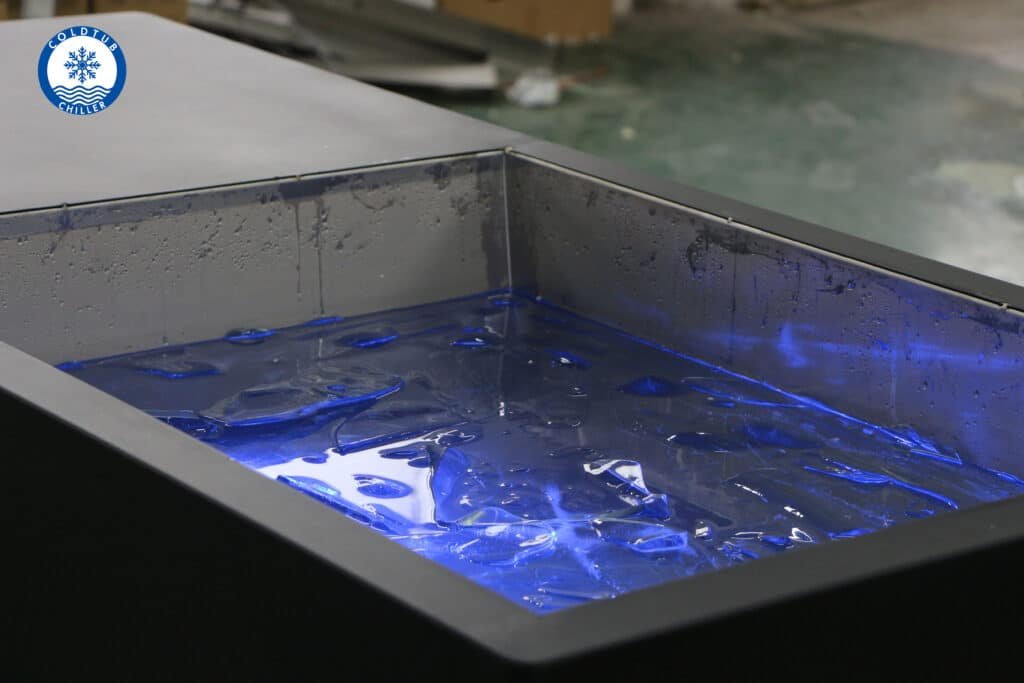
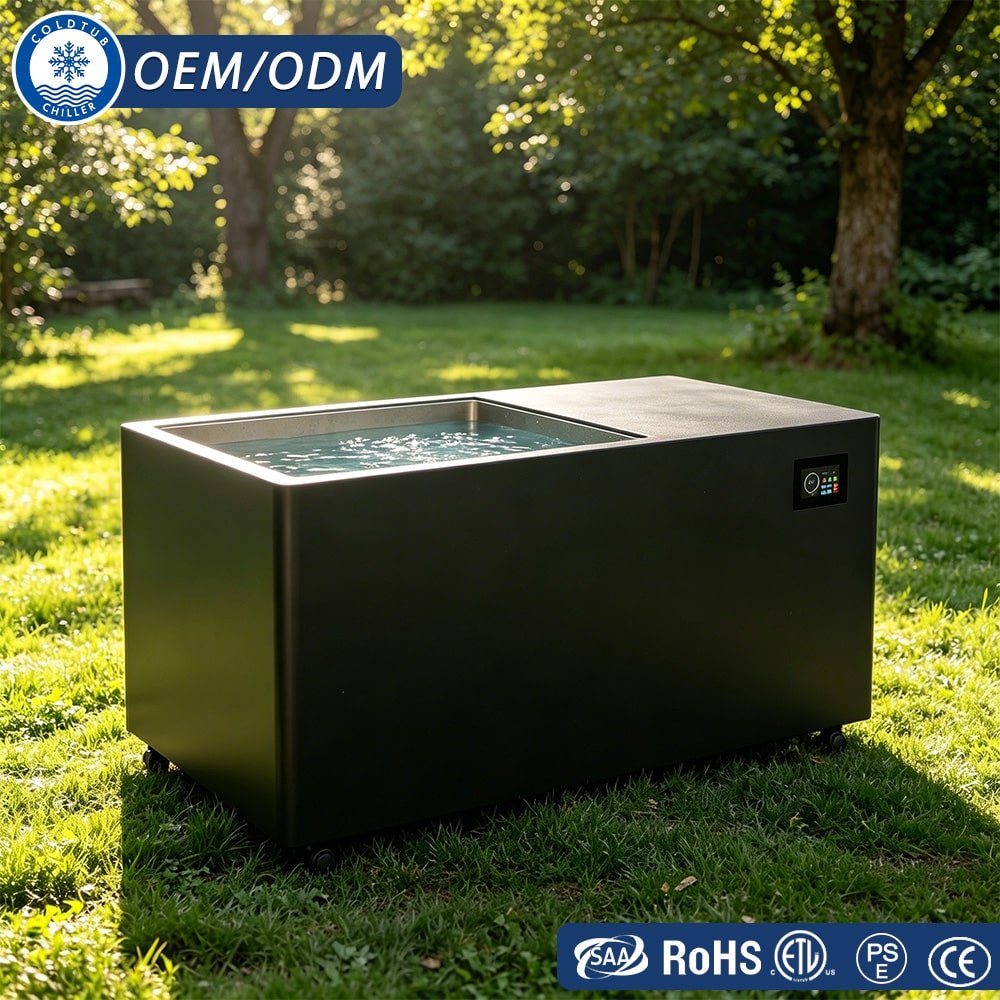
Stainless steel is the material of choice for professional cold plunge installations worldwide, and for good reason. When properly graded and fabricated, it is virtually indestructible in cold water environments, completely non-porous, and easy to sanitise to clinical standards. It is the only material that genuinely improves with use rather than degrading — a well-maintained stainless steel tub used daily for ten years looks essentially identical to one that is new.
The critical variable is the steel grade. There is a significant difference between 304-grade and 305-grade stainless in terms of corrosion resistance under sustained cold water exposure, and between both of those and lesser grades used in cheaper products. According to ASTM stainless steel standards, 304-grade stainless provides excellent corrosion resistance in most environments, while higher-grade alloys are warranted for aggressive chemical exposure or marine environments. For cold plunge use with standard sanitisation, 304 or 305-grade is the correct specification.
The other factor is weld quality. A stainless steel tub with poorly finished welds will develop rust at the weld points — not because the steel itself is failing, but because the heat-affected zone around a bad weld changes the steel’s properties. Properly TIG-welded and passivated seams are as corrosion-resistant as the surrounding steel. Cheaper fabrication shortcuts this process and you see the results within a year.
For a deep dive into stainless steel specifically, see: Stainless Steel Cold Plunge Tub: The Real Buyer’s Guide
Advantages
- Virtually unlimited lifespan with basic maintenance
- Non-porous — no bacterial growth in the material itself
- Compatible with ozone, UV, and all sanitisers
- Handles outdoor conditions year-round
- Easy to clean — no special products needed
- Best resale value of any material
Disadvantages
- Higher upfront cost than acrylic or inflatable
- Heavier — installation requires planning
- Conducts cold to touch — can feel harsh on entry
- Grade matters — cheap “stainless” is not the same
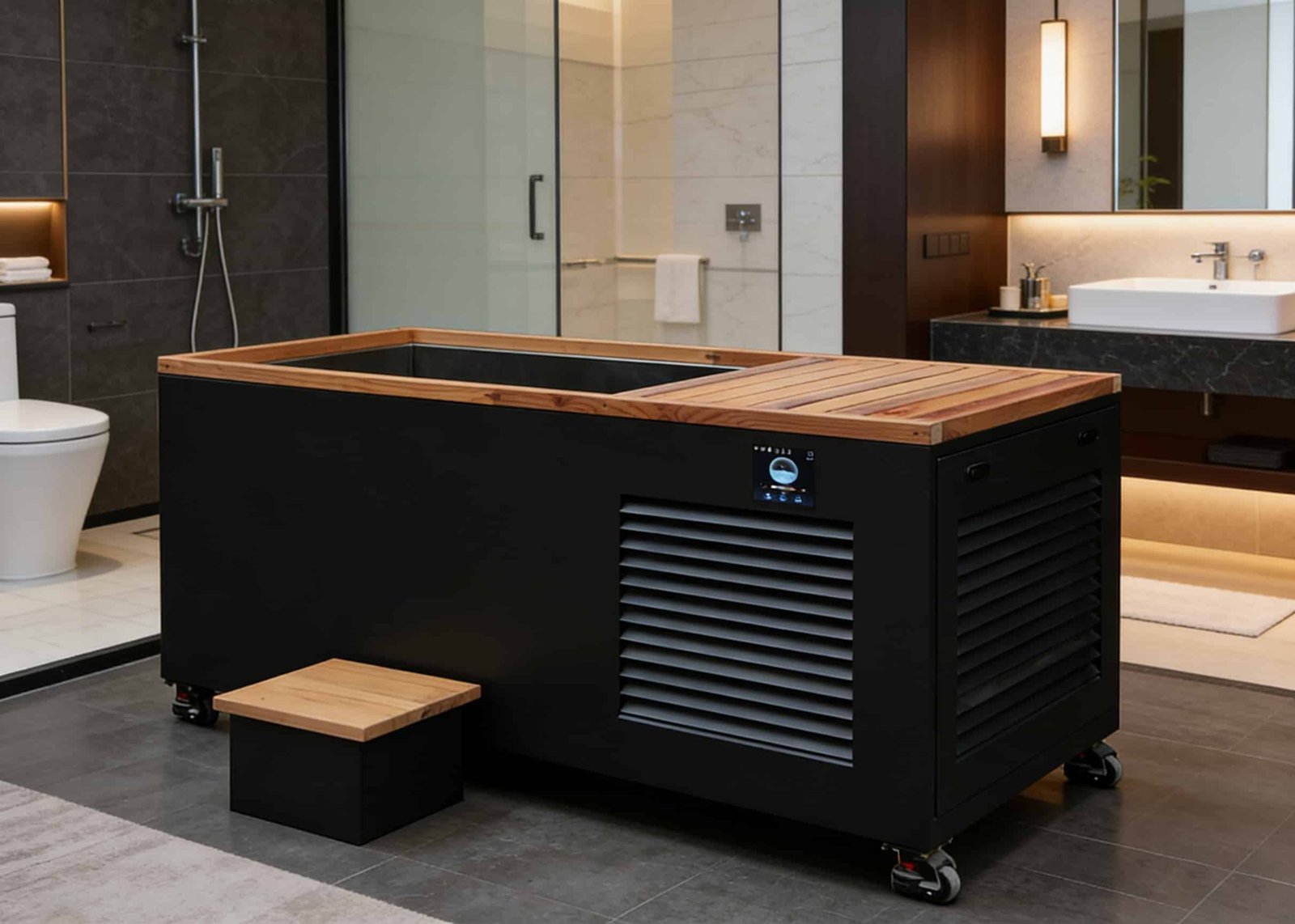
Our WT-09 stainless steel tub is a 500-litre oval tub in 305-grade stainless with a red cedar exterior wrap — the cedar softens the industrial look and adds a meaningful insulation layer. At 500 litres it is appropriate for two users or for single-user commercial environments where a larger water volume is preferred for thermal stability. For facilities needing a statement piece that also performs at commercial standards, this is the specification.
Wood Cold Plunge Tubs: The Premium Aesthetic with Practical Trade-offs
Wood / Hybrid
Best for: Home wellness setups, boutique spas, aesthetic-driven environments
Wood has been used for cold immersion vessels for centuries — Nordic cultures have used wooden cold plunge barrels alongside saunas for as long as both have existed. The appeal is obvious: wood is naturally beautiful, it feels warm to the touch even when the water inside is cold, and a well-made wooden cold plunge barrel looks like a piece of furniture rather than a piece of equipment.
The practical reality of wood is more nuanced. Solid wood cold plunge tubs — particularly those made from thermally modified pine, spruce, or cedar — can last many years when properly maintained. The key phrase is “properly maintained.” Wood requires consistent water management (it must stay wet or it dries and cracks), regular checking of the barrel hoops and staves for gaps, and careful management of sanitiser chemistry — some chemicals that work well in stainless or acrylic tubs can accelerate wood degradation.
The more practical approach for most buyers is a hybrid construction: a stainless steel inner tub that handles the water contact directly, wrapped in a wood exterior for aesthetics and insulation. This gives you the look and feel of a wooden tub with the maintenance profile of stainless steel — the wood exterior never contacts water, so it does not face the same demands.
- Most aesthetically appealing — premium look
- Natural insulation properties in the exterior shell
- Warm to the touch even with cold water inside
- Hybrid builds combine aesthetics with SS durability
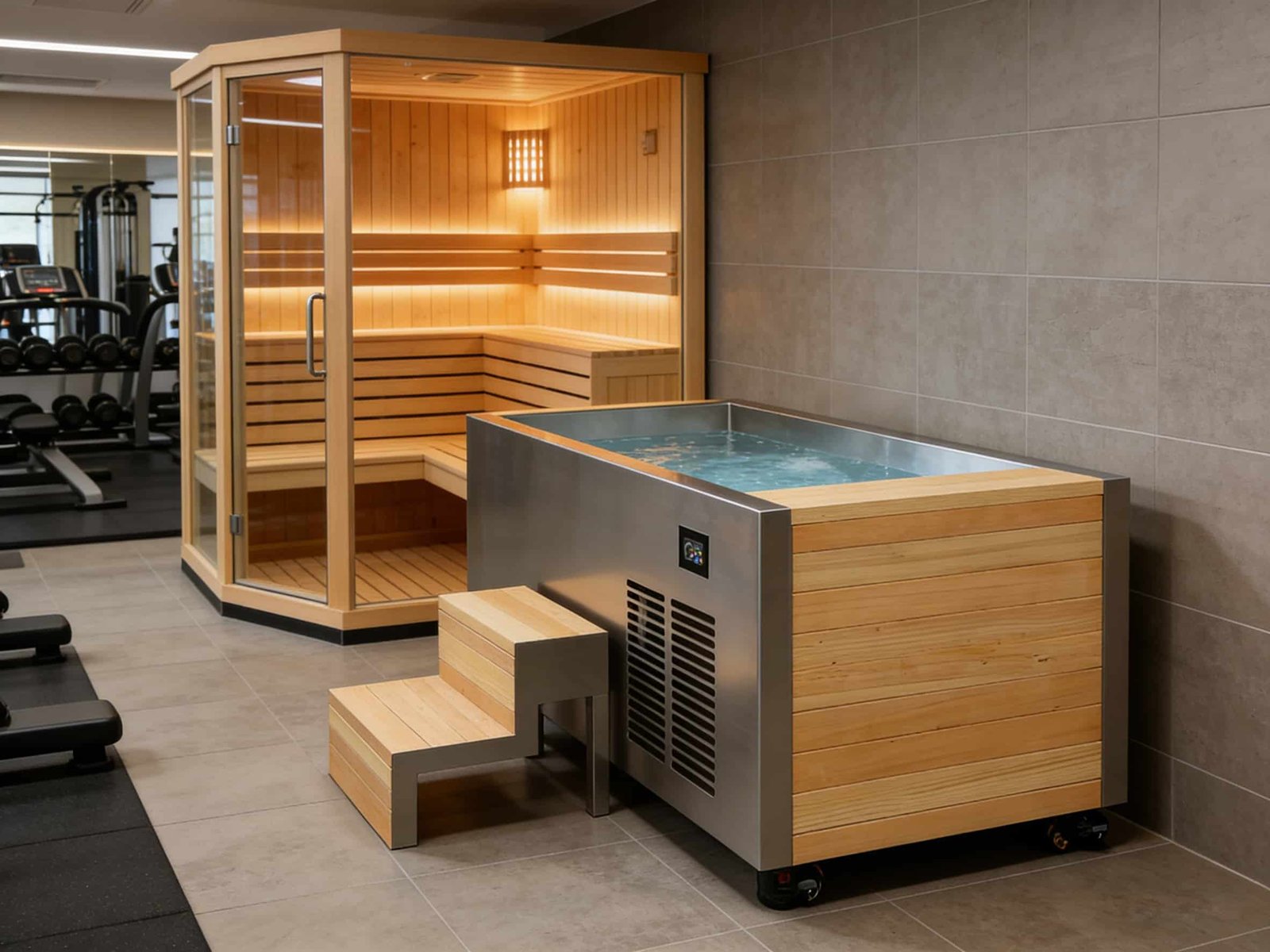
- Ideal for sauna and contrast therapy environments
- Solid wood requires significant ongoing maintenance
- Can develop gaps if allowed to dry out
- Limited chemical sanitiser compatibility (solid wood)
- Higher cost for quality wood species
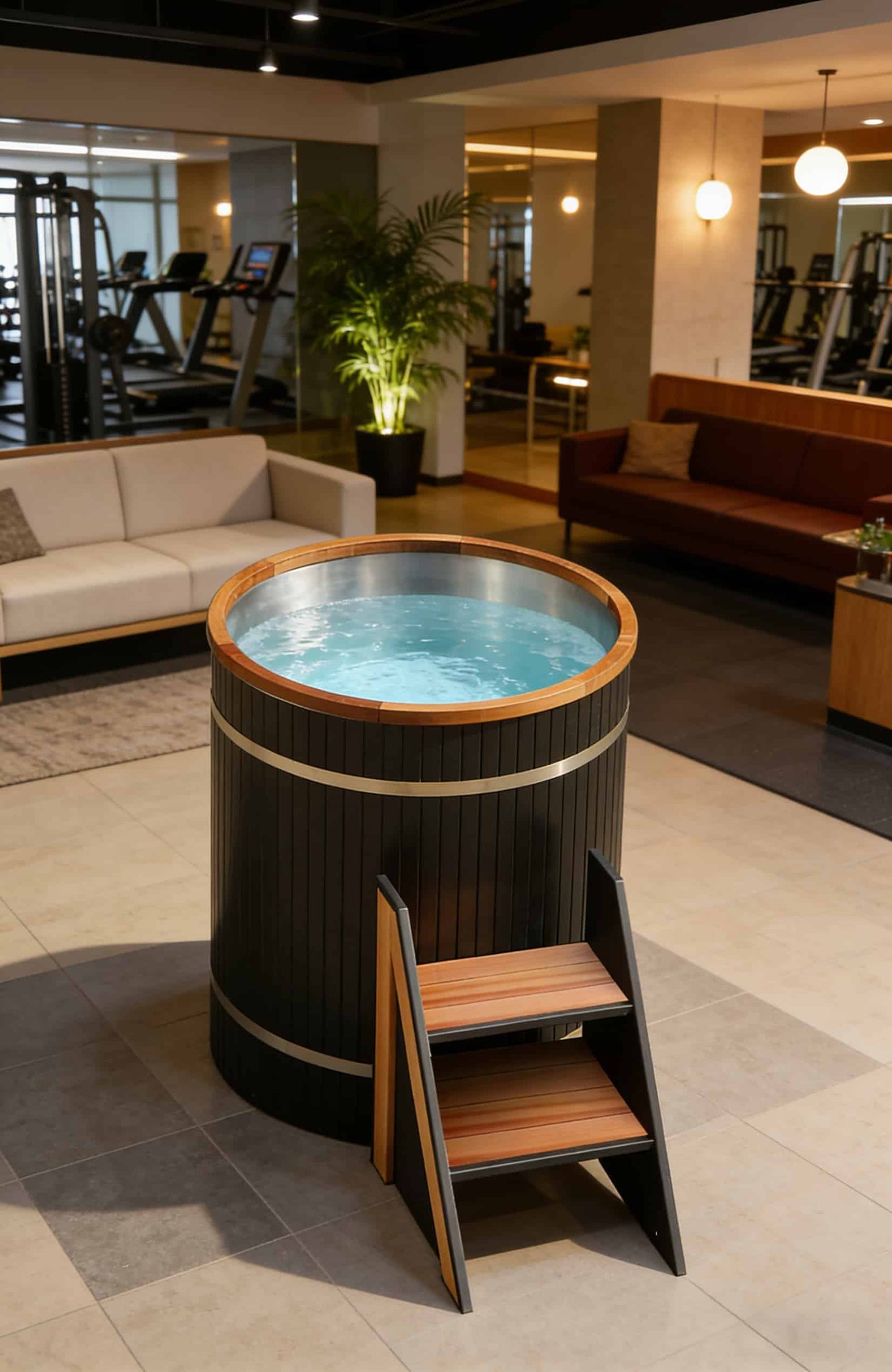
Our WT-05 hybrid cold plunge tub is the practical middle ground — 304 stainless steel inner tub with a WPC and red cedar exterior wrap, 950mm deep for full shoulder immersion. The stainless interior handles all water contact and sanitisation; the cedar exterior provides insulation and the aesthetic of a premium wooden barrel. At 860 × 860mm footprint with a foam lid and wooden step included, it is designed for home or boutique wellness environments where appearance matters as much as performance.
Acrylic Cold Plunge Tubs: The Practical Indoor Choice
Acrylic
Best for: Indoor home gyms, boutique studios, controlled environments
Acrylic is the material most commonly used in consumer-grade cold plunge tubs, and it has genuine strengths that explain its popularity. A well-made acrylic tub is smooth, non-porous at the surface, easy to clean, and available in a range of sizes and shapes that stainless steel fabrication cannot always match at equivalent cost. The surface feels comfortable against skin — no cold metal contact — and acrylic can be formed into ergonomic shapes that improve the immersion experience.
The limitations of acrylic become relevant in demanding environments. It scratches more easily than stainless steel, and scratches create micro-harbors for bacterial growth that become progressively harder to sanitise. It is less tolerant of high-concentration sanitiser chemicals than stainless. And it has a meaningful thermal mass — it absorbs cold from the water and transfers it to the surrounding air — which means a chiller paired with an acrylic tub works harder than one paired with an insulated tub of equivalent volume.
For indoor home use with controlled ambient temperatures and single or small-group use, acrylic is a completely practical choice. For high-traffic commercial environments or outdoor installations, the case for stainless steel becomes much stronger.
- Comfortable surface — no cold metal contact
- Available in more shapes and sizes
- Lower cost than stainless or premium wood
- Easy to clean under normal use conditions
- Good aesthetic for indoor wellness spaces
- Scratches over time, especially in multi-user settings
- Less tolerant of strong sanitisers
- Not ideal for outdoor or high-UV environments
- Lower longevity than stainless in heavy use
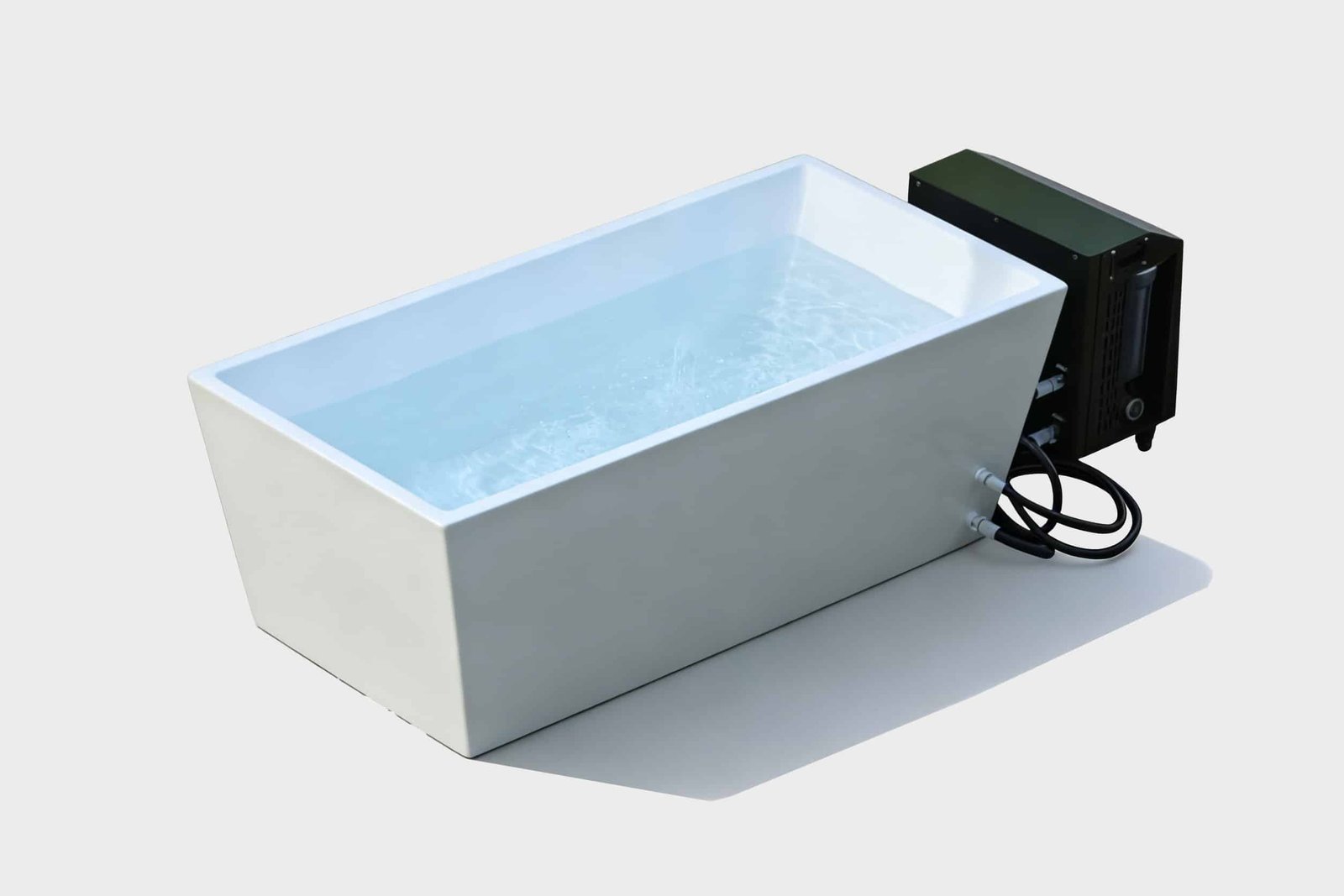
Our WT-03 acrylic cold plunge tub is designed for boutique studios and indoor home installations where appearance and comfort are priorities. Paired with a 1HP chiller, it delivers consistent cold therapy performance in controlled indoor environments.
Inflatable Cold Plunge Tubs: The Entry Point and Travel Option
Inflatable
Best for: Testing cold therapy, travel use, temporary setups, budget entry point
Inflatable cold plunge tubs have improved dramatically in the last two years. Military-grade PVC construction, insulated inner layers, and reinforced seams have addressed the durability concerns that plagued earlier versions. A quality inflatable tub from a reputable manufacturer is genuinely usable for regular cold therapy — it is not just a novelty or a stopgap.
That said, the limitations are real and worth understanding clearly. Inflatable tubs have minimal insulation compared to purpose-built cold plunge tubs — the walls are thick for structural strength, not thermal performance. A chiller paired with an inflatable works harder than one paired with a foam-insulated rigid tub. In warm ambient conditions, maintaining water below 10°C in an inflatable tub requires a chiller at the upper end of the appropriate HP range.
Where inflatables genuinely shine is portability, storage, and cost of entry. A quality inflatable tub costs a fraction of a stainless steel or hybrid wooden tub. It stores flat when not in use. It travels. For someone starting their cold therapy practice who is not yet ready to commit to a permanent installation, an inflatable paired with a good chiller is a completely viable path — and the chiller can be reused when you eventually upgrade to a rigid tub.
- Lowest upfront cost
- Portable — stores flat, travels easily
- No installation required — fill and use
- Good entry point for new cold therapy users
- Chiller can be reused when upgrading
- Minimal insulation — chiller works harder
- Not suitable for daily multi-user commercial use
- Lower longevity than rigid tubs
- Limited depth options for full immersion
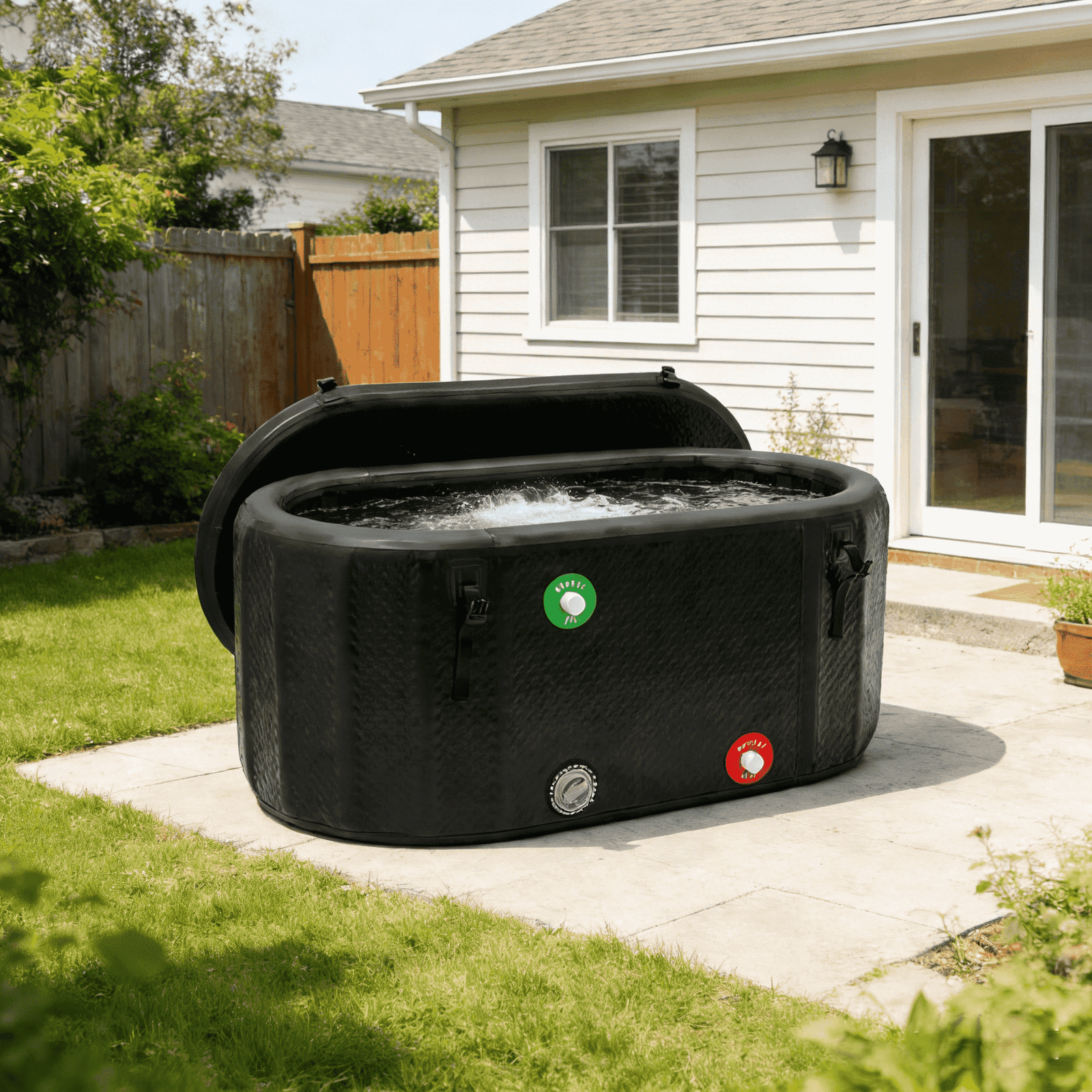
Our WT-02 inflatable ice bath tub uses military-grade PVC with a reinforced base and insulated inner layer. It is compatible with any external chiller and includes the necessary connection fittings for a complete cold plunge setup without a permanent installation.
Side-by-Side Comparison
| Factor | Stainless Steel | Wood / Hybrid | Acrylic | Inflatable |
|---|---|---|---|---|
| Lifespan | 10+ years | 5–10 years (hybrid longer) | 5–8 years | 2–5 years |
| Hygiene | Excellent | Good (hybrid) / Moderate (solid) | Good (when unscratched) | Good |
| Maintenance | Low | Moderate–High (solid) / Low (hybrid) | Low–Moderate | Low |
| Insulation | Low (unless wrapped) | Good (hybrid) | Moderate | Low |
| Outdoor use | Excellent | Good | Moderate | Limited |
| Aesthetics | Professional | Premium / Warm | Clean / Modern | Functional |
| Best for | Commercial, serious users | Home, boutique spa | Indoor home, studio | Entry level, travel |
| Chiller HP needed | Matches volume (insulated) | Matches volume (hybrid insulated) | Add 0.2–0.3HP for heat loss | Add 0.5HP for poor insulation |
Choosing Your Chiller to Match Your Tub Material
The material you choose directly affects what HP chiller you need. An insulated stainless steel or hybrid wooden tub loses heat slowly — your chiller cycles comfortably. An uninsulated acrylic or inflatable tub loses heat faster and increases the chiller’s workload. Always factor the insulation quality of your tub into your HP calculation. For a full breakdown of how to size your chiller correctly, see our cold plunge chiller HP guide.
Which Material Should You Choose?
The honest answer is that the right material depends entirely on your specific situation — not on which one is objectively “best.” Here is a straightforward decision framework.
Choose stainless steel if you are setting up for commercial use, plan to use the tub daily for years, need outdoor durability, or simply want to buy once and never think about the material again. The higher upfront cost is the entire trade-off — the ongoing performance and maintenance story is better than every other option.
Choose a hybrid wood tub if aesthetics matter significantly to your environment — a wellness studio, a sauna room, a premium home setup — and you want the warmth and character of wood without the maintenance demands of solid wood. The stainless inner liner gives you the hygiene profile of stainless; the wood exterior gives you the visual warmth of a traditional barrel.
Choose acrylic if you are setting up a home cold plunge in a controlled indoor environment, the budget is a consideration, and single or light multi-user use is the pattern. Acrylic performs well within its comfort zone — keep it indoors, maintain it regularly, and it will serve you reliably for years.
Choose inflatable if you are new to cold therapy and want to test whether you will actually maintain a consistent practice before investing in a permanent installation. Buy a quality chiller — the chiller is the component worth investing in from day one. When you eventually upgrade to a rigid tub, the chiller carries over completely.
Browse the full range of cold plunge tubs across all materials, or get in touch if you want a recommendation matched to your specific setup.
Frequently Asked Questions
Is 304 or 316 stainless steel better for cold plunge tubs?
How often do I need to clean a stainless steel cold plunge tub?
Can I use a wooden cold plunge tub outdoors year-round?
Does acrylic crack in very cold water?
Can I use an inflatable tub with a chiller long-term?
Which material holds temperature best between sessions?
Not Sure Which Tub Is Right for Your Setup?
We manufacture all four material types and supply factory-direct to gyms, wellness facilities, hotels, and individual buyers worldwide. Tell us your space, your use case, and your budget and we will give you a straight recommendation.