When selecting cold recovery equipment for commercial wellness spaces, the single greatest engineering mistake facility operators make is treating a commercial cold plunge like a residential tub with a larger metal housing. In high-turnover sports clubs, athletic training facilities, and boutique recovery studios, water temperature stability is an active thermal battle against consecutive bather loading. When a wave of fifteen to twenty athletes steps out of a training session, each individual dumps between 1,200 and 1,500 BTU of body heat into the water over three to four minutes. Consumer-grade chillers engineered for intermittent single-user duty cycles simply cannot reject this relentless thermal stress, leading to frozen evaporator coils, high-pressure compressor lockouts, and lukewarm water by mid-morning. This commercial ice bath buying guide details the mechanical requirements, hydraulic clearances, and financial operating models facility directors and procurement teams need to evaluate continuous compressor duty cycles, water sanitation throughput, and commercial ROI.
The Bather Heat Load Reality: Why Residential Chillers Fail in Commercial Facilities
In a standard residential cold plunge installation, a chiller operates under an intermittent duty cycle. The unit pulls ambient tap water down from 65°F to 39°F once, and then idles, cycling on for roughly 15 to 20 minutes every few hours to offset ambient heat transfer through the insulated tub wall. In contrast, commercial cold plunge operations in gyms and wellness centers run on rapid 10-to-15-minute consecutive turns. A facility hosting sixty bather sessions per day must continuously extract up to 90,000 BTU of biological thermal energy across an eight-hour operating window.
A typical consumer-grade 0.5HP chiller produces approximately 4,500 to 5,200 BTU/hr of net refrigeration capacity under peak load. When subjected to continuous bather turns, that 0.5HP compressor falls behind the thermal influx within forty-five minutes. As water temperatures climb from 39°F toward 52°F, members immediately voice dissatisfaction. Commercial operators designing facilities for dedicated commercial cold plunge for gyms must specify continuous-duty rotary or scroll compressors rated between 1.0HP and 1.5HP (such as commercial CHU and CHM series units) to ensure rapid thermal recovery between sessions.
Commercial refrigeration engineering relies on pure titanium coaxial heat exchangers rather than brazed stainless steel plate exchangers. Commercial bather turnover introduces dead skin cells, body lotions, sweat, and elevated sanitizing oxidizers (chlorine, bromine, and ozone) into the circulating water. Stainless steel plate heat exchangers develop micro-pitting corrosion along narrow fluid channels under continuous chloride exposure, eventually pinholing and leaking refrigerant into the bath water. Pure titanium heat exchangers provide complete immunity to chemical corrosion while maintaining an exceptional coefficient of thermal transfer over a ten-year operating life.
Equipment Sizing Architecture: Matching Compressor Horsepower to Tub Volume and Hourly Turnover
Sizing commercial cold recovery machinery requires calculating net cooling capacity against three simultaneous variables: tub water volume, facility ambient room temperature, and maximum peak-hour bather count. Undersizing compressor horsepower results in thermal failure during busy peak periods, while oversizing without variable-speed modulation creates unnecessary compressor short-cycling and premature electrical contactor wear.
Commercial facility directors should follow strict equipment sizing baselines:
- Single-Bather Commercial Pods (80 to 120 Gallons / 300 to 450 Liters): For private athletic training suites hosting 3 to 4 turns per hour, specify a 0.8HP to 1.0HP commercial refrigeration unit delivering at least 8,500 to 10,000 BTU/hr of cooling capacity. This baseline guarantees that bath water remains firmly anchored at 37°F to 39°F without thermal creep.
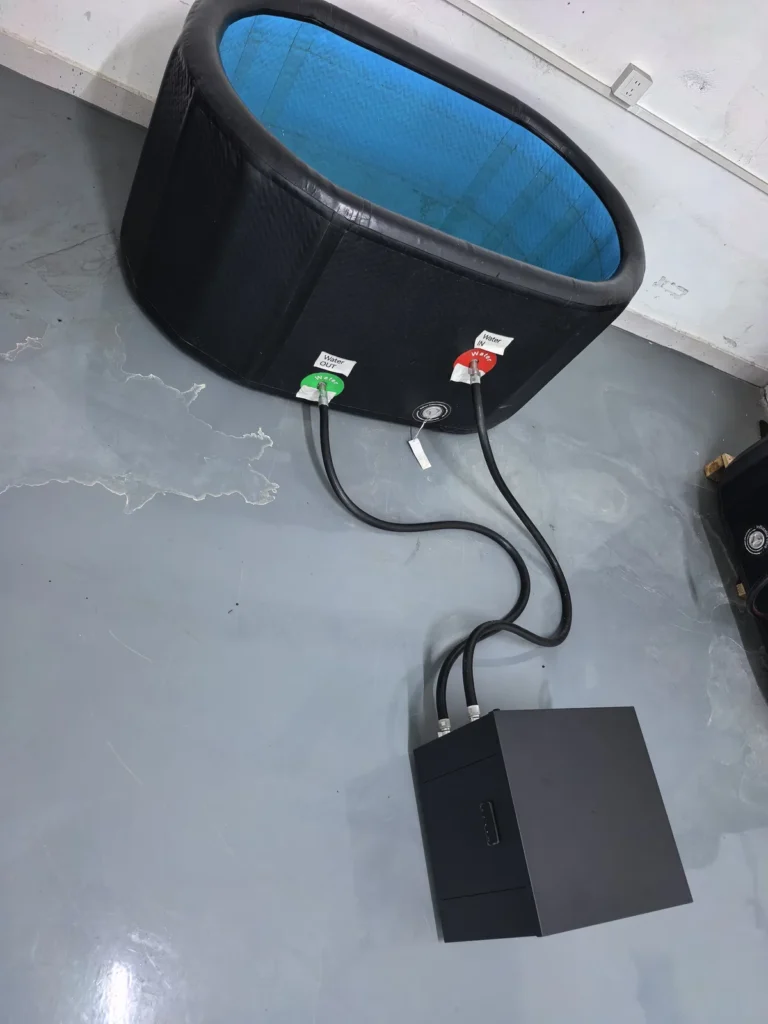
- Cold Plunge Equipment for Recovery Spaces: For projects considering the WT-11 ice making plunge tub, compare the exact model, working water volume and site conditions. WT-11-2 is an ice-making cold plunge tub; confirm seating capacity and recovery time for the selected configuration.
- High-Volume Varsity & Team Troughs (300+ Gallons / 1,100+ Liters): Large varsity team plunge pools require dual-stage 2.0HP to 3.0HP commercial condensing units or parallel 1.5HP chillers connected via common hydraulic manifold headers, providing system redundancy so that routine maintenance does not shut down daily facility operations.
Hydraulic circulation rate is equally critical. Commercial installations utilize dedicated brushless DC magnetic-drive pumps (such as 88W continuous-duty pumps) providing flow rates between 16 and 25 GPM (gallons per minute). Adequate hydraulic velocity ensures high Reynolds number turbulent flow across the titanium heat exchanger surface, preventing localized freezing of water along the evaporator tube walls while rapidly dispersing cold water throughout the tub basin.
Commercial Sanitation Codes: Multi-Stage Filtration and Active Oxidation
Public health regulations governing commercial cold plunge facilities are significantly more demanding than residential pool standards. In commercial recovery environments, public health departments regulate cold plunge tubs under semi-public commercial spa and bathing facility codes. Because cold immersion restricts peripheral blood vessels and forces deep respiratory exhalation, unconditioned communal cold plunge water can rapidly harbor pathogenic bacteria, including Pseudomonas aeruginosa and Legionella, if water filtration relies on consumer-grade miniature cartridges.
A compliant commercial sanitation blueprint incorporates three mechanical barriers:
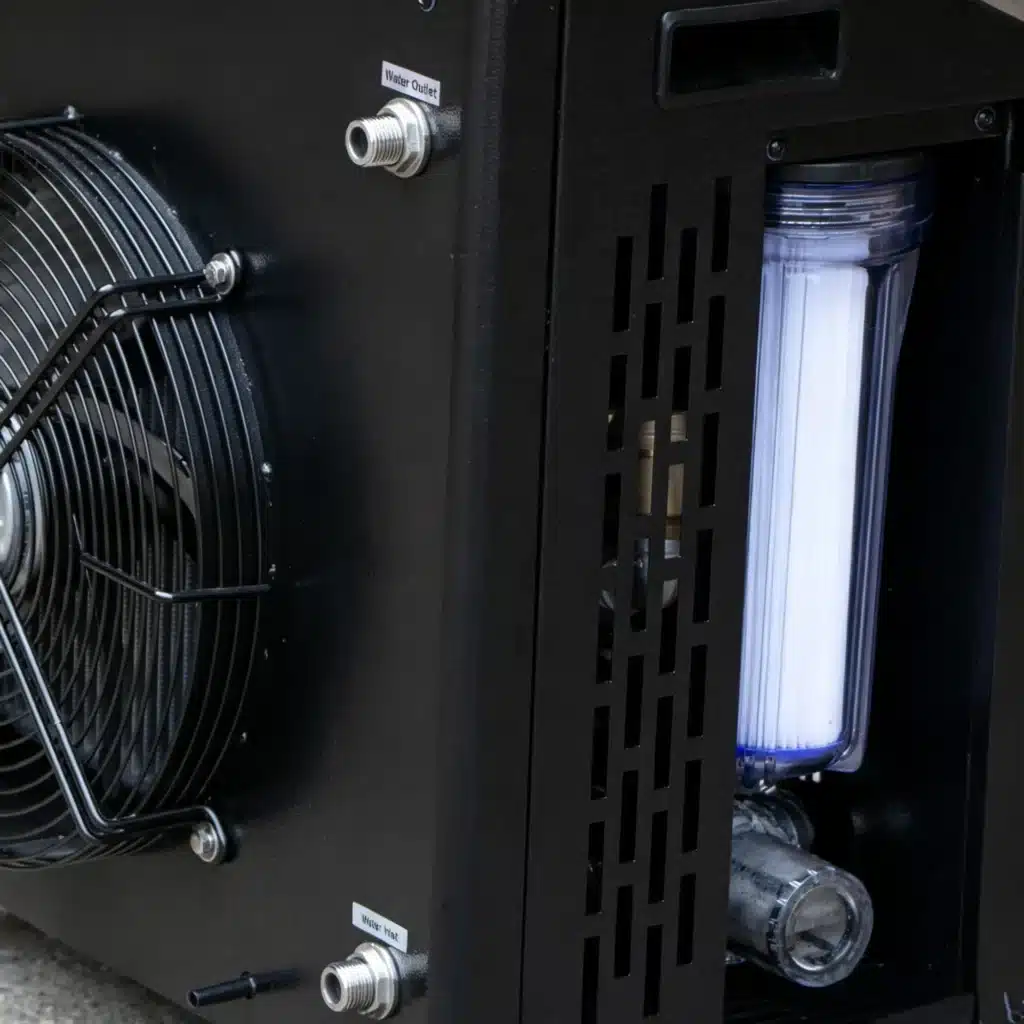
- High-Surface-Area Pleated Mechanical Filtration: Residential chillers typically utilize tiny 20-micron filter cartridges that choke with bather hair and debris within three days of commercial use. Commercial systems specify external heavy-duty 5-inch or 10-inch filter housings accommodating 5-micron to 20-micron dense pleated sediment cartridges, providing at least 15 to 25 square feet of effective filtration area.
- High-Output Venturi Ozone Generation: Commercial chillers integrate corona-discharge ozone generators connected via a dedicated Kynar venturi injection port. Ozone serves as a potent oxidizer, instantly neutralizing dissolved organic compounds, urea, and sweat while clearing bath water clarity without creating pungent chloramine odors in enclosed wellness rooms.
- Continuous Germicidal UV-C Sterilization: Passing circulating water through an inline 254nm ultraviolet sterilization chamber destroys microbial DNA at the cellular level. When paired with secondary non-chlorine sanitizer dosing, UV-C and ozone achieve public health disinfection standards while keeping bather skin free of harsh chemical irritation.
Plumbing integrity must support rapid daily servicing. Commercial systems utilize 1.0-inch or 1.25-inch reinforced food-grade PVC or braided EPDM hoses rated for at least 45 PSI working pressure, terminated with industrial stainless steel camlock or dry-break quick-connect fittings. Isolating ball valves installed on both supply and return plumbing runs allow maintenance personnel to change filter cartridges in ninety seconds without draining the plunge vessel.
Financial ROI Analysis: Capital Expenditure vs. Operational Payback
When presenting a commercial cold plunge investment to gym owners, club boards, or hotel general managers, procurement teams must substantiate capital expenditure (CapEx) against clear operating expense (OpEx) savings and ancillary membership revenue streams. Traditional ice bath operations rely on purchasing bagged commercial ice. A high-traffic sports facility utilizing 80 to 120 pounds of ice daily to chill non-refrigerated tubs expends $25 to $40 per day in ice procurement, accumulating between $750 and $1,200 in monthly operating expense—excluding staff labor hours spent lifting, hauling, and breaking ice blocks.
In contrast, an authentic commercial chiller system pairing an energy-efficient rotary compressor with a heavily insulated vessel (such as 60mm high-density polyurethane insulated tubs) operates at an average coefficient of performance (COP) around 3.2. Once initial pulldown is achieved, maintaining cold water at 38°F requires approximately 8 to 12 kWh of electricity per 24-hour cycle. At standard commercial commercial power tariffs ($0.14/kWh average in the US), daily electrical operating cost ranges from $1.12 to $1.68 per unit, yielding direct OpEx savings of over $800 per month compared to manual ice delivery.
From a direct revenue perspective, modern commercial recovery clubs package cold therapy through tiered membership pricing or dedicated per-session booking models:
- Per-Session Recovery Booking: Dedicated 15-minute cold plunge sessions retailed at $20 to $30 per bather generate $1,600 to $2,400 monthly on just four booked turns daily, amortizing full equipment acquisition cost within three to four months.
- Tiered Gym Membership Surcharge: Introducing unrestricted recovery lounge access (contrast sauna plus cold plunge) as a $39 to $59 monthly membership add-on attracts 40 to 60 participating members in a mid-sized fitness club, producing $1,560 to $3,540 in recurring high-margin monthly subscription revenue.
Factory Inspection and Procurement Verification: The Sample Evaluation Protocol
For overseas commercial brands, distributors, and large wellness franchises sourcing machinery directly from an established cold plunge supplier and specialized cold plunge chiller manufacturer, issuing an initial sample order of one to two units is standard engineering protocol. However, evaluating a factory sample requires systematic technical validation rather than casual unboxing.
Commercial procurement teams must execute an inspection checklist before approving full volume production:
- 24-Hour Continuous Pulldown & Hold Stress Test: Fill the vessel to rated capacity with 70°F water in an ambient room held at 80°F. Record time to reach 39°F, measuring temperature drop rate per hour. Monitor the temperature delta between supply and return water lines (which should maintain a steady 4°F to 6°F differential under stable circulation).
- Electrical Insulation & Leakage Current Verification: Test grounding continuity and measure high-voltage dielectric withstand (Hi-Pot test) to verify complete electrical isolation of the water circuit. Confirm that the integrated industrial GFCI/RCD safety breaker trips cleanly at 10mA to 30mA leakage thresholds.
- Refrigerant Pressure Stability & Noise Profile: Verify high-side and low-side operating pressures under full load to confirm compliant non-leaking factory charging (using eco-friendly R290 or R32 refrigerant circuits). Measure acoustic noise emissions from 1 meter distance: quality commercial units with acoustic compressor jackets should operate below 58 to 62 dB(A).
- Packaging & Sea Freight Impact Resistance: Commercial export crates must feature full plywood perimeter framing, desiccant moisture protection, and heavy foam cradling to prevent condenser coil deformation during rough ocean transit.
Material Engineering: 304 vs. 316 Marine-Grade Stainless Steel & Thermal Insulation Physics
Commercial cold plunge vessels operate under aggressive thermodynamic and chemical stresses far beyond residential bathtubs. When dozens of sweating athletes enter the tub daily, municipal chlorine or bromine sanitizers react with organic loads to form active chloride ions. Over extended operating periods, standard 304 stainless steel—while suitable for residential indoor use—is susceptible to chloride stress corrosion cracking (SCC) and localized crevice corrosion along internal weld seams if water chemistry fluctuates. Commercial recovery facilities, resort hydrotherapy circuits, and outdoor installations should specify 316 marine-grade stainless steel with 2% to 3% molybdenum content. Molybdenum creates a robust passivation layer that completely prevents chloride pitting, ensuring a 15-year commercial operational lifespan without basin structural degradation.
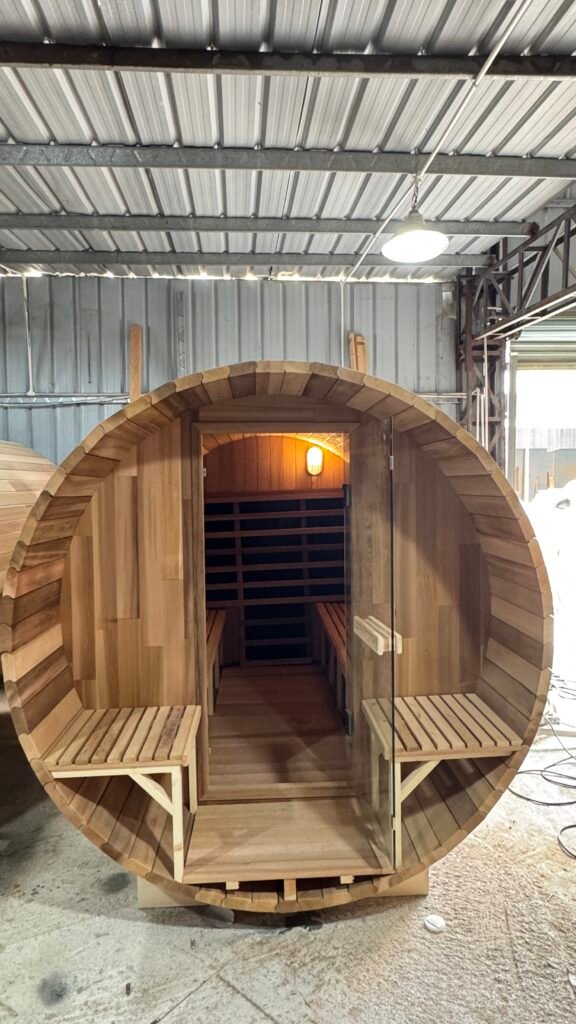
Thermal wall engineering dictates daily refrigeration efficiency. A non-insulated or single-wall metal plunge tub functions as a thermal radiator, drawing ambient room heat directly into the chilled water bath. Commercial plunge vessels must incorporate dual-wall insulated sandwich construction featuring at least 50mm to 60mm of high-density closed-cell polyurethane foam insulation (density rating 38 to 42 kg/m³). In cedar wood-wrapped tub configurations, natural Western Red Cedar or thermally modified timber staves provide high natural R-value thermal resistance alongside internal 304/316 welded linings. High-density perimeter insulation combined with an insulated commercial thermal cover reduces standby thermal absorption by up to 75%, allowing the commercial chiller compressor to remain idle during overnight non-operational hours.
Preventive Maintenance Schedules and Critical Consumable Spare Parts Logistics
In high-turnover sports clubs and athletic training centers, an unplanned cold plunge outage during peak training seasons directly damages membership satisfaction and commercial reputation. Establishing a standardized preventive maintenance protocol ensures maximum equipment uptime while protecting internal refrigeration components from preventable wear.
Commercial facility maintenance teams should implement a tiered service schedule:
- Daily Pre-Opening Protocol: Check water level to ensure pump intake skimmers are fully submerged. Measure chemical oxidation-reduction potential (ORP) and free sanitizer levels. Inspect the chiller digital controller display for diagnostic warning codes or flow sensor alarms.
- Weekly Mechanical Verification: Remove and rinse the external 5-micron pleated sediment filter cartridge using high-pressure tap water. Clear any lint or debris obstructing the chiller front air intake grilles. Verify that the venturi ozone check valve is drawing active vacuum without water backflow.
- Monthly System Sanitization & Flusing: Perform a complete water purge and basin wipe-down using non-abrasive quaternary sanitizers. Flush circulating plumbing lines with commercial line-cleaner to dislodge internal biofilm accumulation. Inspect quick-connect EPDM O-rings for signs of hardening or micro-cracking, applying food-grade silicone lubricant to prevent air suction leaks.
- Biannual Refrigeration & Electrical Audit: Inspect compressor electrical terminals and contactor points for pitting or oxidation. Measure compressor operating amperage draw under full load against factory nameplate ratings. Clean the exterior condenser coil fins using a non-acidic fin comb and coil cleaner to maintain maximum heat rejection airflow.
To ensure uninterrupted facility operations, commercial operators should maintain a dedicated spare parts kit on site containing: two replacement 5-micron pleated filter cartridges, spare EPDM quick-connect sealing gaskets, a backup digital flow sensor, and an auxiliary ozone check valve. Having critical hydraulic consumables immediately accessible eliminates days of waiting for overseas logistics and keeps recovery operations running smoothly.
Frequently Asked Questions (Commercial Procurement FAQ)
What electrical service is required for commercial cold plunge chillers?
Commercial 0.8HP to 1.0HP chillers typically operate on dedicated 110-120V/60Hz 15A or 20A single-phase circuits in North America, while 1.5HP to 3.0HP high-capacity systems require 220-240V/50-60Hz single-phase service pulling 8A to 14A full-load running current. All installations require dedicated circuits protected by Class-A GFCI breakers located within visible line of sight of the equipment.
How often should commercial cold plunge filter cartridges be replaced?
In high-traffic gym environments accommodating 30 or more bathers daily, external 5-micron pleated sediment filter cartridges should be removed and rinsed with fresh water twice weekly, with complete filter replacement every 2 to 4 weeks depending on facility bather cleanliness and pre-rinse compliance.
What physical clearances are needed around commercial chiller plant rooms?
Chillers discharge significant waste heat extracted from the bath water. Maintain at least 18 inches (45 cm) of unobstructed clearance around condenser air intake grilles and 30 to 36 inches (75 to 90 cm) directly in front of the exhaust fan. If housed in an enclosed mechanical closet, install active mechanical ventilation providing at least 10 to 15 air changes per hour (ACH) to prevent ambient room temperatures from exceeding 100°F (38°C).