Carbon Panels vs Ceramic Rods vs Full-Spectrum Emitters Compared
For a carbon vs ceramic infrared sauna comparison, start with the shape and placement of the heaters. A flat carbon-panel layout spreads emitter surfaces across selected cabin walls or lower-body positions. A ceramic rod-style radiator places an elongated heating element in a narrower assembly, often with a reflector and protective housing. Choose around the seated layout and the parts you can install and service, not a claim that one material is automatically healthier or lower EMF.
These designs solve different packaging problems. Panels can occupy broad wall sections around a bench; rod-style radiators give the designer discrete emitter locations to position relative to a seat. Neither description guarantees uniform body exposure, faster warm-up or lower electricity use. Those outcomes depend on the complete cabin, its layout, controls and operating conditions.
What the hardware difference means for a buyer
For a distributed-panel cabin, examine the back, side and leg-area layout as a whole. A broad panel behind the back does not tell you what is installed beside the legs. If the intended user changes seats or posture, compare the emitter positions around that actual position. More panels on a brochure are not automatically more useful panels.
For a ceramic rod-style proposal, examine the radiator assembly rather than the bare element alone. The current EOS IRS 30 Ceramic technical page describes a ceramic emitter, metal housing, reflector and wall or corner mounting. Its manufacturer technical sheet shows the elongated assembly, protective flocked grille and required rear ventilation. That is a component package with physical installation and access needs, not simply a different colored wall panel.
The purchasing consequence is practical: compare where each assembly fits, which protective parts come with it and how a failed component would be accessed. A radiator’s housing and connection arrangement affect service planning; a panel’s coverage area affects the available wall layout. Do not assume either design is easier to maintain without reviewing the selected assembly.
Full-spectrum belongs in a different comparison column
Carbon and ceramic describe construction or material. Full-spectrum describes a claimed spectral range, not a third material grade. A cabin can combine carbon panels with separately specified full-spectrum radiators. The term alone does not identify the emitter construction, verify the claimed wavelength coverage or establish an EMF result.
There is a concrete manufacturer example: Harvia’s VitaMy VITAMY-164-B equipment list identifies full-spectrum heaters at the front and back together with carbon heaters under the bench. It demonstrates that these descriptions can coexist within one cabin. It does not establish a preferred mix for every buyer, and none of those parts or positions should be attributed to an OMNI model.
On small screens, scroll the comparison table sideways.
| Your priority | Practical direction and tradeoff |
|---|---|
| Emitter surfaces around several wall or lower-body areas | Start with a distributed carbon-panel layout. Compare the actual panel positions against the bench and seated posture. Broad installed area is a layout feature, not proof of uniform exposure. |
| Discrete radiator positions around a defined seat | Compare a rod-style radiator layout. Allow for its housing, grille, mounting and connections. A narrow element does not remove the need for its complete protected assembly. |
| A specified combination of spectral coverage and panel positions | Consider a documented mixed layout. Identify which emitter supplies each claimed function; accept the additional component variety only when it serves the product brief. |
| Lower EMF, lower running cost or a health advantage | Do not select by carbon, ceramic or full-spectrum labels alone. These labels do not answer those questions. Compare the relevant model evidence under equivalent conditions. |
If the product brief simply calls for a distributed-panel cabin, a full-spectrum label is not by itself a reason to add another emitter type. If the brief calls for particular radiator positions, a broad panel specification does not settle that requirement either. Define the layout first; evaluate performance claims separately.

Separating Red Light Therapy Add-Ons from True Infrared Heat
Keep a proposed red-light accessory separate from the cabin’s heating system. A colored light can change the appearance of the interior without identifying the heating technology. A glowing radiator can also emit visible light without being a separately specified therapeutic device. Color alone answers neither question.
NASA’s infrared explanation distinguishes infrared from visible radiation. For a buyer, the useful point is straightforward: the color in a product photograph is not a measurement of its complete output spectrum. A blue-lit or apparently unlit panel can still belong to an infrared-heated cabin.
A light-based accessory needs its own component identity, intended function, controls and instructions. If the sales brief uses a therapy claim, require the evidence appropriate to that particular claim and device. An infrared-heater description cannot establish a medical benefit, and a lighting option should not quietly become a promised recovery treatment.
Compare the quotation as separate lines: cabin heating, ordinary lighting and any specifically identified light-based accessory. This prevents an attractive lighting package from concealing a change to the heater offer. It also makes it clear which functions the customer can operate separately and which parts the dealer must support.
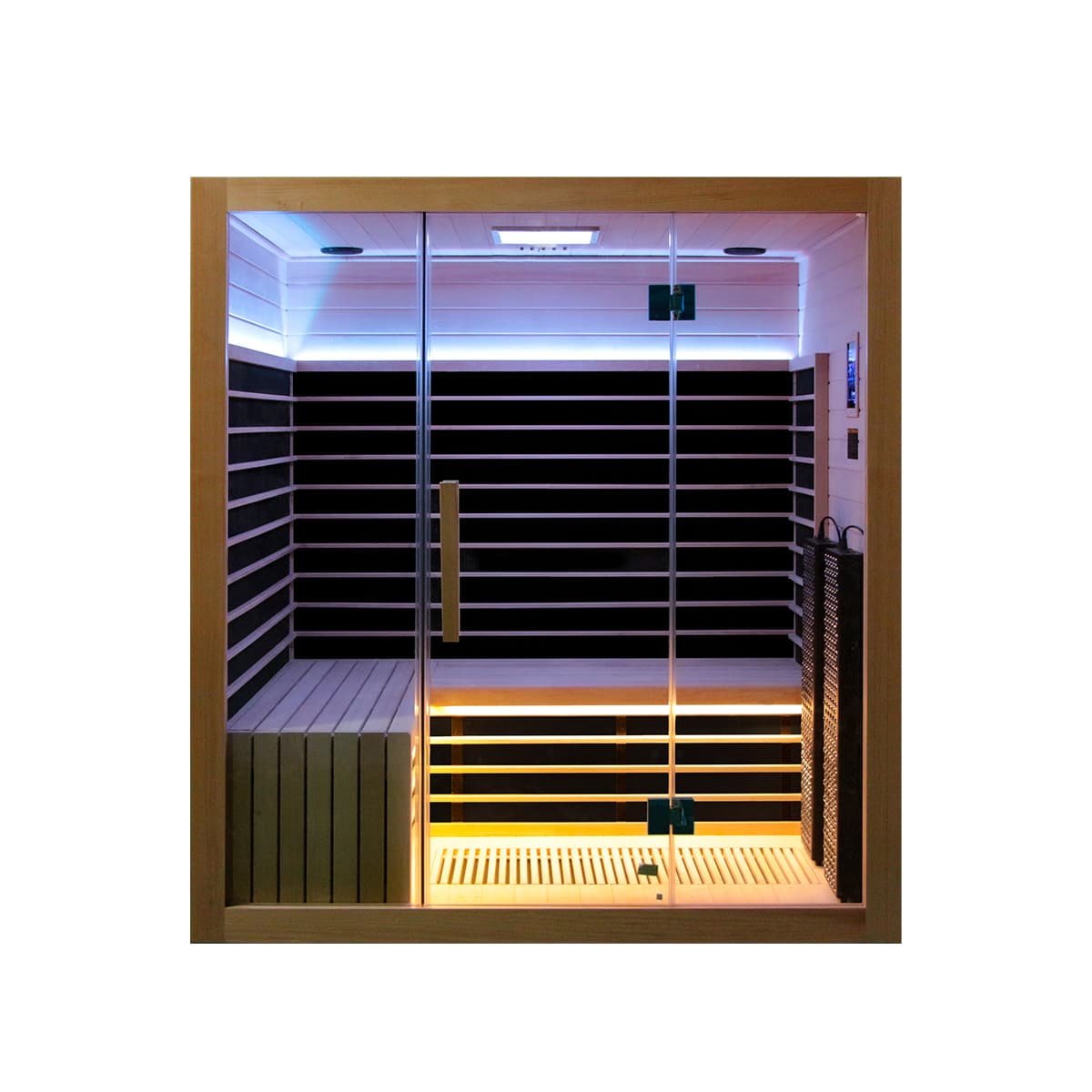
The Aura-RL2 cabin listing provides another enclosure and seating reference. Confirm its offered equipment rather than interpreting the illuminated image as a measured spectrum or a therapy result.
How Importers Audit Low-EMF Claims (Measurement Distance & Lab Method)
Neither carbon nor ceramic is an EMF grade. A low-EMF claim must identify the actual equipment and the quantity measured. An emitter-only result does not establish the result for a complete cabin with its controller, electrical layout and accessories.
The NIEHS overview of electric and magnetic fields provides background on electromagnetic fields and frequency categories. It is not a sauna certification or a universal product limit. Have an appropriately qualified reviewer interpret the actual laboratory evidence rather than treating a headline number as a complete safety conclusion.
Distance and position belong beside the reading. A measurement near an emitter and one at a specified seated position are not interchangeable. Comparing two suppliers requires comparable quantities, methods, locations and operating conditions; otherwise, the smaller reported number may simply answer a different question.
Seven points that make a report usable
- Match the manufacturer, model, electrical variant and sample identity to the offered build.
- Identify whether the tested item was a complete cabin, a heater component or another subassembly.
- Record the measured quantity, units, frequency coverage and stated method.
- Locate the measurement positions, distances and relevant instrument orientation on a reproducible map.
- Check which operating modes, settings and electrical accessories were energized.
- Have the qualified reviewer assess the instrument/calibration information, assessment basis and report limitations.
- Keep the full report with the approved configuration and review later component substitutions before reusing its claim.
These are report-review questions, not a new testing standard. They help the importer distinguish a traceable result from a promotional excerpt. A safety document, a spectrum measurement and an EMF report may address different matters; none should be silently substituted for the others.
If two offers lack comparable evidence, leave the EMF comparison unresolved. You can still compare their physical layout and service arrangement, but you cannot honestly rank their measured fields or advertise a numerical guarantee for the entire range.
Matching Heater BOM to Your Exact Cabin Model
Turn the selected layout into one orderable build. The bill of materials should connect the cabin, emitter references, positions, guards, sensors, controls, electrical variant and approved options. That connection prevents a sample with one heater arrangement from becoming a bulk order with another.
The Aura-1 infrared sauna reference is a starting point for an OMNI enquiry. Its visible panels support a discussion about the enclosure and seating layout; they do not prove that the offered version uses the carbon components or ceramic assemblies described in the independent manufacturer examples above.
Choose a build the dealer can identify and support
A mixed-emitter cabin needs each component family identified in the service record. A distributed-panel cabin needs the location and replacement reference of each panel identified just as clearly. Neither a familiar cabinet shape nor the same nominal component rating establishes that a substitute is interchangeable.
During sample review, compare the installed arrangement with the approved drawing: what is behind the back, beside the user, near the legs and beneath the bench? Then check the intended operating controls and the documented service access. The purpose is to confirm the chosen design, not to approve every possible catalogue option.
For a later substitution, record what changes and ask the responsible technical reviewer which evidence is affected. A different emitter, controller or accessory may require a different assessment; do not assume either that all existing evidence survives or that every document automatically becomes invalid.
When you review OMNI Ice infrared sauna cabin platforms, bring the layout you want and the functions your buyer actually needs. Select the documented configuration that satisfies those requirements. Carbon, ceramic and full-spectrum labels are useful starting descriptions, but the purchase is the complete, identifiable cabin that arrives.